
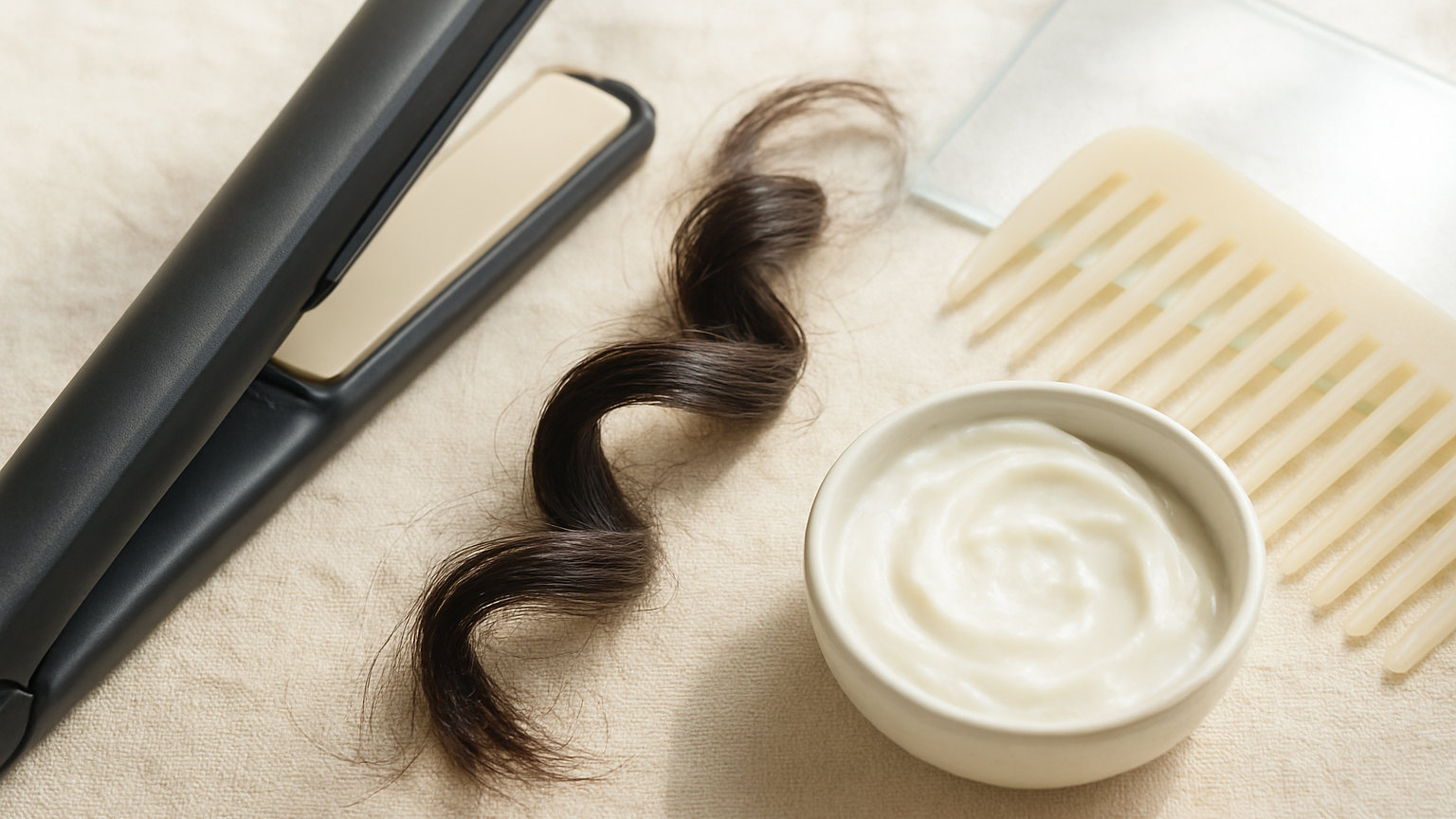
Hair damage comes from four sources, and they are not equal. The one people worry about least, ordinary mechanical handling, accumulates more damage over a lifetime than anything else, because it happens every single day.
What is damage, exactly?
Hair is dead keratin arranged in three layers, and damage means degradation of the outer cuticle and, eventually, the cortex beneath.
An intact cuticle lies flat like roof tiles, giving shine, smoothness and moisture retention. Damage lifts and erodes those scales, so hair becomes rough, dull, porous, tangle-prone and weak. Once the cuticle is gone, the cortex is exposed and the hair splits.
None of it repairs, because there are no living cells in the shaft.
What does heat do?
Above around 150 degrees, water inside the shaft turns to steam and forces its way out, creating cavities and lifting the cuticle. Higher temperatures degrade keratin directly and, above about 215 degrees, cause irreversible structural change.
Styling wet or damp hair is the worst case, since there is far more water to vaporise. Straighteners used on damp hair produce an audible sizzle, which is the sound of damage.
Heat protectants slow heat transfer and coat the surface. They reduce damage rather than preventing it, and they do not make high temperatures safe.
What do chemicals do?
Bleach lifts the cuticle to reach the cortex, oxidises melanin, and in the process breaks disulphide bonds and degrades keratin. That damage is permanent and cumulative.
Permanent dye works similarly at lower intensity. Perms and relaxers break disulphide bonds deliberately and reform them, which weakens hair substantially.
Chemical damage is the most severe category, and it is also the most predictable. Bleached hair needs a fundamentally different routine, not simply more conditioner.
What does mechanical handling do?
This is the one that adds up. Brushing, detangling, towel drying, tying, sleeping and simply moving against clothing all abrade the cuticle.
Individually each is trivial. Repeated daily across years, they are the largest single contributor to why the ends of long hair are in worse condition than the roots.
Detangling from the roots down, rubbing with a terry towel, brushing while wet and tight elastics are the four worst habits, and all four are free to change.
What about the environment?
Ultraviolet light degrades keratin proteins and oxidises melanin, which is why hair lightens in summer and why colour fades and turns brassy.
Chlorine and salt water strip lipids. Hard water deposits minerals that roughen the shaft. Wind causes friction and tangling. Cold dry air and central heating both dehydrate the shaft.
Pollution deposits particulates that contribute to dullness and, some evidence suggests, oxidative damage.
Which does the most harm?
Chemical processing does the most damage per event by a wide margin. Bleaching once causes more structural change than a year of gentle handling.
Mechanical handling does the most over a lifetime, because it is daily and cumulative and nobody counts it.
Heat sits between the two, depending entirely on temperature and frequency. Daily straightening at 230 degrees is closer to chemical damage in effect; occasional use at 150 with protection is minor.
How do you know how damaged your hair is?
The stretch test: take a wet strand and pull gently. Healthy hair stretches around thirty per cent and returns. Over-elastic hair that stretches a long way and does not recover suggests protein loss. Hair that snaps immediately suggests brittleness.
The float test for porosity is unreliable, and how quickly hair gets wet and dries tells you more. Fast to soak and fast to dry suggests a raised cuticle and significant damage.
And simply looking at the ends against the roots under good light shows the accumulated difference clearly.
Can damaged hair be saved?
Managed rather than restored. Nothing rebuilds a cuticle that has worn away, and no product returns bleached hair to its original condition.
What can be done is substantial: conditioning improves flexibility and appearance immediately, bond builders reduce breakage in chemically treated hair, and stopping the cause prevents further loss. Combined with regular removal of the worst ends, hair visibly improves over six to twelve months as damaged length is cut away and healthier growth replaces it.
The realistic goal is growing out damage rather than repairing it, which is slower and considerably more effective.


