
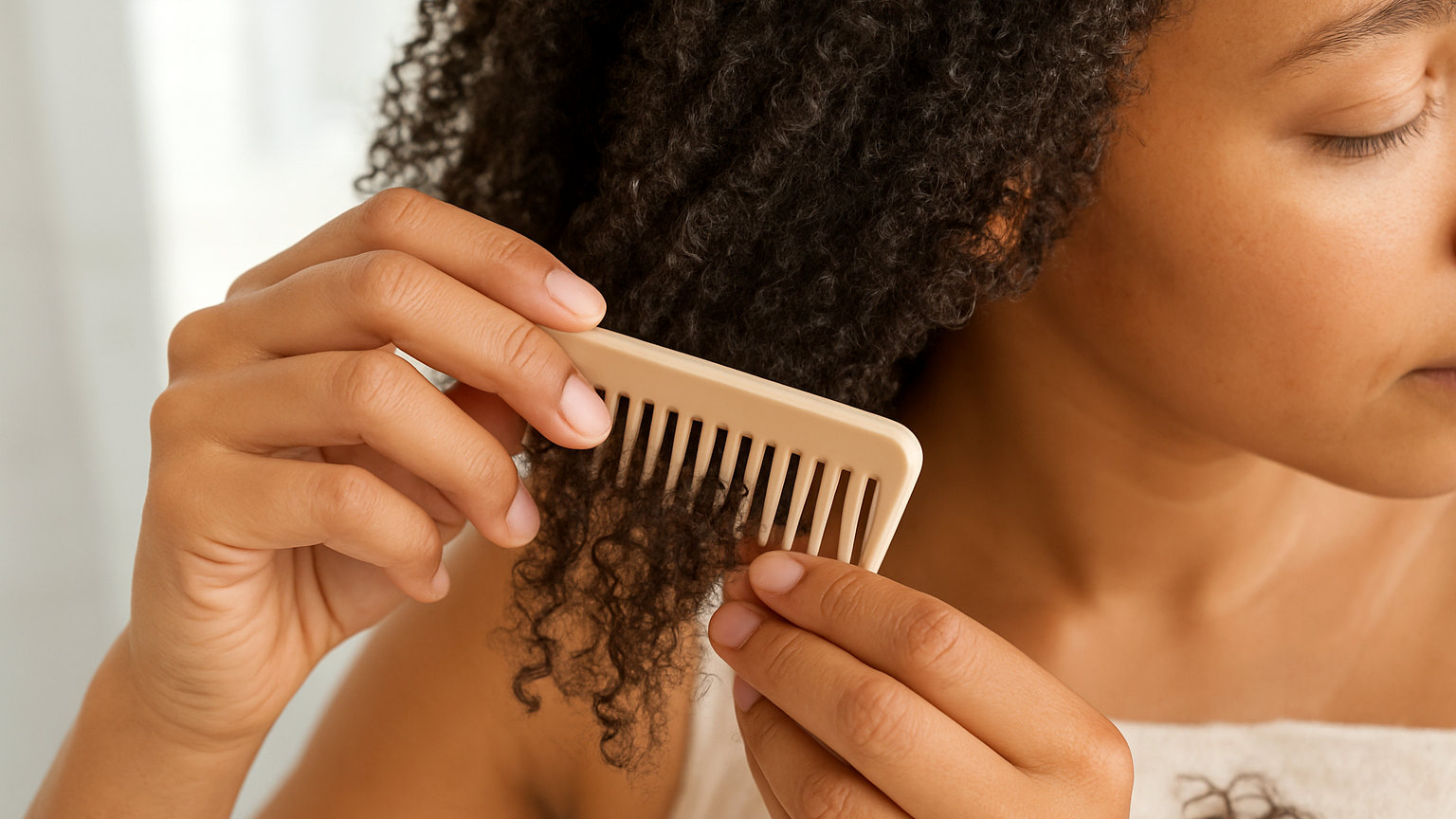
Mechanical damage is one of the largest causes of breakage and one of the least discussed, because brushing feels too ordinary to be doing harm. Almost all of it is avoidable with a change in method.
Should you brush wet hair?
Cautiously, and with the right tool. Wet hair is at its most vulnerable: water causes the shaft to swell, the cuticle lifts, and elasticity increases so hair stretches further before it snaps.
For straight and wavy hair, it is generally better to detangle before washing, when hair is dry and stronger, and then handle it minimally while wet.
For curly and coily hair, the opposite applies. Detangling dry causes far more damage and destroys curl definition, so it should be done wet, with conditioner in, using fingers or a wide-tooth comb.
Where should you start?
At the ends, always, working upward in sections. This is the single most useful change most people can make.
Brushing from the roots down pushes every tangle ahead of the brush, gathering them into a larger knot that then has to be forced through. Starting at the ends removes each tangle individually, and by the time you reach the roots there is nothing left to catch.
Hold the section above where you are working so tension is taken by your hand rather than by the roots.
Which tool should you use?
A wide-tooth comb for wet hair and for curly hair generally, since it separates without pulling through.
A flexible detangling brush with widely spaced, cushioned bristles for damp or dry hair. These reduce tension by flexing rather than forcing.
A boar bristle brush is useful on dry straight hair for distributing oil from the scalp along the lengths, which is genuinely beneficial for dry ends.
Avoid fine-tooth combs on tangled hair, and avoid any brush with hard plastic bristles that end in a point, since those snag and tear the cuticle. Bristles with a small ball at the tip are gentler.
Does brushing a hundred strokes help?
No, and it is a genuinely damaging piece of Victorian advice that persists. The original logic was distributing scalp oil down the length, which does happen to some degree.
What also happens is repeated friction against the cuticle, which roughens it and causes breakage. Brushing enough to detangle and distribute oil is useful; brushing as a ritual is not.
How do you deal with a bad tangle?
Add slip rather than force. A leave-in conditioner, a detangling spray or a little conditioner applied directly to the knot lets the hairs slide past each other.
Work it apart with fingers first, separating rather than pulling. Then a wide-tooth comb from the bottom of the tangle. Patience costs a few minutes; forcing costs the hair.
If a knot genuinely will not come apart, cutting it out is better than tearing through it, since the surrounding hair will be damaged in the attempt.
What causes tangling in the first place?
A raised cuticle, mainly, which is why damaged and high-porosity hair tangles more. Dryness, since dry hair has more friction.
Sleeping on cotton, which grips. Wind, tying hair up tightly, and wearing scarves and collars that rub. Not conditioning the lengths.
Addressing the cause reduces the brushing needed, which reduces the damage, which reduces the tangling. It works in both directions.
What helps overnight?
A silk or satin pillowcase reduces friction considerably compared with cotton, and it is one of the few widely recommended hair purchases that does what it claims.
Loosely plaiting long hair, or tying it in a loose bun on top of the head, prevents it moving against the pillow all night. Avoid tight elastics, and use a fabric-covered band rather than anything with a metal join.
Does brushing help hair grow?
Not meaningfully. The claim rests on the idea that brushing stimulates blood flow to the follicles, and while gentle scalp massage does increase circulation, there is little evidence that this translates into measurable growth.
What brushing can do is the opposite. Aggressive brushing causes traction on the follicle and breakage along the shaft, so hair appears to grow more slowly because it is snapping as fast as it lengthens. Gentle handling does more for apparent growth than any stimulating technique.


