
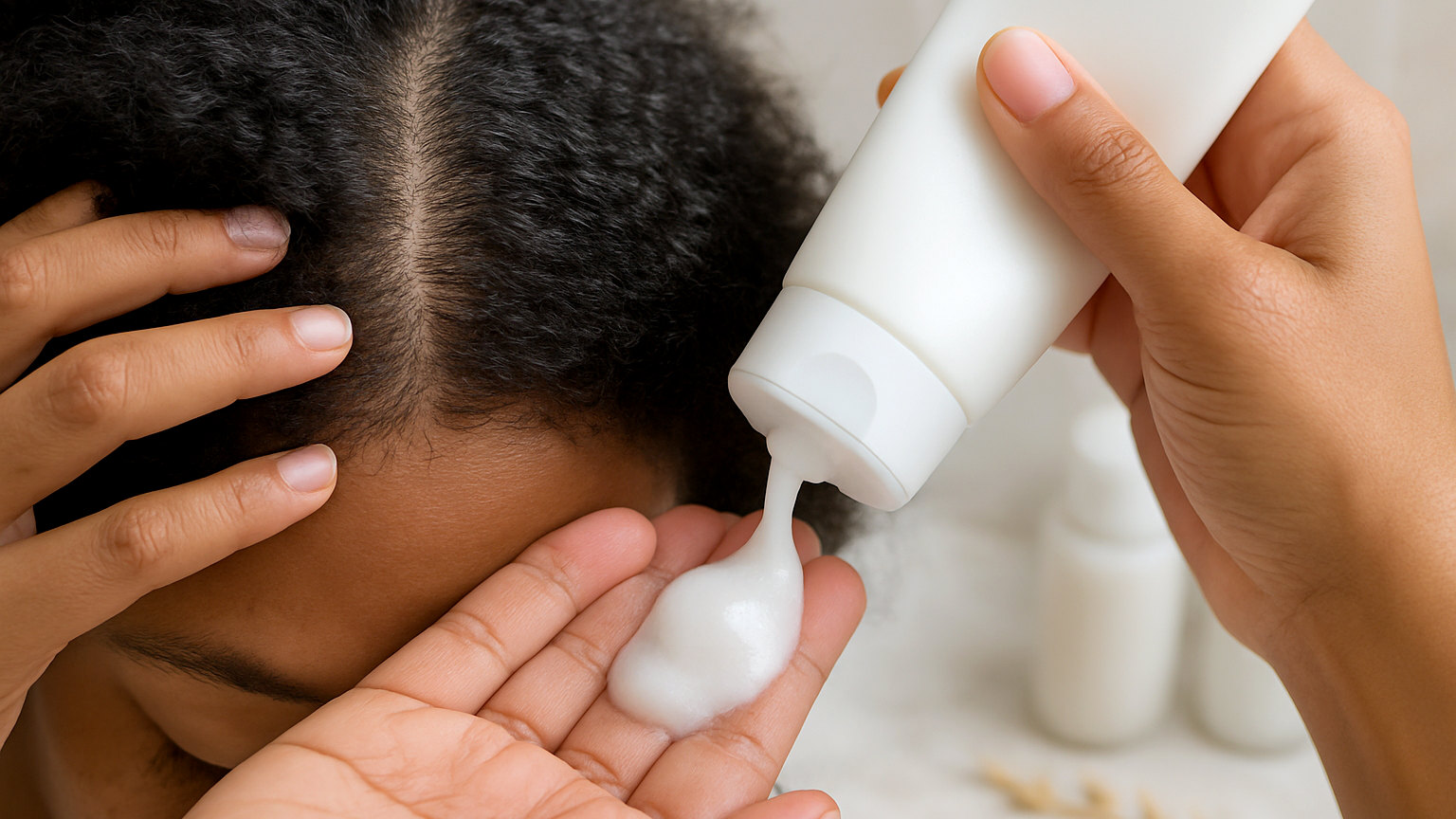
Almost all shampoo is marketed by hair type, and it should be chosen by scalp type. Shampoo spends its working life on the scalp; the lengths are cleaned incidentally by what rinses through them.
What does shampoo actually do?
It uses surfactants, molecules with a water-loving end and an oil-loving end, to lift sebum, sweat, dead skin and product residue so they can be rinsed away.
Everything else in the bottle is secondary: conditioning agents to reduce the roughness that cleansing causes, thickeners, fragrance, preservatives and whatever active the marketing is built around.
The important variable is how aggressive the surfactant system is.
Are sulfates bad?
Less bad than their reputation and not all the same, which is the part usually lost.
Sodium lauryl sulfate is a strong surfactant that cleans thoroughly and can irritate the scalp and strip colour. Sodium laureth sulfate is milder and tolerated well by most people, and the blanket sulfate-free rule treats them as identical when they are not.
Sulfate-free formulas use gentler surfactants such as cocamidopropyl betaine and glucosides. They lather less, which people mistake for cleaning less, and they may not remove heavy silicone or product build-up.
They suit dry, curly, damaged or colour-treated hair. An oily scalp often does better with something more effective.
How do you match shampoo to your scalp?
Oily scalp: a clarifying or standard shampoo with an effective surfactant system, used as often as needed. Look for salicylic acid if there is also flaking.
Dry or itchy scalp: a gentle sulfate-free formula, and consider whether the problem is the shampoo or infrequent washing.
Flaking scalp: an antifungal shampoo containing ketoconazole, zinc pyrithione or selenium sulfide, since most persistent flaking is seborrhoeic dermatitis rather than dryness.
Sensitive scalp: fragrance-free, short ingredient list, and avoid methylisothiazolinone, a preservative that causes a substantial share of scalp reactions.
What about the hair itself?
The lengths are better addressed by conditioner and treatments than by shampoo, since anything conditioning in a shampoo is largely rinsed away within a minute.
Where shampoo choice does affect the lengths is in how much it strips. Colour-treated hair fades faster with strong surfactants. Very dry or damaged hair roughens further. In both cases a milder formula protects what the conditioner then improves.
Which claims mean nothing?
Repairing, in any strong sense, since hair is not living tissue and cannot be repaired, only coated and smoothed. Detoxifying, which describes no real process.
Thickening, which usually means a temporary coating that swells the shaft and washes out. Anything promising growth from a shampoo, which spends thirty seconds on the scalp and is rinsed away.
pH balanced is closer to meaningful, since hair and scalp prefer a slightly acidic pH around 4.5 to 5.5, and a high-pH product roughens the cuticle. Most modern shampoos are formulated in that range regardless of whether they advertise it.
Do you need to alternate shampoos?
Not for the reason usually given. Hair does not become accustomed to a shampoo, and the perception that one stops working is usually build-up accumulating over weeks.
What is genuinely useful is having two: your regular shampoo, and a clarifying one used every few weeks to remove residue, particularly if you use styling products, silicones or dry shampoo, or live in a hard water area.
How much should you use?
Less than most people, and applied to a wet scalp rather than dry hair. A coin-sized amount for short hair, roughly twice that for long, emulsified between the hands first.
Two shampoos are worthwhile when hair is genuinely dirty or coated in product: the first lifts the bulk, the second cleans properly. On a routine wash, one is enough.
Does an expensive shampoo work better?
Rarely, and this is one of the weaker price-to-performance relationships in personal care. Surfactants are inexpensive commodity ingredients, and the difference between a four-pound bottle and a forty-pound one is largely fragrance, packaging and conditioning agents that rinse away.
Where paying more can be justified is for specific active ingredients, such as a medicated antifungal for a flaking scalp, or for a formulation that genuinely suits a sensitive scalp when cheaper ones have not. Neither of those is about prestige.


