
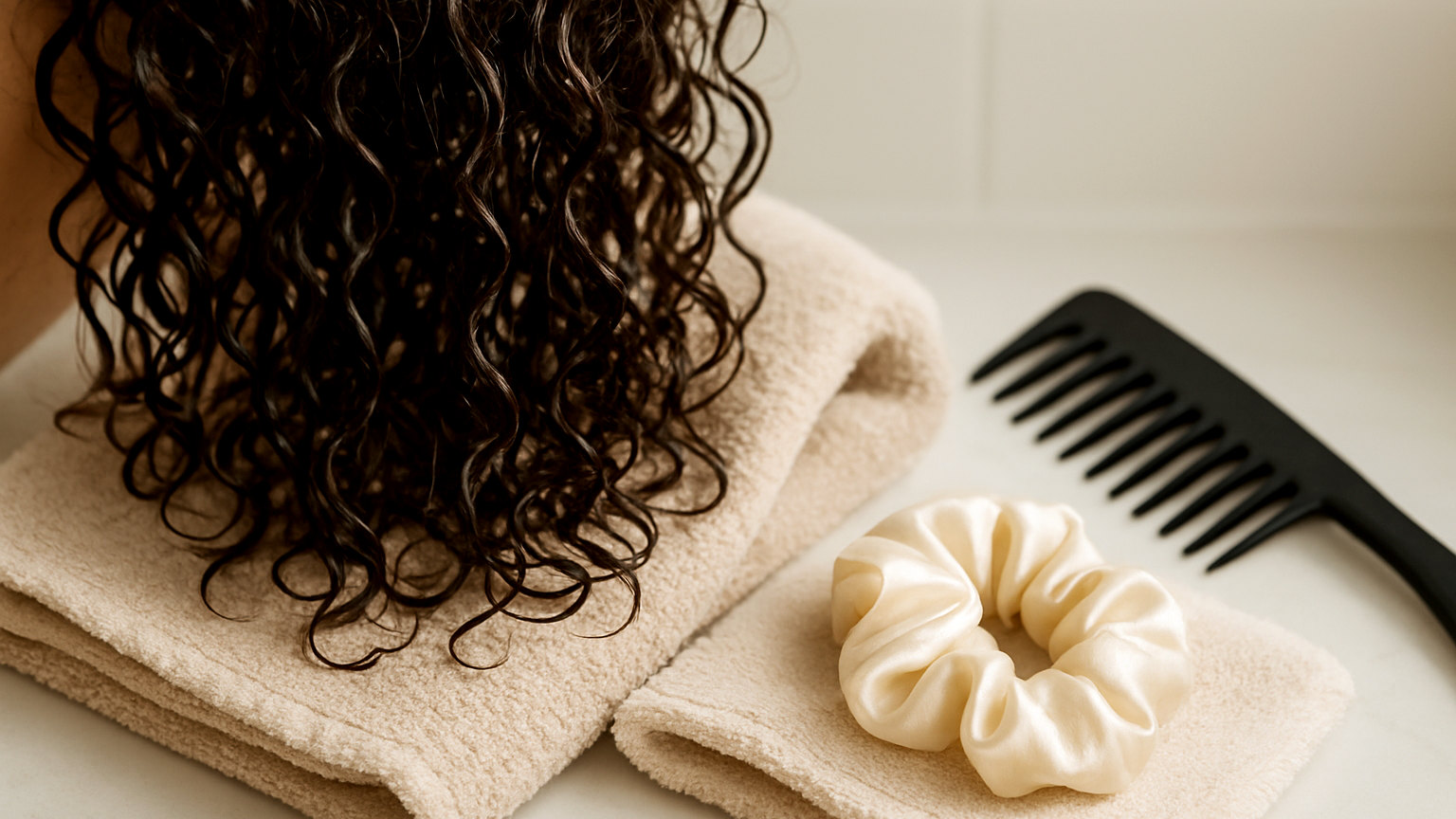
Hair is at its most vulnerable when wet, and the ordinary business of towelling, brushing and tying it up in that state causes more damage than most people attribute to heat styling.
Why is wet hair weaker?
Water penetrates the shaft and causes it to swell, which lifts the cuticle so the scales no longer lie flat. That makes hair rougher and more prone to catching on itself.
Water also disrupts the hydrogen bonds that give hair its structure. Wet hair can stretch considerably further than dry hair before breaking, which sounds like an advantage and is not: stretched hair does not fully recover, and repeated stretching causes permanent weakening.
This is why the same brushing that is harmless dry causes breakage wet.
What does rubbing with a towel do?
Creates friction against a raised cuticle, roughening it further and causing breakage and frizz. Terry towelling is particularly bad, since the loops catch individual strands and pull.
Squeeze rather than rub. Press the towel against sections of hair to absorb water, working from the roots down, and let it take the moisture rather than working at it.
A microfibre towel or an old cotton t-shirt has a smoother surface and causes considerably less friction. For curly hair, the t-shirt method preserves curl definition that towelling destroys.
Should you brush it wet?
Only if necessary and only with the right tool. For straight and wavy hair, detangling before washing is gentler.
If you must, use a wide-tooth comb or a flexible detangling brush, work from the ends upward in sections, and apply a leave-in conditioner first to add slip. Never use a fine-tooth comb or a bristle brush on soaking hair.
Curly and coily hair is the exception and should be detangled wet with conditioner in, since dry detangling causes more damage.
Is sleeping with wet hair bad?
Not for the reasons folklore suggests, and not ideal either.
It does not cause colds, which are viral. What it does cause is hours of friction between a swollen, vulnerable shaft and a pillow, producing tangling and breakage.
A damp scalp under a pillow for eight hours also creates a warm, humid environment that can encourage the yeast involved in seborrhoeic dermatitis, and it can worsen existing flaking.
If it is unavoidable, dry the roots at least, plait the lengths loosely, and use a silk or satin pillowcase.
Is air drying better than blow drying?
Less obviously than people assume. Research has found that prolonged exposure to water causes its own damage, since the shaft remains swollen and the cuticle raised for as long as it stays wet.
A hair dryer used on a moderate setting at a distance, after allowing hair to dry partially, appears to cause less cumulative damage than leaving hair soaking for hours. Very hot air held close is worse than either.
The practical middle ground is to let hair dry to around eighty per cent naturally, then finish with warm rather than hot air and a nozzle pointing down the shaft.
What about tying it up wet?
Best avoided. An elastic around swollen, stretched hair creates a specific weak point, and hair frequently snaps at the band.
If you need it out of the way, use a loose fabric scrunchie or a claw clip rather than a tight band, and change the position rather than using the same spot daily.
What helps most?
A leave-in conditioner applied to damp hair, which reduces friction through the whole drying process. A microfibre towel or t-shirt. Handling hair as little as possible until it is at least partly dry.
And accepting that hair takes time to dry. Most of the damage in this whole area comes from trying to speed that up.
Does swimming change any of this?
It adds a step worth taking. Wetting hair with clean water before entering a pool means the shaft absorbs less chlorinated water, since it is already saturated.
A leave-in conditioner before swimming adds a further barrier. Rinsing immediately afterwards removes most of what did get in, and a chelating shampoo weekly during a swimming season prevents the mineral and chlorine build-up that turns light hair brassy or greenish.


