
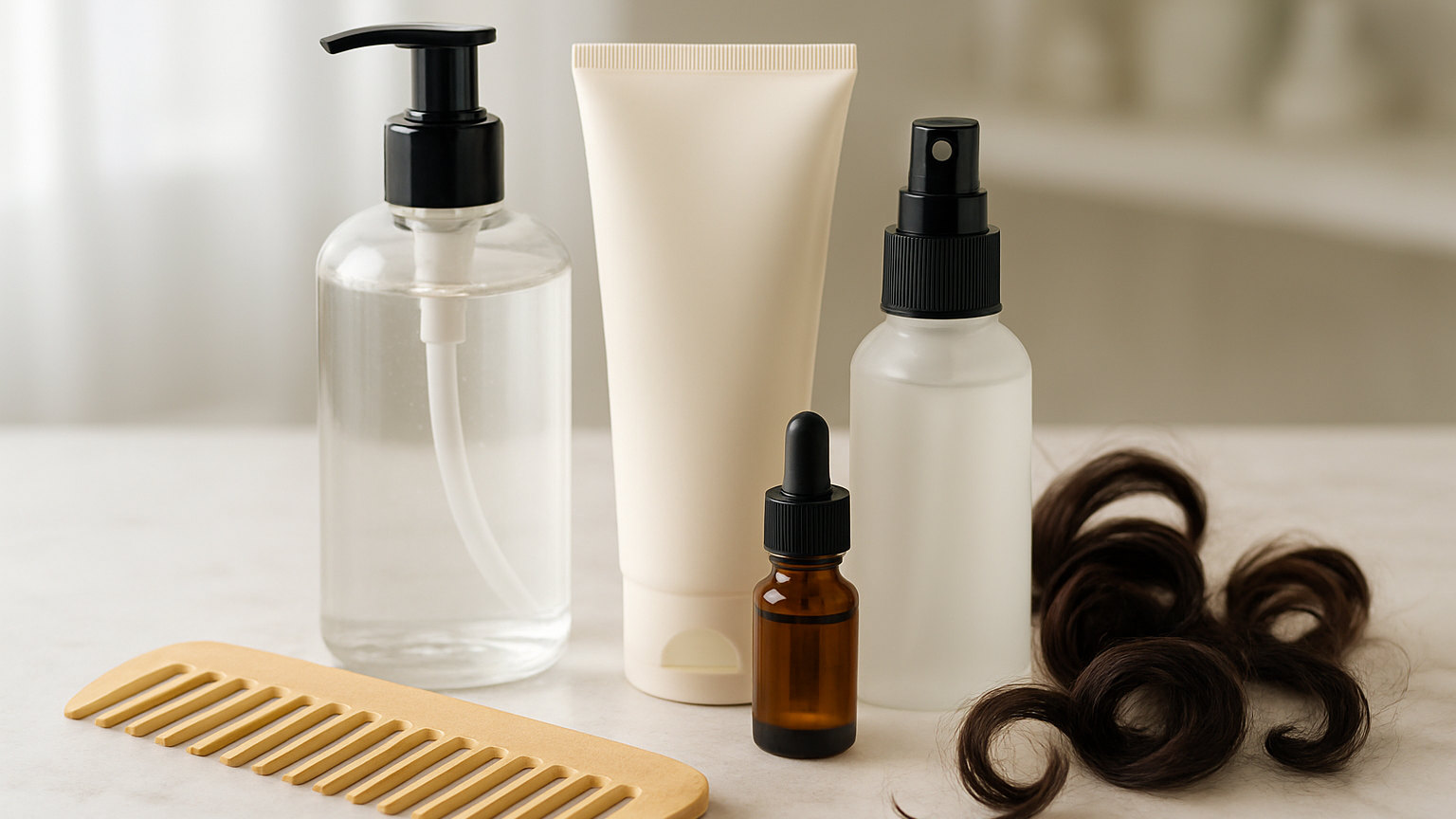
Hair care accumulates products the way skincare does, and most of what people add is solving a problem an earlier addition created. Four things cover almost everything.
What are the four?
A shampoo suited to your scalp. A conditioner suited to your lengths. Something to reduce mechanical damage, whether a wide-tooth comb, a detangling brush or a silk pillowcase. And heat protection if you use heat.
That is a complete routine for most people, and it will produce better hair than an elaborate one applied inconsistently.
How should the wash itself go?
Detangle before washing if your hair is straight or wavy. Wet hair thoroughly, which takes longer than most people allow, particularly for low-porosity or thick hair.
Shampoo the scalp with the pads of your fingers rather than your nails, for thirty to sixty seconds, and let the lather rinse through the lengths. Rinse fully.
Apply conditioner to mid-lengths and ends, leave for one to three minutes, then rinse for longer than feels necessary. Squeeze out water with a microfibre towel or a t-shirt rather than rubbing.
What is worth adding weekly?
A deep conditioner or mask, if your hair is dry, coloured or heat-styled. Fifteen minutes once a week does more than a slightly better daily conditioner.
Scalp attention if you need it: an antifungal shampoo for flaking, or a gentle exfoliating treatment for build-up.
What is worth adding monthly?
A clarifying shampoo every two to six weeks if you use styling products, silicones or dry shampoo. A chelating shampoo instead if you live in a hard water area.
Both strip thoroughly, so both should be followed by a mask.
What should you add for a specific concern?
Frizz: a leave-in conditioner and a sealing oil or serum on damp hair. Dryness: a richer conditioner and a weekly mask. Damage and breakage: a bond-building treatment and less heat.
Oily scalp: wash more often with a gentler shampoo rather than less often with a stronger one. Flaking: an antifungal shampoo rather than a moisturising one, since most persistent flaking is not dryness.
One addition at a time, with a few weeks between them, so you can tell what is working.
What can you skip?
Separate volumising, colour-protecting and smoothing shampoos, which mostly do the same cleaning with different marketing. Hair perfumes and glosses, which are pleasant rather than functional.
Scalp scrubs with physical grains, which irritate more than they clean. Anything promising growth from a rinse-off product. Protein treatments, unless your hair is genuinely protein-deficient, since overuse causes brittleness.
How much time does it need?
Less than the internet implies. A good wash takes ten minutes, a mask adds fifteen once a week, and careful detangling takes two or three minutes.
The most valuable habits cost nothing at all: detangling from the ends upward, squeezing rather than rubbing, tying hair loosely, and turning the styling temperature down.
How long before you see a difference?
Condition and behaviour improve within a few washes, since conditioning acts on the surface immediately.
Reduced breakage shows over two to three months, as damaged ends are trimmed away and new growth is retained. Scalp conditions settle in four to six weeks with the right product.
Anything relating to growth or thickness takes at least three to six months, because that is how long it takes for new hair to become visible.
What order should the products go in?
In the shower: shampoo, then conditioner, then rinse. If you use a mask, it replaces the conditioner rather than being added to it.
Out of the shower, on damp hair: leave-in conditioner first, then any curl cream or styling product, then heat protectant if you are drying it, then oil or serum last on the ends. Lightest to heaviest, as with skincare.
Applying oil before a leave-in is the common error, since the oil blocks whatever comes after it.
How do you know it is working?
Hair that detangles more easily, holds a style better and shows fewer split ends at the next trim. Those are the honest measures.
Photographs help here as much as in skincare, particularly for anything relating to thickness or length, where gradual change is close to invisible day to day.


