
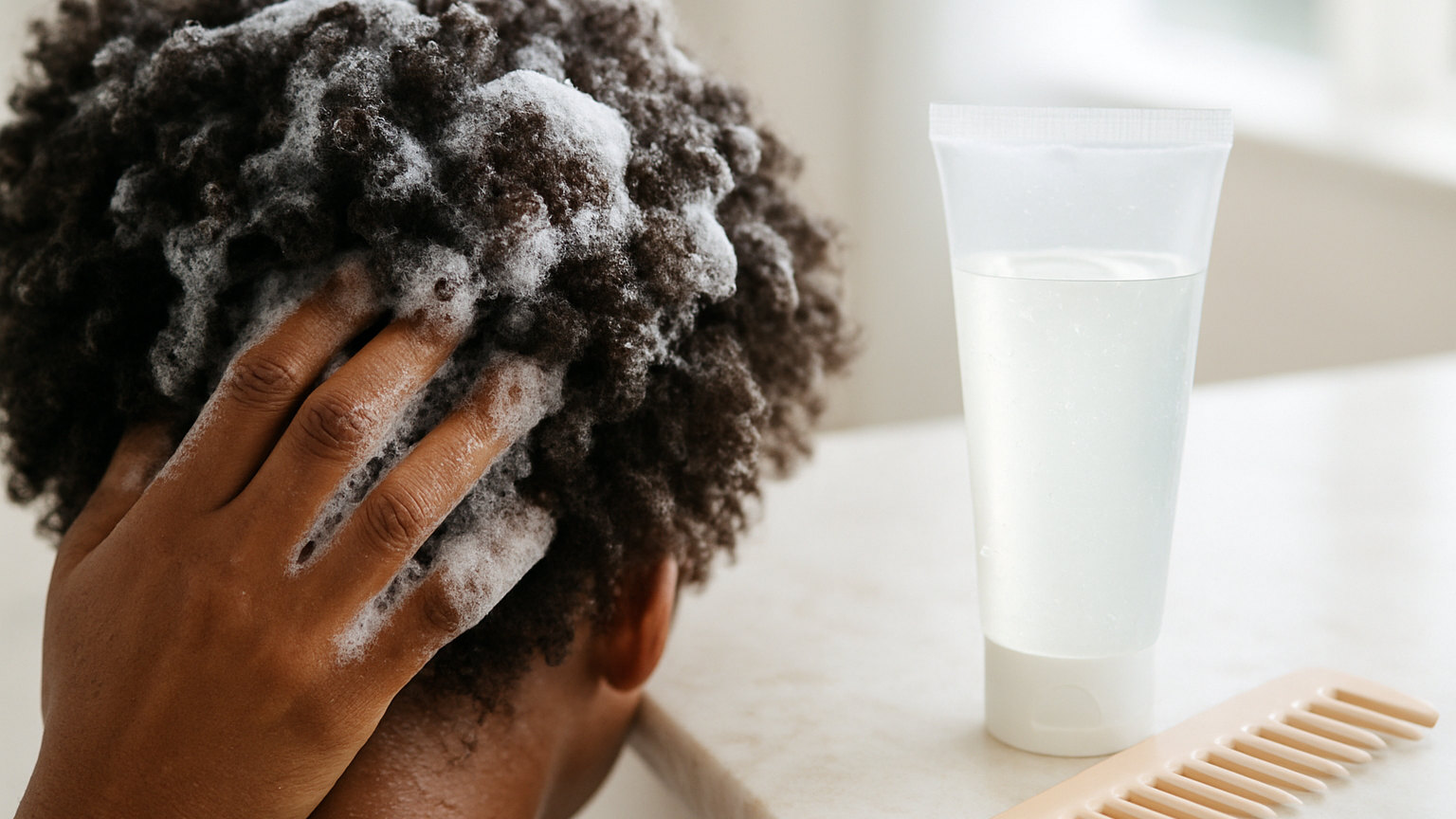
Clarifying shampoo is a stronger cleanser designed to remove what regular washing leaves behind. Used at the right interval it solves a real problem, and used weekly it creates a different one.
What does it remove?
Silicones, particularly non-water-soluble ones such as dimethicone, which resist ordinary surfactants. Styling product residue, including waxes, polymers and hairspray.
Dry shampoo, which accumulates on the scalp when used for consecutive days. Heavy oils. Chlorine and salt water. And sebum that has oxidised on the scalp over weeks.
What it does not remove well is hard water mineral deposits, which need a different mechanism entirely.
How is it different from normal shampoo?
A higher concentration of stronger surfactants, usually sulfate-based, and fewer conditioning agents to soften the effect.
The result is more thorough cleaning and a stripped feeling afterwards, which is expected rather than a fault. It is doing deliberately what a daily shampoo avoids.
What is a chelating shampoo?
A different tool for a different problem, and the distinction matters in hard water areas.
Chelating shampoos contain agents such as EDTA or phytic acid that bind metal ions, so they remove calcium, magnesium, iron and copper deposits from the hair shaft. A clarifying shampoo removes organic build-up; a chelating one removes mineral build-up.
Signs you need the chelating kind include hair that feels coated and rough despite clarifying, colour turning brassy or greenish, and living somewhere with visible limescale.
How often should you use one?
Every two to six weeks for most people, and the interval depends on what you put on your hair.
Heavy styling product use, daily dry shampoo, silicone-rich conditioners or hard water push toward every two weeks. Minimal product use and soft water push toward every six.
Weekly use is too often for most hair and reliably causes dryness, frizz and scalp irritation.
How should you use it?
On the scalp and roots first, working through the lengths as it rinses. Two applications if there is significant build-up, since the first lifts the bulk and the second cleans properly.
Always follow with a deep conditioner or mask. Clarifying leaves the cuticle raised and the hair more porous, so replacing some of what was removed matters, particularly for coloured or damaged hair.
Who should avoid it?
Anyone with very dry, coily or severely damaged hair, where the stripping does more harm than the build-up. Anyone with a dry or eczema-prone scalp.
People with freshly coloured hair, since it accelerates fading. Wait at least a fortnight after colouring, and use a gentler alternative in between.
Anyone whose hair is already limp and dull from over-washing rather than from build-up, where the answer is a gentler routine rather than a stronger one.
Does apple cider vinegar work instead?
Partly, and it is not equivalent. A diluted vinegar rinse is acidic, which helps flatten the cuticle and adds shine, and it can loosen some mineral deposits.
It does not remove silicones or heavy styling residue, since it contains no surfactants. It is a reasonable finishing rinse and a poor substitute for clarifying.
Dilute it properly, roughly one part vinegar to four parts water, since undiluted vinegar is acidic enough to irritate the scalp.
How do you reduce the need for it?
Use water-soluble silicones, which rinse out with ordinary shampoo, or avoid them. Limit dry shampoo to two consecutive days. Apply styling products to the lengths rather than the scalp.
And rinse thoroughly, for longer than feels necessary. A substantial share of what people call build-up is simply conditioner that was never fully rinsed out.
How do you know it worked?
Hair should feel noticeably lighter and slightly rougher immediately afterwards, before conditioning. Volume returns, and conditioner starts working again on the next wash.
If nothing changes, build-up was probably not the problem, and using a clarifying shampoo more often will make things worse rather than better. If hair feels straw-like for several days afterwards, the interval was too short or the conditioning step was skipped.


