
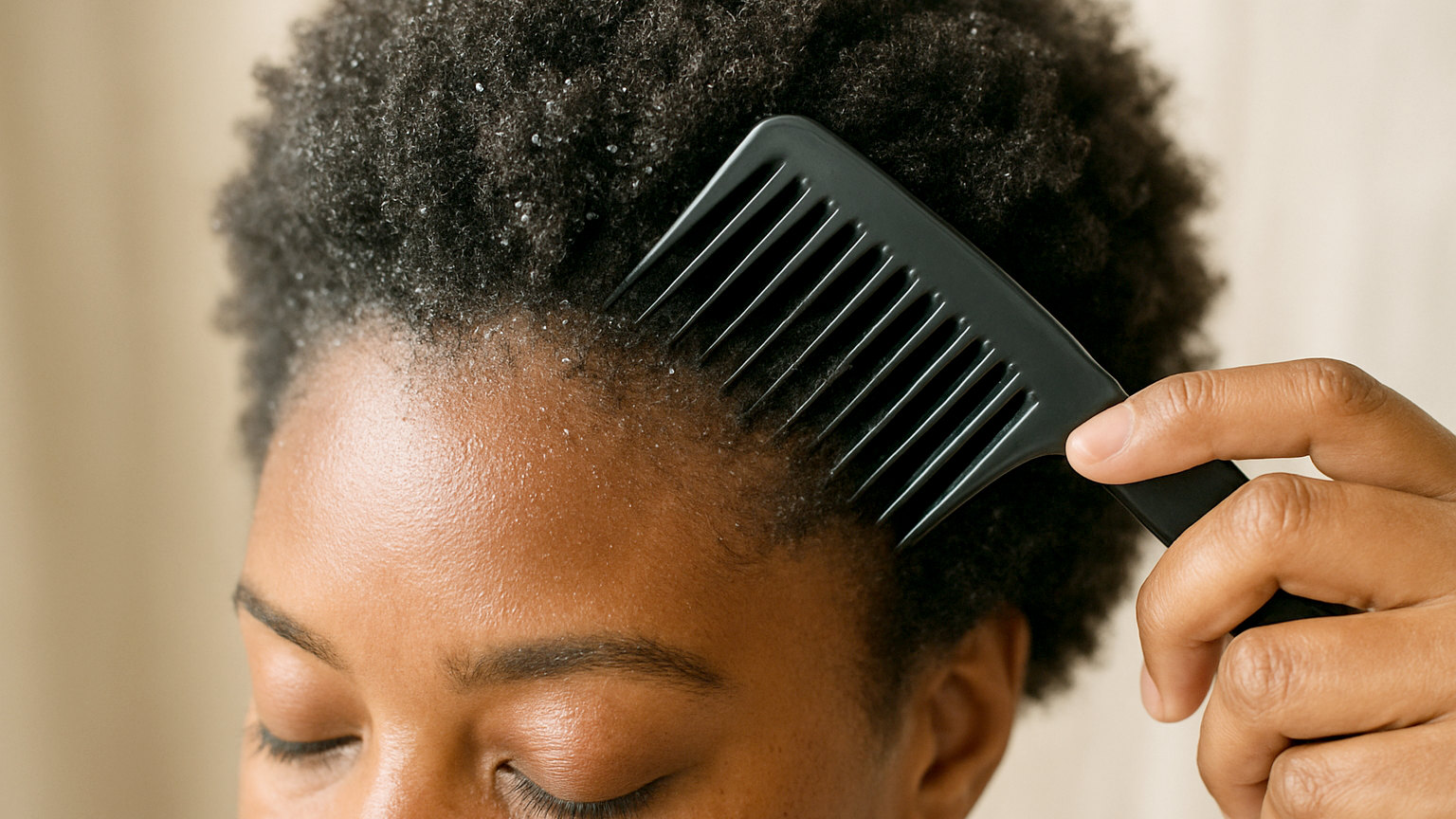
Hair typing is dominated by the curl pattern chart, running from 1 for straight to 4 for coily. It is the best known system and the least useful in practice, because two other characteristics predict what your hair needs far more reliably.
What does curl pattern tell you?
How your hair looks and how easily oil travels down the shaft, which is genuinely useful for a couple of decisions.
Straight hair lets sebum move down easily, so it looks oily at the roots sooner and is rarely dry at the ends. Coily hair makes that journey almost impossible, so the ends are dry while the scalp may still be oily. That explains the wash frequency difference between hair types and very little else.
The subdivisions into 3a, 3b and 3c are largely descriptive. Two people with the same designation can need entirely different products.
What is porosity?
How readily hair absorbs and holds moisture, determined by the condition of the cuticle. This is the characteristic that actually predicts what products will work.
Low porosity hair has a tightly closed cuticle. Water beads on it, products sit on the surface, and it takes a long time to get wet and to dry. It is easily weighed down and benefits from lightweight products and gentle heat to help penetration.
High porosity hair has a raised or damaged cuticle. It absorbs water quickly and loses it just as fast, tangles readily and frizzes. It benefits from richer products, sealing with oils, and protein treatments.
Most hair is somewhere in between, and porosity increases with damage from colouring, heat and age.
How do you test porosity?
The float test, done with a clean strand in a glass of water, is popular and unreliable, since products and natural oils affect whether it sinks.
Better indicators come from how your hair behaves. Does it take a long time to get properly wet in the shower, and a long time to dry? That suggests low porosity. Does it soak through instantly and dry quickly, feeling rough afterwards? That suggests high porosity.
Does a product sit on top and take ages to absorb, or disappear immediately? The same pattern applies.
What about density and thickness?
Two different things that are frequently confused, and both matter.
Density is how many hairs you have per square centimetre. It determines how much product you need and how hair looks when styled. You can assess it roughly by how easily your scalp shows through when hair is parted.
Thickness, or coarseness, is the diameter of an individual strand. Fine hair is weighed down easily and damages quickly. Coarse hair resists styling and tolerates more. Someone can have fine hair in high density, or coarse hair that is sparse.
Which of these should drive your choices?
Porosity for products, density for quantity, thickness for how much your hair will tolerate, and curl pattern mainly for washing frequency and styling method.
That order is close to the reverse of how the industry presents it, and it explains why people with identical curl types find that the same recommended product suits one and not the other.
Does hair type change?
Yes, more than people expect. Pregnancy, menopause, thyroid conditions, some medications and chemotherapy can all change texture and curl pattern, sometimes permanently.
Porosity changes with damage and with age, and hair generally becomes finer and drier over decades. A routine built for the hair you had at twenty-five will not necessarily suit the hair you have at fifty.
Is any of it worth agonising over?
No. The useful conclusions are simple: match product weight to porosity, apply conditioner to the lengths, wash according to your scalp, and use heat protection.
The elaborate typing systems circulating online generate a great deal of anxiety and very few decisions that would not have been reached by paying attention to how your hair behaves.
Can one head have several types?
Commonly, and it is not a fault. Curl pattern frequently varies across the head, with looser curls underneath and at the front, and tighter ones at the crown and nape.
Porosity varies along the length of a single strand: the roots are newest and least porous, and the ends may be years old and considerably more damaged. That is why the same product can weigh down the roots while doing very little for the ends, and why applying different products to different sections is more sensible than searching for one that suits everything.


