
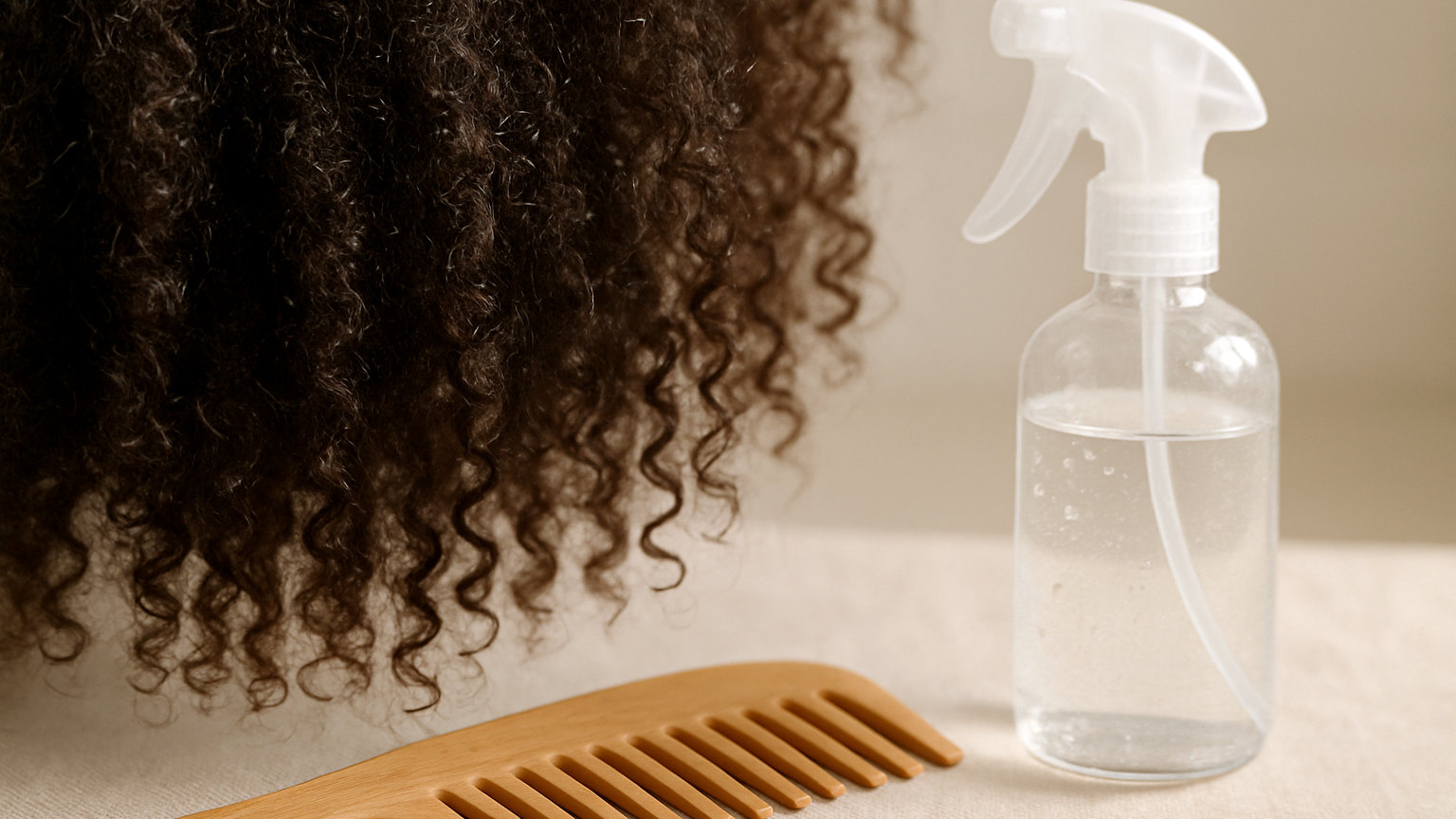
Frizz happens when individual hairs lift away from the shape the rest are holding. Two things cause it, usually together, and understanding both explains why humidity affects some people dramatically and others barely at all.
What does humidity actually do?
Hair is hygroscopic, meaning it absorbs water from the air. As it does, hydrogen bonds within the shaft break and reform in new positions, and the shaft swells.
Swelling forces the cuticle scales apart, so they no longer lie flat. Individual strands become rougher, catch on each other and lift away from the mass. Curly hair also loses its formed shape as the bonds holding it rearrange.
The rate of absorption depends on how open the cuticle already is, which is the second half of the explanation.
Why does damaged hair frizz more?
Because a raised cuticle absorbs water faster and holds it less well. Damage from bleaching, heat, chemical straightening or years of friction leaves gaps in the outer layer.
High-porosity hair therefore reacts to humid air within minutes, while low-porosity hair with an intact cuticle resists it. Two people in the same weather can have entirely different mornings.
This is why anti-frizz strategies split into two halves: reduce damage, and seal what damage exists.
Is dry hair more prone to it?
Yes, and the mechanism is straightforward. Hair short of moisture draws it from the air more eagerly, so dry hair in humid conditions swells more dramatically.
That is the paradox people find confusing: frizz looks like too much moisture and is often caused by too little. Properly conditioned hair has less capacity to absorb from the atmosphere and holds its shape better.
What helps most?
Conditioning thoroughly, since well-moisturised hair absorbs less from the air. A leave-in conditioner on damp hair, which continues working through the day.
Sealing with an oil or a silicone-based serum on the mid-lengths and ends, which slows water exchange in both directions. Applying to damp rather than dry hair traps moisture inside rather than locking it out.
Reducing damage: lower heat settings, heat protection, gentler detangling, and less frequent chemical processing.
Which ingredients work?
Silicones such as dimethicone form a smooth film that flattens the cuticle and resists humidity. They are effective, they wash out with a clarifying shampoo, and the objection to them is largely aesthetic.
Oils, particularly argan, jojoba and squalane, seal and smooth. Coconut oil penetrates the shaft rather than only coating it, which suits some hair and weighs down fine hair.
Humectants such as glycerin are the complicated case. They draw water in, which helps in moderate conditions and can make frizz worse in very humid air, since the hair keeps absorbing. In damp climates a humectant-free product often works better.
How should you dry it?
Squeeze rather than rub, with a microfibre towel or an old t-shirt. Terry towelling roughens the cuticle and creates frizz before you have started.
Handle it as little as possible while drying. For curly hair, plopping or diffusing preserves the formed shape. For straight hair, a nozzle directing air down the shaft rather than across it helps the cuticle lie flat.
A cool shot at the end helps set the cuticle flat, which is one of the few blow-dryer features that does what it claims.
Is frizz always damage?
No, and this is worth saying. Some frizz is simply new growth, or hairs that have broken at different lengths, or the natural texture of the hair.
Baby hairs around the hairline are new growth rather than damage. Fine, wispy hair frizzes more readily regardless of condition. Curly hair has a naturally raised cuticle and will never be entirely smooth, which is a characteristic rather than a fault.
Do anti-frizz treatments at a salon work?
Keratin and similar smoothing treatments do work, by coating the shaft and, in some formulations, forming temporary bonds that hold the cuticle flat. Results last several weeks to a few months.
The caution is formaldehyde. Some treatments release it when heated, and it is a recognised irritant and carcinogen. Products sold in the UK are regulated on this, and salons should be able to tell you what is in what they are using. Ventilation during the treatment matters, particularly for the stylist.


