
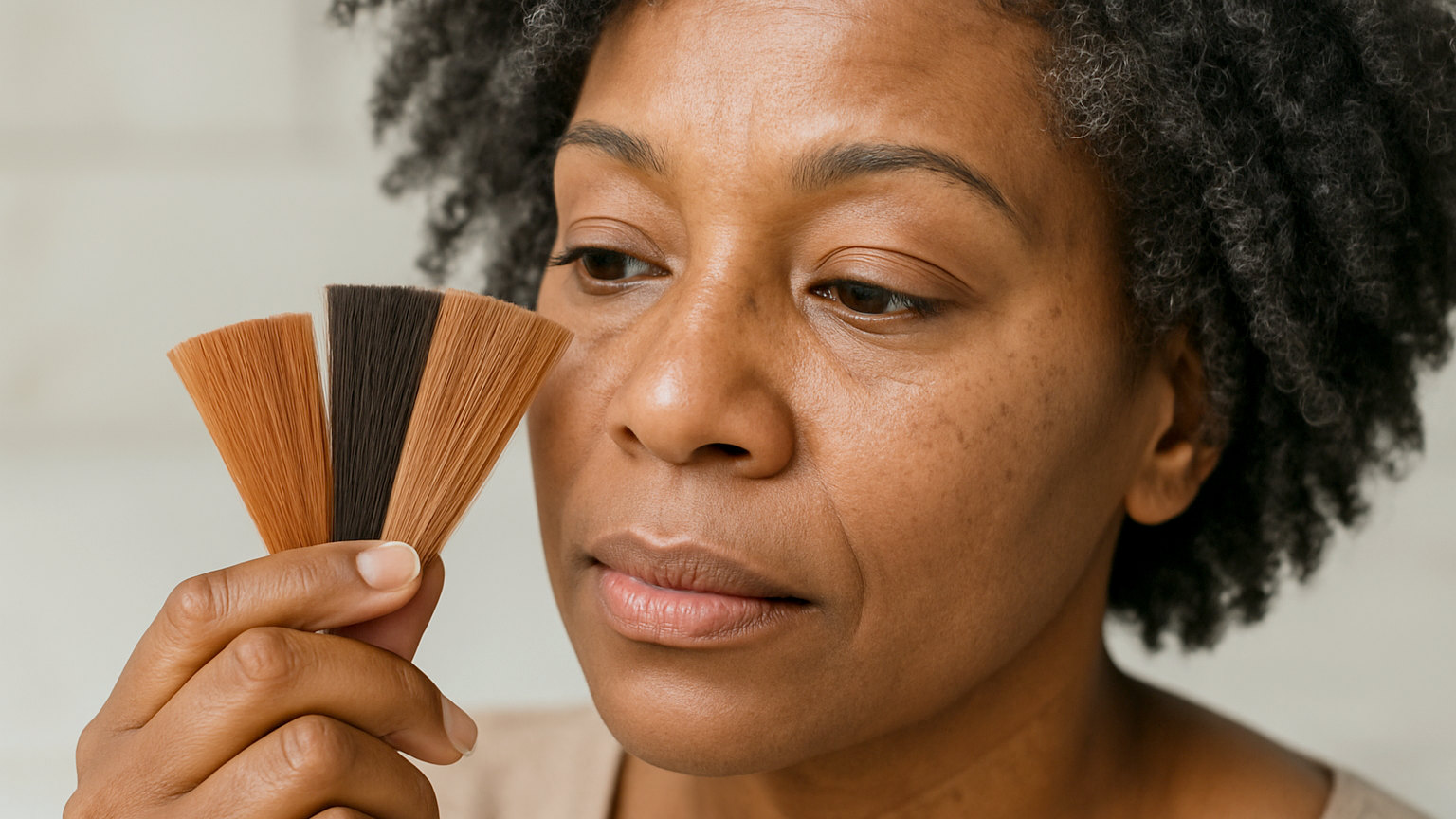
Most advice on this rests on matching hair colour to skin undertone, which is genuinely useful and incomplete. Two other questions predict satisfaction better, and they are rarely asked.
How do you find your undertone?
Look at the veins on the inside of your wrist in natural light. Blue or purple suggests a cool undertone; green suggests warm; a mix suggests neutral.
Consider which jewellery suits you: silver generally flatters cool undertones, gold flatters warm.
Think about how you burn. Skin that burns readily and tans poorly is more often cool; skin that tans easily is more often warm. None of these is definitive, and together they usually agree.
How does undertone map to colour?
The broad principle is to match tone rather than contrast it. Cool undertones are generally flattered by ash blondes, cool browns, and blue-based reds such as burgundy.
Warm undertones suit golden blondes, caramel and chocolate browns, and copper or auburn reds.
Neutral undertones have the widest range, which is genuinely an advantage rather than a consolation.
The most common mistake is an ash shade on warm skin, which can read as grey and drain colour from the face, and a golden shade on cool skin, which can look sallow.
What about eye colour?
Less important than skin, and worth considering for contrast. Colours that contrast with your eyes make them more prominent; colours that echo them create a more harmonious, softer look.
Neither is better. It depends on whether you want the hair or the face to be the focus.
What matters more than either?
Two practical questions. First: how far is this from your natural colour, and therefore how visible will regrowth be?
A shade within two levels of your natural colour is forgiving and grows out gracefully. Anything more than that produces a visible line within three weeks and commits you to a maintenance schedule.
Second: how much maintenance are you genuinely willing to do? Blonde on naturally dark hair means roots every four to six weeks, toner every three to six weeks, and a routine built around preserving it.
Most dissatisfaction with hair colour comes from underestimating this rather than from choosing the wrong shade.
Does age change what suits you?
Skin tone changes with age, generally becoming less saturated, and hair colour that flattered at twenty-five can look harsh at fifty.
Very dark shades tend to be less forgiving as skin loses contrast, which is why people often move a shade or two lighter over time. Very warm shades can emphasise redness in skin that has become more reactive.
This is a gradual shift rather than a rule, and it is worth revisiting rather than assuming a shade that always suited you still does.
How do you test before committing?
Hold swatches or fabric in the shade against your face in natural daylight, next to your jawline, and see what it does to your skin. This works better than imagining it.
Try a semi-permanent version first, which washes out in six to twelve washes. For a significant change, a wig or a temporary spray gives a sense of the shape as well as the colour.
And take photographs, since a mirror in a bathroom is a poor guide to how something reads in daylight.
What should you tell a colourist?
Your full colour history, including box dye and henna, however long ago. What you want, with photographs of a similar starting colour rather than only the end result.
How often you are realistically willing to come back, and what your budget is. A good colourist will design something around those constraints, which produces a better outcome than an ambitious result you cannot maintain.
Does grey change the calculation?
Yes, in a way people rarely anticipate. Grey hair has no pigment, so it takes colour flatly and shows regrowth more starkly against a coloured length.
The more grey you have, the more a dark all-over colour demands, since a white root line against dark hair is far more visible than against light. Many people find that going a shade or two lighter as grey increases reduces the maintenance considerably without looking like a change.


