
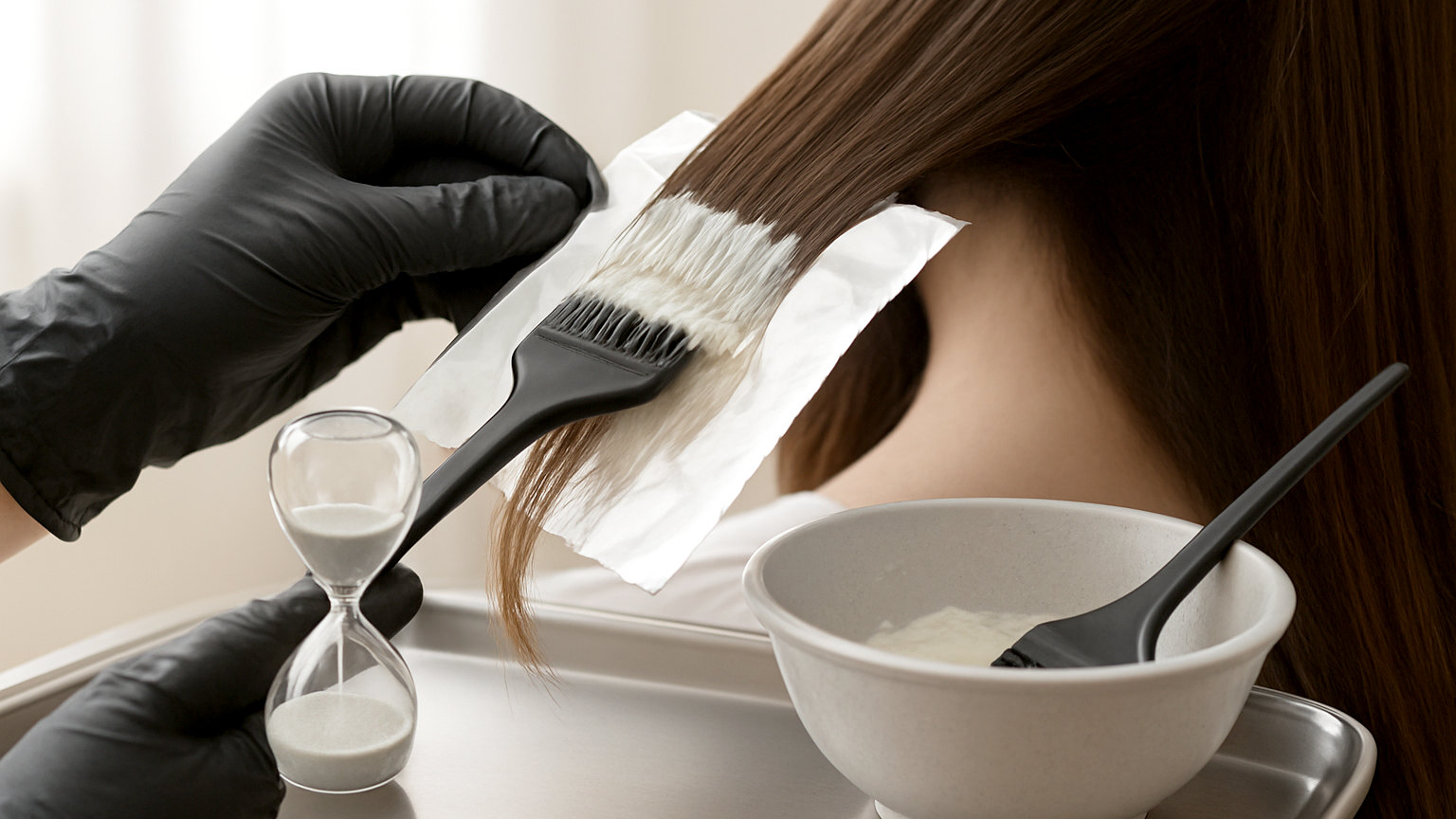
Going blonde from dark hair is the most damaging thing routinely done to hair, and the difference between a good outcome and a ruined one is largely a matter of how many sessions it is spread across.
Why does it take multiple sessions?
Because bleach removes pigment in stages and each stage takes time on the hair. Dark hair contains a great deal of eumelanin, and lifting through red, orange and yellow to pale blonde requires either a long single process or several shorter ones.
A single session pushed far enough to reach blonde causes structural failure in most dark hair. Spreading it over two or three appointments, six to eight weeks apart, allows the hair to be conditioned and stabilised between stages.
A colourist who says it will take three appointments is making a technical judgement, and it is the most commonly ignored advice in a salon.
What happens to the colour on the way?
Hair passes through predictable stages: dark brown to red-brown, to red, to orange, to yellow-orange, to yellow, to pale yellow.
Those warm tones are the underlying pigment being exposed as darker pigment is removed. They are not a mistake and they are not a sign the product failed.
Reaching pale yellow is the point at which toner can produce a genuinely cool blonde. Toning orange hair purple produces mud rather than ash, which is the most common home attempt and the most common disappointment.
What determines how far you can go?
Starting depth, hair condition, texture and previous chemical history.
Virgin dark hair lifts more predictably than previously coloured hair. Box dye on the lengths is the most common complicating factor, since artificial pigment lifts unevenly and can produce patchy results.
Coarse hair resists lifting and needs longer processing; fine hair lifts quickly and damages quickly. Both need different handling.
What is the damage, realistically?
Bleach breaks disulphide bonds and degrades keratin. Hair becomes more porous, weaker, more elastic when wet and considerably more prone to breakage.
That damage is permanent for the hair that has been bleached, and the only route to undamaged hair is growing it out.
Bond builders added during the process genuinely reduce this and are worth asking for by name. They do not eliminate it.
How do you protect your hair through it?
Space sessions at least six to eight weeks apart, and be prepared to accept a longer timeline if your hair needs it.
Have deep conditioning and bond treatments between sessions. Stop heat styling entirely during the process if you can.
Trim between sessions, since damaged ends compromise the whole result and will need removing anyway.
Do not attempt any other chemical service, including perming or relaxing, in the same period.
Why should you not do it at home?
Because the judgement required is about when to stop, and that is difficult to make on your own head.
Bleach continues working, and the difference between correctly lifted and structurally failed can be a few minutes. Assessing that requires seeing all of the hair and knowing what a compromised strand feels like.
Home attempts on dark hair also commonly produce banding, where roots lift further than lengths because of scalp heat, leaving stripes that require correction.
What does maintenance involve?
Roots every six to eight weeks, which means bleaching the new growth each time. Toner every three to six weeks.
Purple shampoo weekly, sulfate-free shampoo, weekly masks, bond treatments, minimal heat, and a chelating shampoo in a hard water area.
It is a genuine commitment in time and money, and it is worth costing out before starting rather than after.
Is there a gentler route?
Yes, and it suits many people better. Balayage or babylights lighten sections rather than the whole head, which is considerably less damaging and grows out without a line.
Going lighter gradually over a year, a level or two at a time, produces a better outcome than attempting it in one summer, and the hair that survives the process is in far better condition.


