
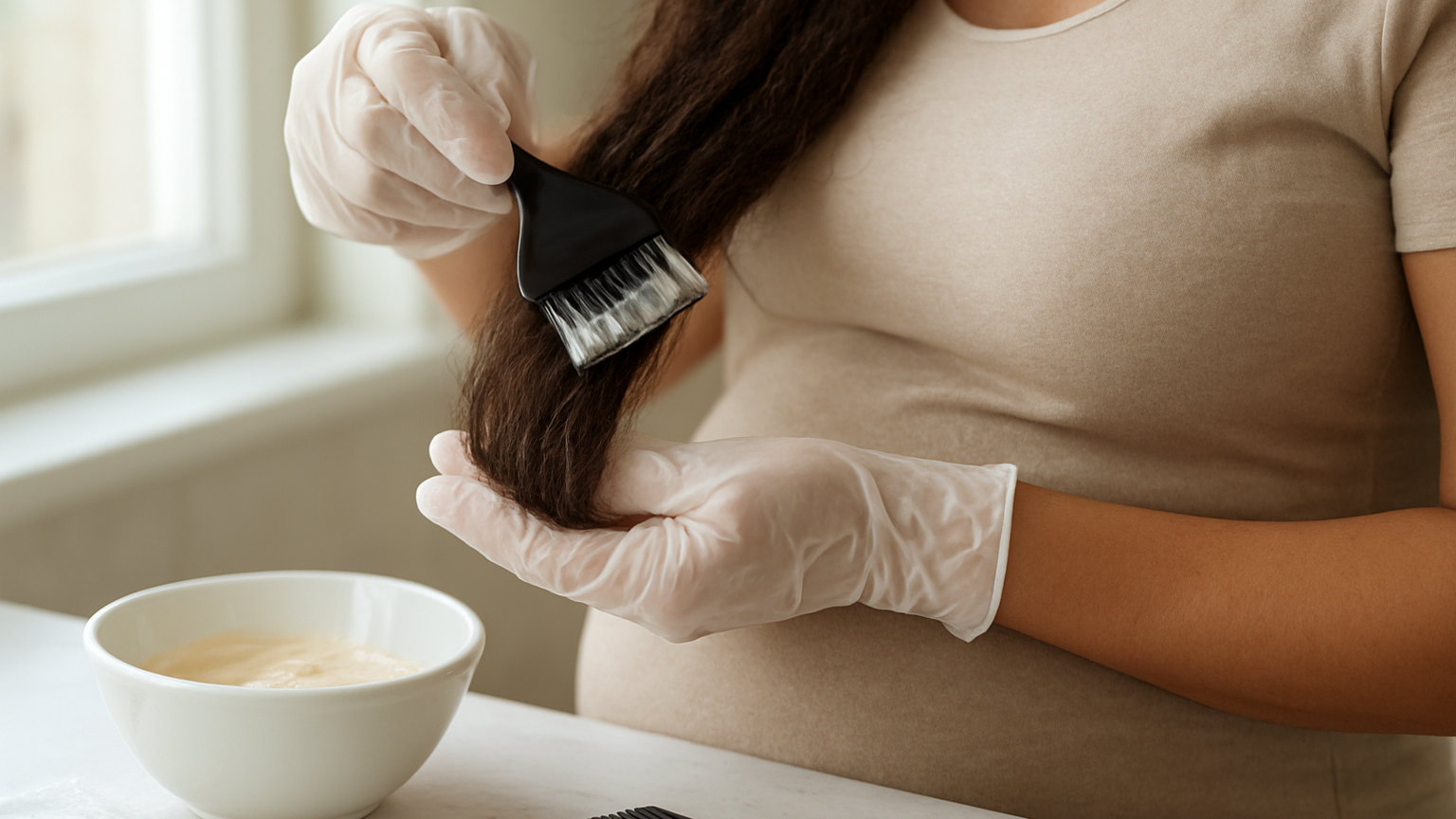
This is one of the most common questions asked of hairdressers, and the honest answer is that the evidence is reassuring rather than absolute. The usual advice is about reducing an already small exposure rather than avoiding a demonstrated risk. This is general information; your midwife or GP knows your circumstances.
What does the evidence show?
Very little absorption through the scalp, which is the central point. Hair dye sits on the hair and on the skin surface, and only a small amount passes through into the bloodstream.
Studies have not established a link between ordinary hair colouring during pregnancy and harm to a developing baby. The concerns that circulate come largely from studies of hairdressers with sustained occupational exposure rather than from people colouring their hair every few months.
NHS guidance describes the chemicals in hair dye as not highly toxic and considers occasional use during pregnancy to be low risk.
Why is the second trimester suggested?
Because the first trimester is when organ development occurs, and it is a general principle of pregnancy advice to minimise unnecessary exposures during that period.
This is precaution rather than evidence of harm. Many people colour their hair before knowing they are pregnant, and there is no reason to be alarmed by that.
Waiting until after twelve weeks is a reasonable choice for anyone who would prefer the extra margin.
Which options reduce exposure further?
Highlights, balayage and foils, since the product is applied to the hair rather than to the scalp. This is the single most useful adjustment available.
Semi-permanent colour, which contains no developer and fewer of the chemicals people are concerned about.
Vegetable-based colours and pure henna, though henna needs care over what is in it.
What about the smell and ventilation?
Worth taking seriously, mainly for comfort. Pregnancy heightens sensitivity to smell, and ammonia is unpleasant at the best of times.
Ask for a well-ventilated area, or a seat near a door. Ammonia-free formulations are more pleasant, though the alternative alkaline agents are not meaningfully different in safety terms.
Nausea in the first trimester makes a two-hour colour appointment genuinely difficult, which is a practical reason to wait beyond the theoretical one.
Does the allergy test still matter?
More than ever, and it is frequently overlooked in this conversation. Pregnancy can alter immune responses, and reactions to paraphenylenediamine can develop suddenly regardless.
Do the allergy alert test forty-eight hours before every application, including with a product you have used throughout previous pregnancies.
What about henna?
Pure henna is a plant dye with no developer and is generally considered safe, and the important word is pure.
Black henna and compound hennas frequently contain paraphenylenediamine at high concentrations or metallic salts, and these should be avoided entirely, pregnant or not.
Pure henna also coats the shaft and can react unpredictably with future chemical colouring, so it is worth understanding that it is a long-term commitment rather than a temporary alternative.
Is it safe while breastfeeding?
Yes, on current understanding. The amount absorbed is minimal and there is no evidence of meaningful transfer into breast milk.
The practical considerations are different: keeping product away from a baby, washing hands thoroughly afterwards, and the fact that a salon appointment with a newborn is a logistical rather than a medical problem.
What if you would rather avoid it entirely?
Entirely reasonable, and there are options. Root touch-up powders and sprays sit on the surface and wash out. Temporary colours and coloured dry shampoos cover grey at the parting.
Highlights that grow out without a line reduce how often anything is needed. And a period of not colouring is nine months rather than forever, which some people find easier once framed that way.
Does pregnancy change how hair takes colour?
Sometimes, and it catches people out. Hormonal changes can alter hair texture and porosity during pregnancy, so a shade that has always produced a predictable result may process differently.
Hair often feels thicker during pregnancy, since less is being shed, which can also affect how evenly colour distributes. A strand test is worth doing even with a familiar product, and it is worth telling a colourist you are pregnant so they can allow for it.


