
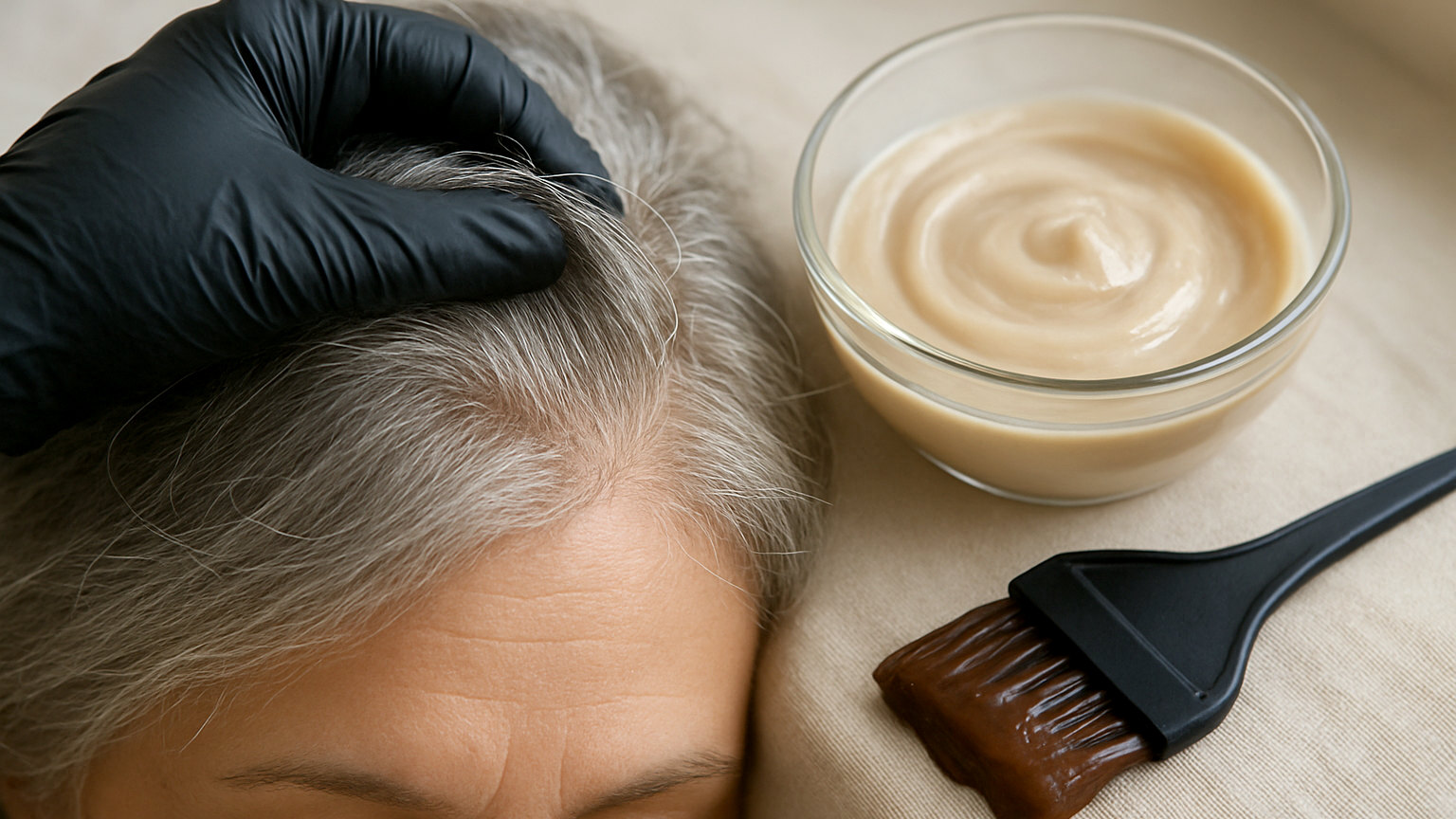
Grey hair is not simply hair without colour. It has a different texture and structure, and both affect how it takes dye, which is why the approach that works on the rest of the head often fails on the grey.
Why is grey hair harder to colour?
Because it contains no melanin, so there is nothing for the colour to build on. Artificial pigment alone has to do all the work, which produces a flatter result.
Grey hair also tends to be coarser with a more tightly packed cuticle, which resists penetration. This is what colourists mean by resistant grey, and it is why the same product can cover one person's grey and slide off another's.
Texture varies across the head, so scattered greys at the temples often resist more than a uniform grey elsewhere.
What actually covers it?
Permanent colour with a twenty volume developer is the standard, since it opens the cuticle enough to deposit properly and provides full opacity.
For resistant grey, colourists often pre-soften, applying developer alone briefly to open the cuticle before the colour goes on. At home, applying to dry unwashed hair and allowing the full processing time achieves some of the same.
Shades with a natural or neutral base cover better than fashion tones, which lack the warm underlying pigment that gives coverage its depth.
What about blending instead of covering?
For early or scattered grey, blending is often a better outcome than full coverage and needs considerably less maintenance.
Demi-permanent colour softens grey to a lighter tone rather than covering it, which reads as highlights rather than as roots. It fades gradually rather than growing out with a line.
Highlights and lowlights break up the grey visually and grow out far more gracefully than an all-over colour, which is why many people move to them as grey increases.
How do you deal with regrowth?
Root touch-up products between colours, which are genuinely effective. Powders and sprays cover the parting and wash out; root touch-up sticks work well on temples.
Changing your parting occasionally hides a line remarkably well.
Colouring the roots only, every four to six weeks, and pulling the colour through the lengths for the last five minutes rather than the full time. Applying permanent colour repeatedly to the same lengths builds up, darkens and damages.
How often can you colour?
Roots every four to six weeks is the usual rhythm for full coverage. More often than four weeks means overlapping onto previously coloured hair, which is where damage accumulates.
If regrowth is bothering you before four weeks, root touch-up products are the answer rather than colouring more often.
What if you want to stop colouring?
The transition is the difficult part, and there are several routes rather than one.
Growing it out with a deliberate blended transition, using highlights or lowlights to soften the line, is the most common approach and takes twelve to eighteen months.
Cutting short accelerates it considerably. Using a colour remover or having the lengths lightened to match the grey is faster and more damaging.
Shadow roots and balayage were developed partly for this purpose and make a growing-out line look deliberate.
How should you look after grey hair?
It behaves differently even uncoloured. It is often coarser and drier, produces less sebum protection, and has a more open cuticle, so it absorbs and loses moisture readily.
It also yellows, from sun, smoke, pollution and product build-up. A purple-toned shampoo used occasionally neutralises this, and overusing it leaves a dull lilac cast.
Richer conditioning and gentler cleansing suit it better than the routine that worked before it appeared.
What about the allergy test?
Non-negotiable. Permanent colour contains paraphenylenediamine or related compounds, and sensitisation can develop suddenly after years of use.
The allergy alert test needs doing forty-eight hours before every application, including with a product used many times before. Reactions can involve significant facial swelling, and this is the single most important safety step in home colouring.


