
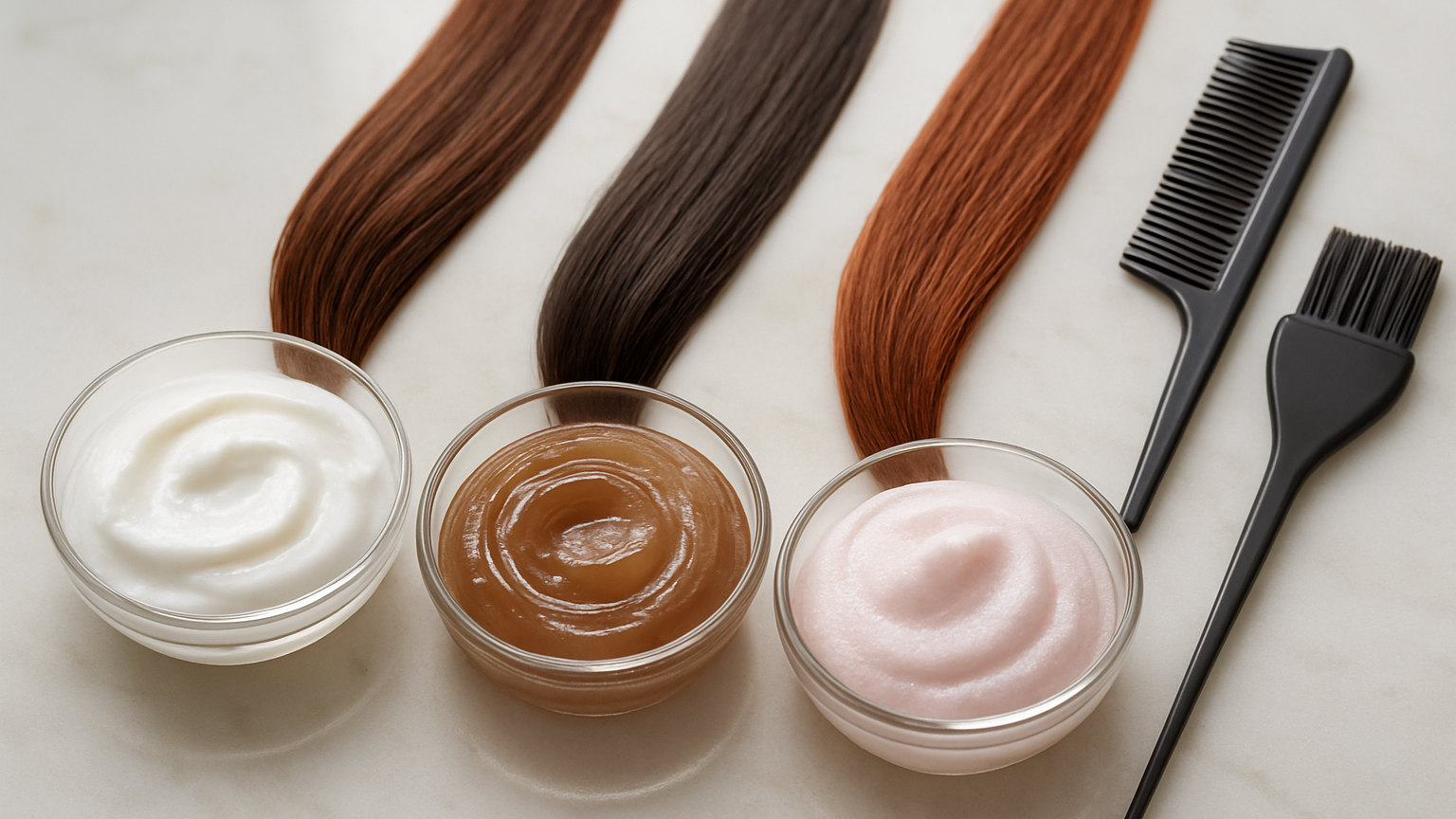
The three categories differ in how far into the hair the colour goes, and everything else follows from that: how long it lasts, how much damage it causes, and what it can and cannot do.
What is permanent colour?
Colour that penetrates the cortex and forms large pigment molecules inside it, using an alkaline agent to open the cuticle and peroxide as a developer.
It lifts existing colour as well as depositing, so it can go lighter as well as darker. It provides full grey coverage. It does not wash out, and it grows out, leaving a visible root line after four to six weeks.
It causes the most damage of the three, because the cuticle must be opened and melanin oxidised.
What is demi-permanent?
Colour that uses a low-volume developer, usually ten volume or less, and a mild alkaline agent. It deposits into the cuticle and outer cortex without meaningful lifting.
It lasts around twenty to twenty-eight washes and fades gradually rather than growing out with a hard line, which many people find considerably easier to maintain.
It covers grey partially, blending rather than fully covering, which suits early or scattered grey well.
It is a good deal gentler than permanent colour and is often the sensible default for anyone going darker or matching their natural shade.
What is semi-permanent?
Colour with no developer at all. The pigment molecules are small enough to sit in and just under the cuticle, and they wash out progressively.
It lasts six to twelve washes. It cannot lighten. It cannot properly cover grey, though it will stain it to a degree that varies with the shade.
It causes minimal damage, and some formulations are conditioning. This is the category most fashion shades and pastels belong to, along with most home colour marketed as gentle.
What about temporary colour?
Sprays, chalks, wax and coloured mousses, which sit entirely on the surface and wash out in one shampoo.
Root touch-up sprays and powders belong here and are genuinely useful between colours, particularly for concealing grey at the parting.
Which should you choose?
Going lighter: permanent, or bleach if the lift needed is substantial. Nothing else will do it.
Full grey coverage: permanent. Demi will blend and soften but will not cover completely, particularly on coarse resistant grey.
Going darker or matching your natural shade: demi-permanent, which achieves the same result with considerably less damage.
Adding tone, richness or shine without changing depth: demi or semi.
Experimenting, or colouring already damaged hair: semi-permanent.
How do they behave as they fade?
Permanent colour does not fade so much as grow out, leaving a demarcation line at the roots. The lengths can lose tone and turn brassy as the underlying warmth shows through.
Demi fades gradually and evenly, so the transition is softer. Semi fades fastest and can go patchy on porous hair, since damaged sections hold it differently.
Red fades fastest across all three, because red pigment molecules are larger and sit less securely.
Can you use them on top of each other?
Semi over permanent is fine and is a common way to refresh tone between colours.
Permanent over previously dyed hair will not lighten it, and applying it repeatedly to the same lengths builds up and causes darkness and damage. Colour the roots and pull through only briefly at the end.
Bleach over any of them requires care, since colour removal is unpredictable on previously dyed hair, and this is where home colouring most often goes wrong.
Does any of it avoid a patch test?
No. Anything containing paraphenylenediamine or related dyes requires an allergy alert test forty-eight hours beforehand, every time, including products used many times before. That applies to permanent and demi, and to some semi-permanent formulations.
What about henna and natural dyes?
Pure henna deposits colour on the surface and is genuinely gentle, and it is permanent in a way that causes problems later: it coats the shaft and can react unpredictably with peroxide, so subsequent bleaching or colouring may produce green tones or uneven lift.
Always tell a colourist if you have used henna, even years ago. And avoid compound hennas, which contain metallic salts or added dyes, since these are the ones most likely to react badly and are not always labelled clearly.


