
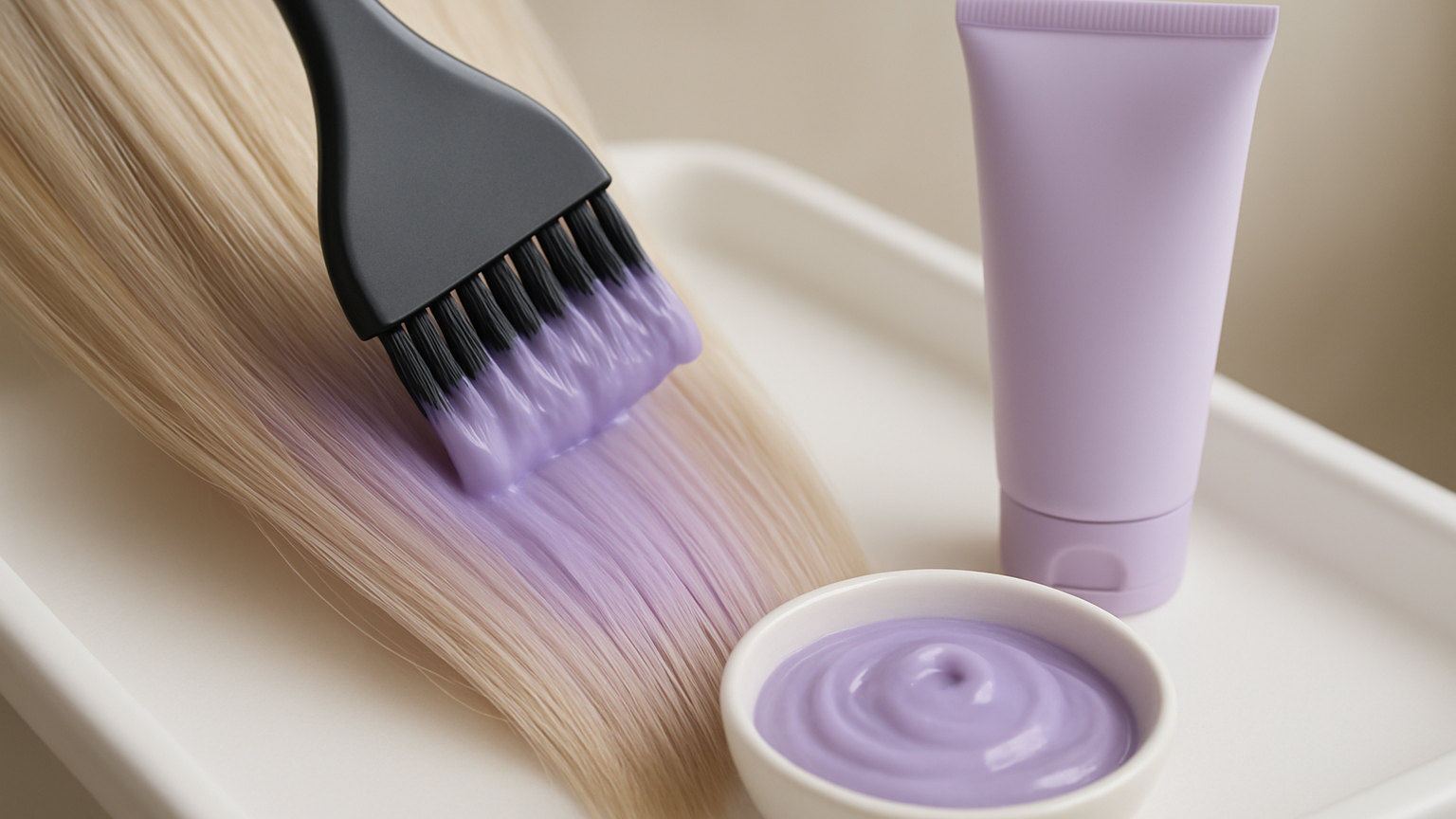
Lightening hair and toning it are two separate operations, and most complaints about blonde turning brassy are really about the second one wearing off. Understanding the difference explains a great deal about why blonde is high maintenance.
Why does lightened hair need toning?
Because bleach removes pigment in a predictable order. Eumelanin, which produces brown and black, is destroyed before pheomelanin, which produces red and yellow.
So hair passes through red, then orange, then yellow on the way to pale blonde. Stopping at any point leaves the warm underlying pigment exposed.
Lifting far enough to remove all of it would destroy the hair, so in practice lightening stops while some warmth remains, and toner neutralises what is left visually rather than removing it.
How does toner work?
By colour theory. Opposite colours on the colour wheel cancel each other out, so purple neutralises yellow, blue neutralises orange, and green neutralises red.
A toner deposits a small amount of the opposing pigment, which makes the warmth read as neutral or ash rather than removing it. Nothing has been taken away; the eye simply stops seeing it.
This is why toner is a deposit-only process using a low or zero volume developer, and why it does very little damage compared with lightening.
How long does it last?
Three to six weeks in most cases, and less on very porous hair.
The toner molecules sit in and just under the cuticle rather than reacting deep in the cortex, so every wash removes some. Bleached hair is porous by definition, which means it takes toner readily and loses it just as readily.
This is the single most common source of frustration with blonde, and it is not a failure of the salon. Toner is a maintenance step rather than a permanent result.
How is purple shampoo different?
Same principle, considerably weaker. Purple shampoo contains violet pigment that deposits a small amount with each wash, topping up the neutralising effect.
It maintains a toner rather than replacing one. Used once a week, left on for two to five minutes, it extends how long blonde looks cool.
Overusing it leaves a dull grey or lilac cast, particularly on very light or porous hair, and many formulations are drying. Once a week is generally enough, and alternating with a moisturising shampoo helps.
Blue-toned shampoos address orange rather than yellow, which suits darker blonde and lightened brunette hair.
Which toner do you need?
It depends on which unwanted tone you have, and this is where people most often choose wrongly.
Yellow needs purple. Orange needs blue. Red needs green. Pale yellow that is close to acceptable needs a much lighter touch than brassy orange, which may need lifting further before toning will work at all.
A toner cannot fix hair that has not been lifted far enough. Applying purple to orange hair produces a muddy brown rather than an ash blonde, which is the most common home toning disaster.
What causes brassiness to return?
Toner fading, primarily. Beyond that: sun, which oxidises both natural and artificial pigment; hard water, which deposits minerals that read as orange; chlorine; and heat styling.
A chelating shampoo every few weeks in a hard water area addresses the mineral component, which purple shampoo cannot touch. That distinction is worth knowing, since people often reach for more purple shampoo when the problem is water.
Can you tone at home?
Toning glosses and demi-permanent toners are among the more reasonable home colouring tasks, since they deposit rather than lift.
Process for less time than the instructions suggest and check every few minutes, because porous hair grabs pigment quickly and going too far produces grey or lilac. Apply to damp towel-dried hair for a more even result.
What cannot be fixed at home is hair that needs lifting further before it can be toned, which is the situation most home toning attempts are actually in.
Does toner damage hair?
Minimally, and considerably less than lightening. Deposit-only toners and glosses use little or no developer, so the cuticle is barely disturbed.
Demi-permanent toners use a low volume developer and cause slight swelling, which is a fair trade for a result lasting weeks rather than days. Neither is comparable to bleaching, and toning regularly is not a meaningful contributor to the damage blonde hair accumulates.


