
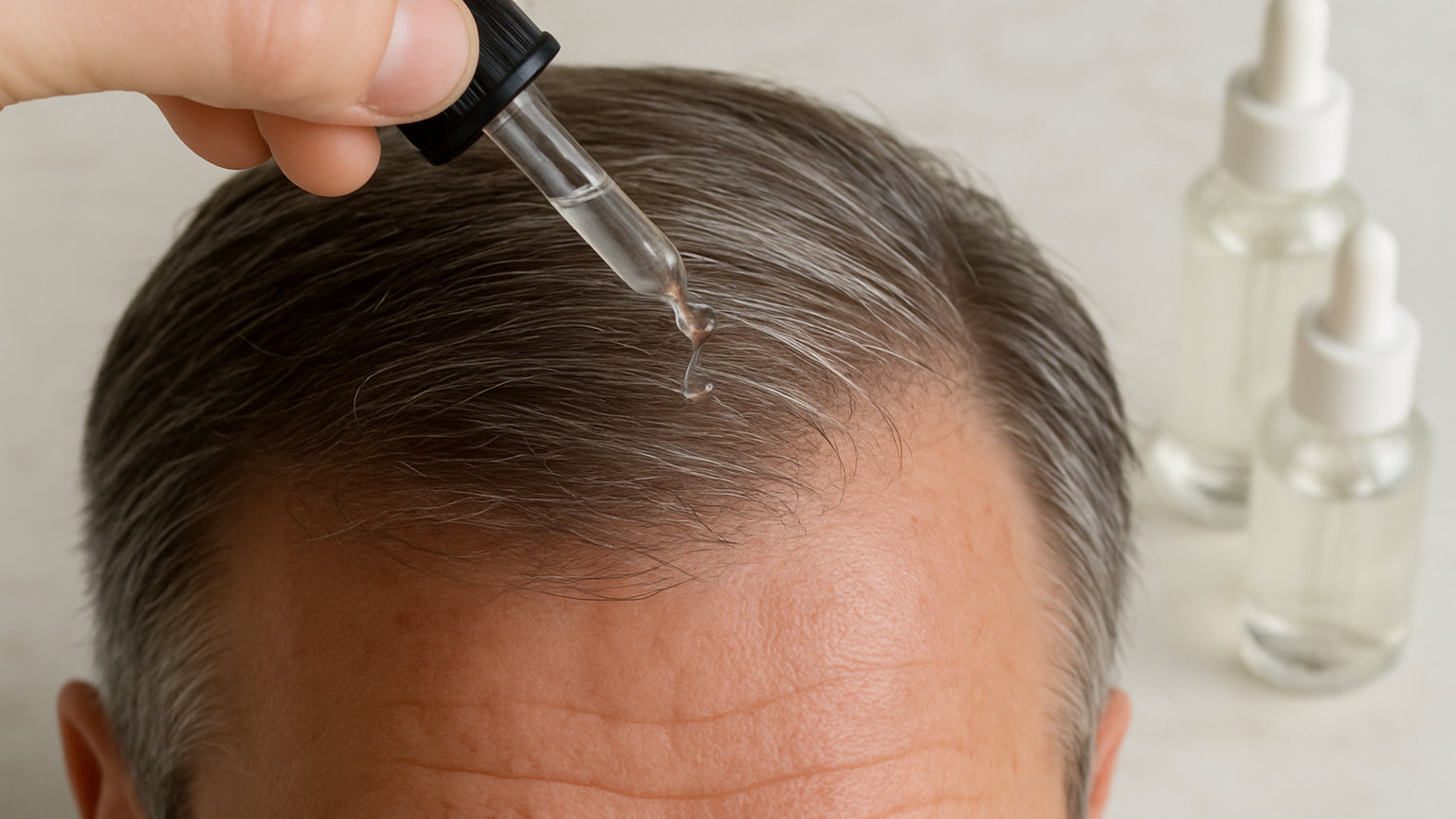
Hair growth serums occupy a crowded shelf with one well-evidenced ingredient and a great many competing for the space around it. Knowing which is which saves both money and, more importantly, months.
What has genuine evidence?
Minoxidil, and nothing else in the topical category comes close. It has decades of trials, is licensed for the purpose, and produces measurable regrowth in a substantial proportion of users.
It is available over the counter, and any serum claiming comparable results without containing it is claiming to have matched the standard treatment without the evidence base that established it.
That does not make everything else worthless. It does mean that a product should be judged against minoxidil rather than against doing nothing.
Does caffeine do anything?
There is a plausible mechanism and thin human evidence. Laboratory work shows caffeine counteracts the suppressive effect of dihydrotestosterone on follicle growth in cultured tissue.
Translating that to a shampoo or serum is the difficulty. Rinse-off products have contact times measured in seconds, and the concentration reaching the follicle from a leave-on product is not well established.
A handful of small manufacturer-linked studies report benefit. Independent replication is limited. It is a reasonable adjunct and a poor primary treatment.
What about peptides and redensyl?
Peptides marketed for hair are a broad category rather than a single ingredient, and the evidence for one tells you nothing about another.
Redensyl, capixyl and similar branded complexes have manufacturer-funded studies behind them, typically small, short and without independent replication. The proposed mechanisms are credible and the data is weak.
They are not implausible. They are also considerably more expensive than minoxidil for considerably less certainty.
Which ingredients are worth having for other reasons?
Some serum ingredients help the scalp rather than the follicle, which is a legitimate contribution.
Salicylic acid clears build-up that can contribute to itching and flaking. Zinc pyrithione and ketoconazole treat seborrhoeic dermatitis, and an inflamed scalp is not a good environment for growth. Niacinamide supports the skin barrier.
None of these grows hair directly. All of them address conditions that make hair worse, which is worth doing on its own terms.
What should make you sceptical?
Before-and-after photographs with different lighting, parting or styling, which is the most common way modest results are made to look dramatic.
Claims of results in weeks, when hair grows a centimetre a month and no visible change is possible before three. Any use of the word cure. Long ingredient lists with unstated concentrations.
Studies with fewer than thirty participants, funded by the manufacturer, published in journals you cannot find, and never replicated.
Where do these fit?
After investigation and after the evidenced options, not instead of them.
The sequence that makes sense is blood tests to identify a treatable cause, then minoxidil or a prescription treatment appropriate to the diagnosis, then scalp health, then anything else as an adjunct if you want to.
Spending a year and several hundred pounds on serums while an untreated iron deficiency or thyroid problem continues is the failure mode this category produces most often.
How would you test one fairly?
Six months minimum, since that is how long hair needs. Photographs in the same light, from the same angles, every eight weeks, with the parting in the same place.
Change one thing at a time. Starting a serum, a supplement and a new shampoo in the same week makes the result uninterpretable, which is convenient for the seller and useless for you.
Do they work for everyone?
No topical works where the follicle is gone. Serums are marketed broadly, and they can only act on follicles that still exist and are producing something, however fine.
That means they may help early pattern loss and will do nothing for a scarring alopecia or an area that has been smooth for a decade. It also means the same product can appear to work for one person and fail entirely for another with visibly similar hair, because the underlying cause differs.
What about the shampoo versions?
Contact time is the problem. A shampoo is on the scalp for under a minute and is then rinsed away, which is a poor delivery method for anything intended to act on the follicle.
Medicated shampoos treating scalp conditions are the exception, since they work on the surface and are designed for it. A growth shampoo is best understood as a mild scalp treatment rather than a substitute for a leave-on product.


