
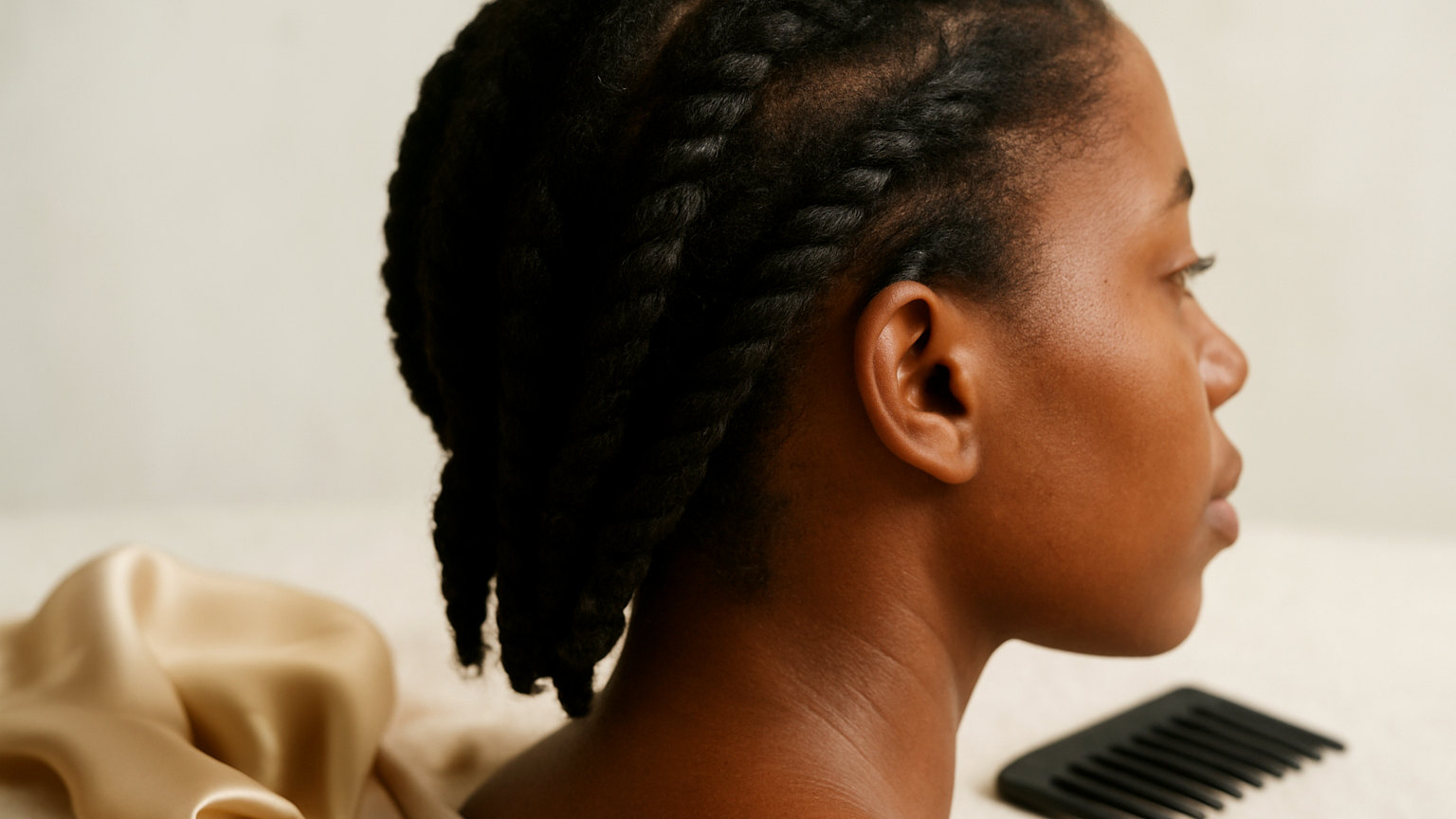
Protective styles do help with length, and not by affecting growth. They work by reducing the amount of hair lost to daily handling, and that only holds if they are fitted, worn and removed correctly. Done badly, they cause more damage than they prevent.
What is a protective style?
Any style that tucks away the ends of the hair and reduces daily manipulation. Braids, twists, cornrows, buns, wigs worn over braided hair, and locs all qualify.
The defining features are that the fragile ends are not exposed to friction against clothing and air, and that the hair is not being combed, brushed and styled every day.
How do they help with length?
Through retention rather than growth. Growth happens at the follicle at roughly a centimetre a month regardless of what the lengths are doing.
What varies is how much of that centimetre survives. The ends of the hair are the oldest and most fragile part, and daily detangling, brushing, styling and friction against fabric all cost length.
Reducing that handling from daily to weekly or fortnightly means considerably less is lost, so the net gain over a year is larger. That is the whole mechanism.
When do they cause damage instead?
When they are too tight, kept in too long, or too heavy.
Tension is the main risk. A style fitted tightly at the hairline causes traction on follicles that are already the most vulnerable on the head, and sustained traction leads to traction alopecia, which becomes permanent if it continues.
If it hurts, causes bumps or pustules along the hairline, or gives you a headache, it is too tight. Pain is not a normal part of having hair styled, and asking for it to be redone looser is entirely reasonable.
Weight matters too. Long, heavy extensions bear on the natural hair at the root, and the strain accumulates over weeks.
How long should a style stay in?
Generally six to eight weeks as a maximum, and less for anything heavy.
Beyond that, new growth at the root creates tension where it meets the braided section, shed hairs accumulate and tangle at the base, and removal becomes considerably more difficult and more damaging.
The shed hair point is worth understanding: you shed fifty to a hundred hairs a day whether braided or not, and in a protective style those hairs cannot fall away. After eight weeks, several thousand shed hairs are trapped in the style, which is why take-down can look alarming and why matting occurs if it is left longer.
What should happen between styles?
A proper break, which is the step most often skipped. Moving directly from one set of braids into another gives the scalp and hairline no recovery time.
A week or two between styles, with the hair washed thoroughly, deep conditioned, detangled carefully and trimmed if needed. This is also when you can assess the hairline honestly for any thinning.
How do you look after hair while it is in?
Wash the scalp, which people frequently avoid for fear of disturbing the style. A diluted shampoo applied directly to the scalp with an applicator bottle, rinsed thoroughly, every one to two weeks.
Moisturise the exposed hair and the scalp with a light leave-in or oil, since braided hair still dries out. Cover with a silk or satin scarf or bonnet at night to reduce friction and frizz.
Do not scratch with nails, which damages the scalp, and be cautious with heavy oils if you are prone to flaking.
How should they be taken out?
Slowly, with plenty of conditioner or oil for slip, working in sections from the ends. Rushing take-down undoes months of careful retention in an afternoon.
Expect a substantial amount of shed hair, which is accumulated rather than newly lost. Detangle in sections with fingers first, then a wide-tooth comb, before washing.
Do they work for everyone?
The principle applies to any hair type: less handling means less breakage. The specific styles suit some hair textures better than others.
Fine, straight hair often does better with simpler versions such as loose plaits or buns, since tightly braided styles put more strain on finer strands. The underlying goal is low manipulation, and any style achieving that qualifies.


