
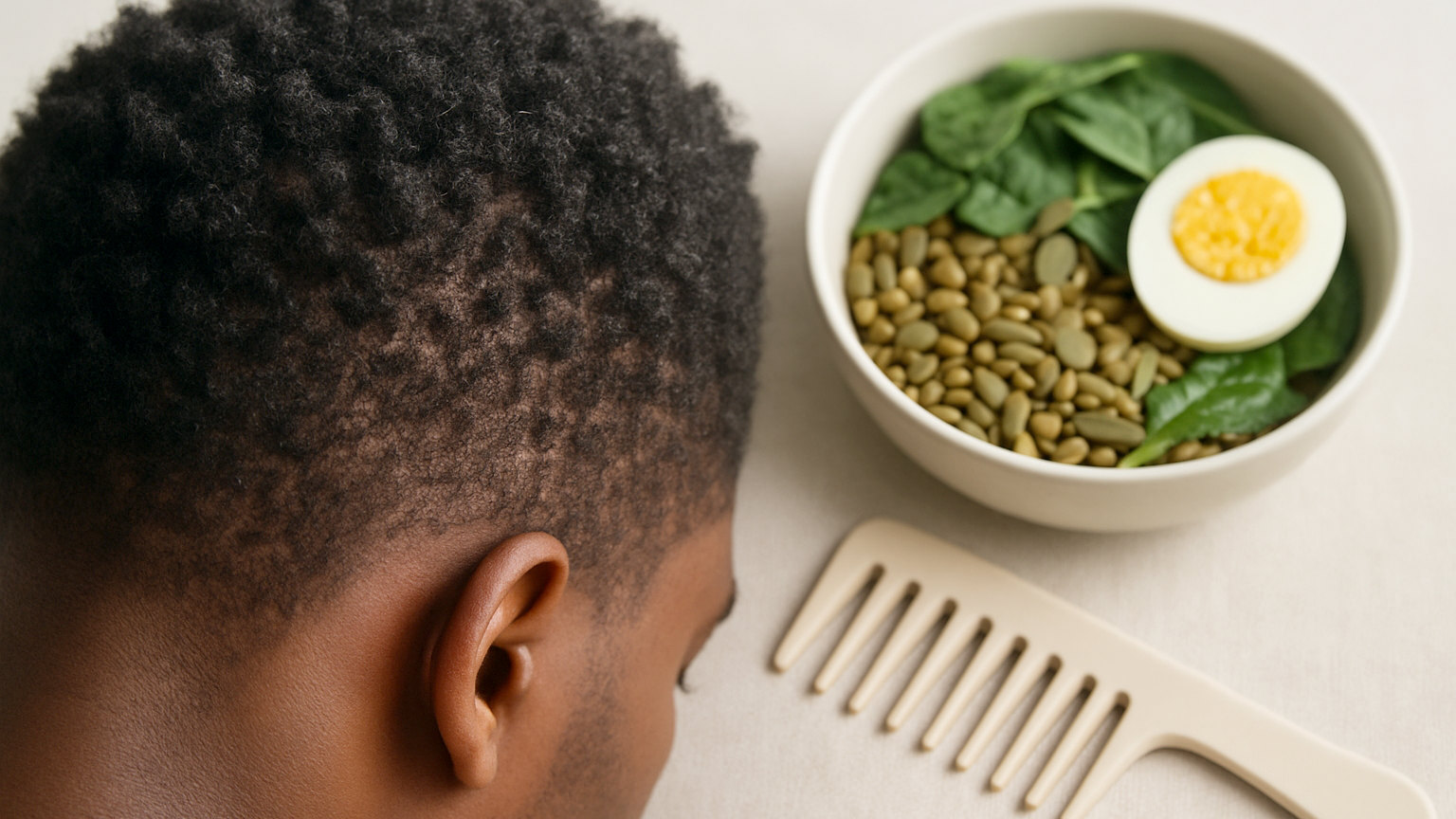
Diet affects hair growth substantially when something is genuinely missing and very little when nothing is. That single distinction explains why nutritional advice for hair divides so sharply between people it transforms and people it does nothing for.
Why does hair show deficiency early?
Because hair follicles contain some of the fastest-dividing cells in the body, and because hair is not essential to survival.
When nutrients are short, the body allocates them to organs that matter. Follicles are among the first tissues to be deprived, so they shift into the resting phase and shed. Hair is effectively an early warning system for nutritional status, which is why sudden shedding after a period of poor eating is so common.
Which nutrients actually matter?
Protein first. Hair is almost entirely keratin, a protein, and inadequate intake directly limits what the follicle can produce. This is the most common cause of diet-related hair loss and the most often overlooked.
Iron, which is required for the enzymes involved in rapid cell division. It is the most common deficiency affecting hair in the UK, particularly in women with heavy periods.
Zinc, which is involved in protein synthesis and follicle function. Vitamin D, widely deficient in the UK, with a reasonable association with hair loss. B vitamins, particularly B12 in vegetarians and vegans.
And enough calories overall, which matters more than any individual nutrient.
Why do crash diets cause shedding?
Because rapid weight loss is a physiological stressor, and it usually involves both calorie restriction and reduced nutrient intake at once.
The follicles respond by entering the resting phase, and the shedding appears two to three months later, by which point the person has usually stopped dieting and cannot see the connection.
Very low calorie diets, extended fasting and any regime producing rapid loss all do this. Weight loss surgery is a well-recognised cause and is usually managed with careful supplementation for exactly this reason.
Does eating more of something help if you are not deficient?
No, and this is where most food-based hair advice falls down. Follicles use what they need and excrete or store the rest.
Someone eating adequate protein does not grow hair faster by eating more. Someone with normal iron gains nothing from supplementing and may cause harm. The relationship is a threshold rather than a slope.
This is why the lists of hair-boosting foods circulating online are largely harmless and largely useless for anyone already eating reasonably.
Who is most at risk?
Anyone eating restrictively, whether through dieting, disordered eating or a limited diet for other reasons.
Vegans and vegetarians, particularly for iron, B12 and zinc, since plant sources are absorbed less efficiently. This is manageable with attention and worth testing rather than assuming.
Anyone with a condition affecting absorption, including coeliac disease and inflammatory bowel disease. Older adults, who often eat less overall. And anyone recovering from illness or surgery.
How much protein is enough?
General guidance suggests around 0.75 grams per kilogram of body weight daily as a minimum for adults, which is roughly 45 to 55 grams for most people.
That is a floor rather than an optimum, and many people eating restrictively fall below it without realising. Spreading protein across meals rather than concentrating it in one is generally better for how it is used.
Should you take a supplement?
Only after testing. Blood tests for ferritin, vitamin D, B12 and thyroid function are a reasonable request from a GP and identify something actionable more often than people expect.
Taking iron without a documented deficiency is a poor idea, since it accumulates. Taking a general hair supplement while an untested deficiency continues is the version of this that wastes months.
How long before diet changes show?
Three to six months before shedding slows, and six to twelve before regrowth is visible, because the follicle cycle has to complete.
Correcting a deficiency does not produce a visible change in weeks, and judging it at that point is judging an incomplete process. Blood levels normalise well before hair does.


