
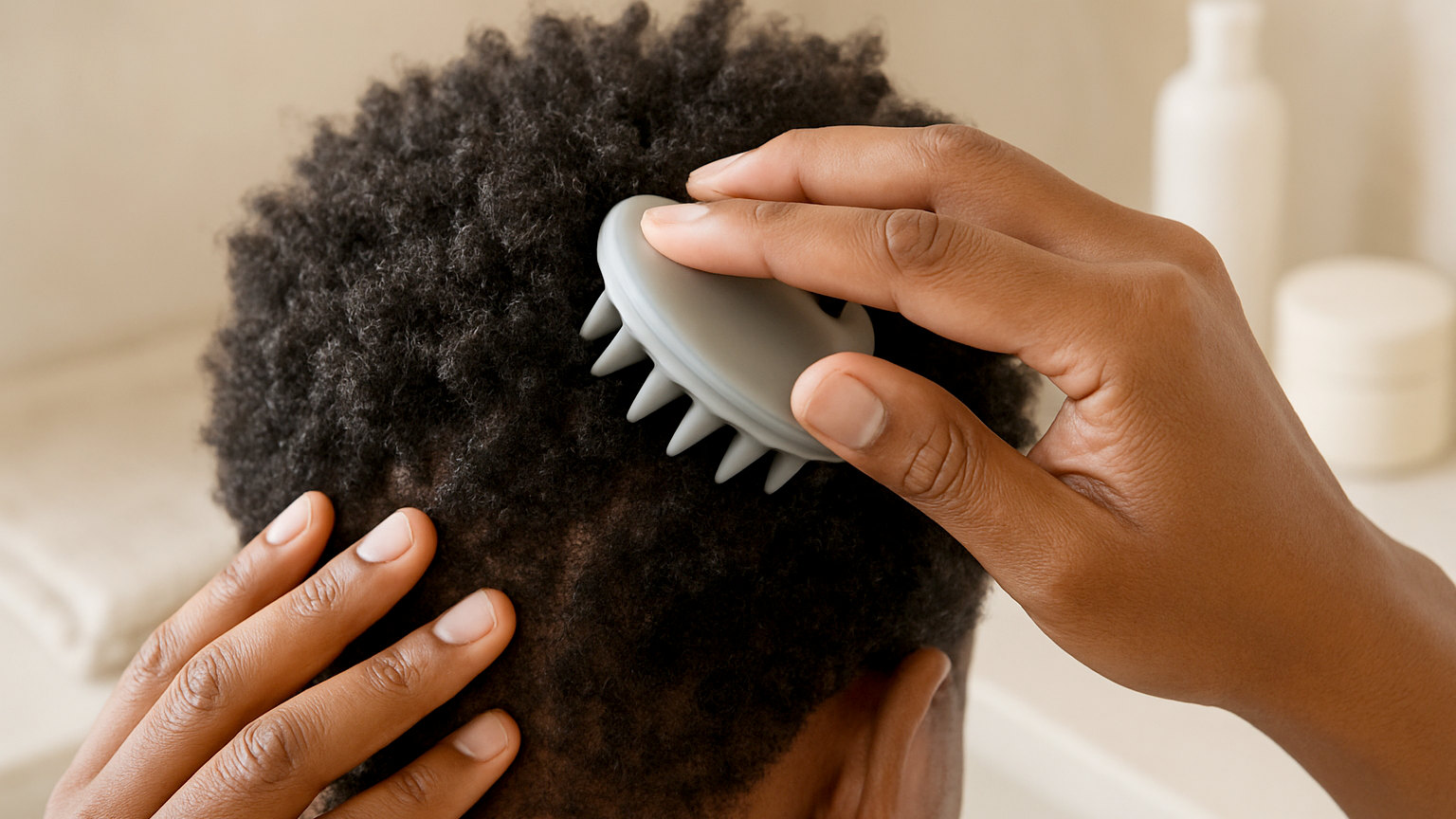
Scalp massage is one of the few hair growth interventions that is free, harmless and supported by at least some evidence. It is also routinely oversold, and the honest position sits between the enthusiasm and the dismissal.
What is the proposed mechanism?
Two things. Increased blood flow to the follicle, delivering more oxygen and nutrients, which is intuitive and difficult to demonstrate as producing growth.
More interestingly, mechanical stress on the dermal papilla cells at the base of the follicle. Laboratory work suggests that stretching these cells alters gene expression in ways associated with hair growth, which gives the practice a more specific rationale than circulation alone.
What does the research show?
A small Japanese study followed nine men performing four minutes of standardised scalp massage daily for twenty-four weeks and found a measurable increase in hair thickness, though not in the number of hairs.
A larger survey-based follow-up reported that a majority of participants with pattern hair loss described stabilisation or improvement after months of twice-daily massage, though self-reported data of that kind is weak evidence.
So: a plausible mechanism, small studies, modest effects on thickness rather than density, and nothing approaching the evidence base for minoxidil or finasteride.
How should you do it?
Fingertips rather than nails, using the pads to move the scalp itself rather than sliding across the hair.
Work in small circles, section by section, covering the whole scalp. Firm enough that you can feel the scalp shifting over the skull, gentle enough not to cause discomfort or tangle the hair.
Four to five minutes daily is the pattern used in the research. Consistency over months matters more than duration in any one session.
Do massage brushes help?
They make it easier and more pleasant, which matters for consistency, and there is no evidence they outperform fingers.
Silicone scalp brushes are useful during shampooing, where they help lift build-up and distribute product, and they are gentler than nails for anyone who scratches at their scalp. Choose flexible silicone rather than hard plastic bristles.
Electric massagers are pleasant and unstudied.
Does it help with anything else?
Probably more than it helps growth. It loosens build-up before shampooing, which improves cleaning. It is relaxing, and stress reduction has its own relevance to hair.
For anyone with a tight, tender scalp, which is common with tension headaches, it provides genuine relief. And it encourages people to look at their scalp regularly, which means changes get noticed earlier.
Should you use oil with it?
It depends on your scalp rather than your hair. Massage with oil is a long-standing practice and suits dry scalps well.
For oily scalps or anyone prone to seborrhoeic dermatitis, adding oil can worsen flaking, since the yeast involved feeds on lipids. Massaging dry, before washing, avoids the issue entirely.
Rosemary oil has attracted attention following a small trial comparing it with minoxidil that found broadly similar results over six months. The study was small and had limitations, and it is a reasonable thing to try diluted rather than a demonstrated equivalent to established treatment.
How long before you would know?
Six months at minimum, which is the duration used in the research, and the effect measured was thickness rather than visible density.
Photographs in consistent light every eight weeks are the only sensible way to judge it, since the change is well below what daily observation detects.
Is it worth doing?
Yes, with realistic expectations. It costs nothing, carries no risk, may modestly improve hair thickness over months, and has secondary benefits that are more reliable than the primary one.
What it is not is a substitute for investigating why hair is thinning, or for treatment with real evidence behind it. Massaging the scalp while an untreated thyroid problem or iron deficiency continues is the version of this that wastes a year.
Can it ever do harm?
Rarely, and there are two situations worth naming. Massaging too vigorously, particularly with nails or on wet hair, causes breakage and tangling, which undoes any benefit.
And anyone with active scalp inflammation, an infection, or a scarring alopecia should be cautious, since friction on inflamed skin makes matters worse. If your scalp is sore, flaking or has pustules, that needs treating before anything else is added to it.


