
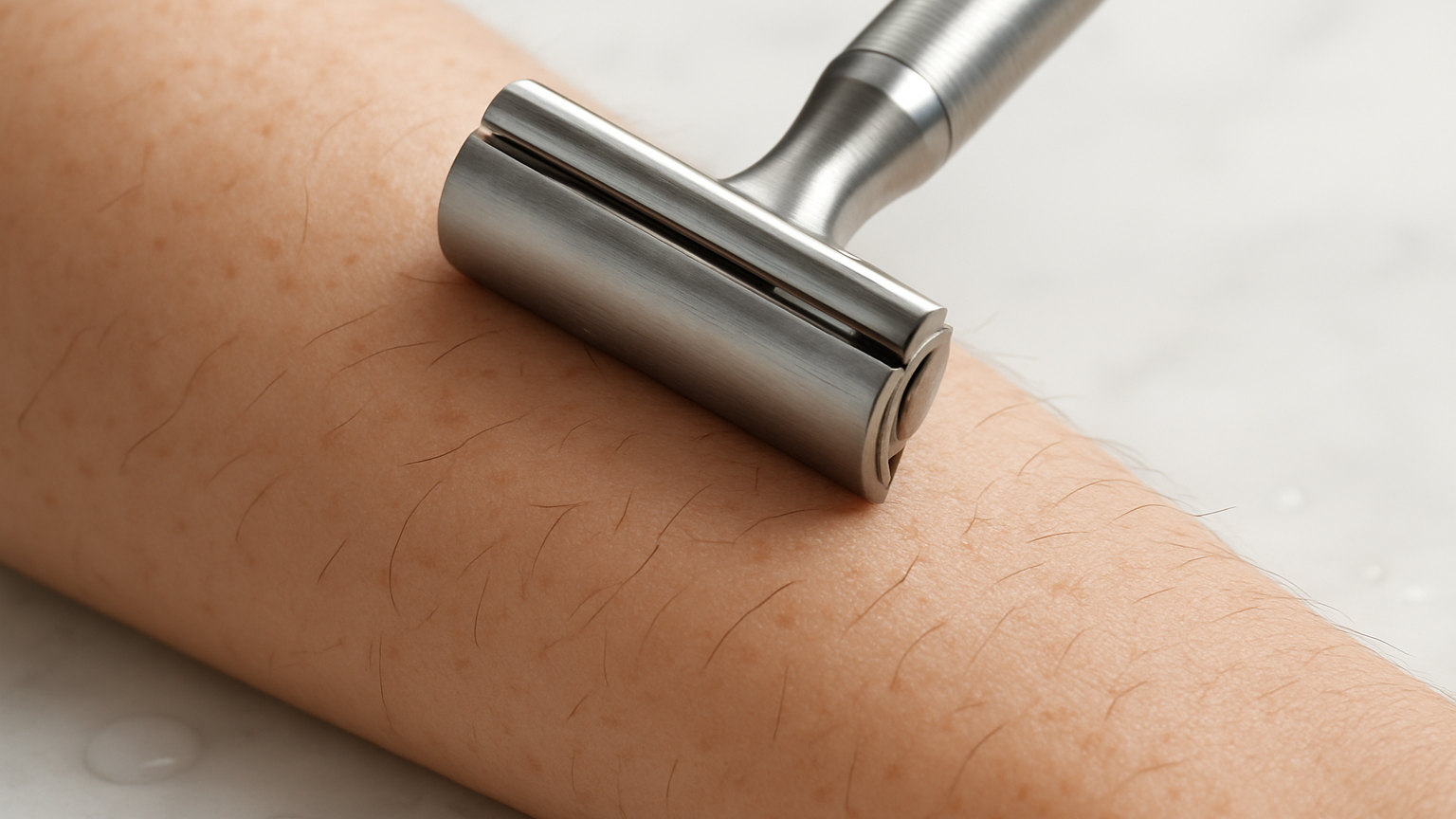
Shaving does not make hair grow back thicker, darker or faster. This has been tested repeatedly since the 1920s and the finding is consistent. The reason it feels otherwise is a matter of geometry.
Why does it feel coarser?
Because of what a razor does to the end of the hair.
A hair that has grown undisturbed has a fine, tapered tip. Shaving cuts straight across the shaft at its full diameter, leaving a blunt end. A blunt end feels rougher against the skin and looks thicker at the tip, even though the hair itself is unchanged.
The follicle is unaffected. It has no way of detecting that the shaft has been cut several millimetres above the skin, and it continues producing exactly the same hair.
Why does it look darker?
Three reasons, none of them involving actual change.
The blunt tip presents more surface area of the pigmented shaft, where a tapered tip has less pigment at the very end. New growth emerging from the follicle has not been exposed to sunlight, which lightens hair over time, so it appears darker than the sun-bleached hair it replaced.
And short stubble against the skin creates contrast that longer, lying-flat hair does not.
What does the research show?
Studies going back to 1928 have shaved one area and left another as a control, then measured regrowth in diameter, rate and colour. They consistently find no difference.
A frequently cited study in the 1970s reached the same conclusion, and the finding has not been meaningfully challenged since. It is one of the better-settled questions in this field.
Why is the myth so persistent?
Because the sensory evidence feels compelling, and because of when people usually start shaving.
Adolescents begin shaving at exactly the point when androgens are causing body hair to become naturally thicker and darker. The hair does coarsen over the following years, and the shaving is the visible variable, so it gets the credit.
Anyone who started shaving at fourteen and had noticeably coarser leg or facial hair at eighteen experienced a real change with an entirely different cause.
Does this apply to facial hair?
Yes, and the same misattribution occurs. Beard growth thickens through the late teens and twenties because of androgen exposure over time, not because of how often it has been shaved.
The same applies to the belief that shaving encourages a patchy beard to fill in. It does not, and beard density is genetic and continues developing into the twenties regardless.
Does anything actually change regrowth?
Waxing and epilation remove hair from the root, and repeated over years they can damage some follicles enough that regrowth becomes finer and more sparse. That is a genuine effect and an unpredictable one.
Laser and intense pulsed light target the follicle deliberately and produce lasting reduction. Hormonal changes alter growth genuinely, which is why body hair changes at puberty, in pregnancy and around menopause.
Shaving does none of these things, because it never reaches the follicle.
Does it matter which way you shave?
For comfort and ingrown hairs, yes; for thickness, no.
Shaving against the direction of growth gives a closer result and increases the chance of the cut end retracting below the skin surface and growing inward. Shaving with the grain is gentler and less close.
Neither affects what the follicle produces. If regrowth genuinely seems coarser after starting on a new area, the likeliest explanations are the blunt tip and the passage of time.
Does it apply to head hair too?
Yes, and the same myth circulates in a different form: the idea that shaving your head makes hair grow back thicker.
It does not, for the same reason. What changes is that a closely shaved head presents blunt ends of uniform length across the whole scalp, which looks and feels denser than the same hair at three inches where thinning is visible. That appearance is genuine and the hair itself is unchanged, which is why the effect disappears as it grows out.
Does hair removal cream differ?
Only in where it cuts. Depilatory creams dissolve the shaft slightly below the surface rather than at it, so regrowth feels softer for a day or two before the blunt end emerges. The follicle is untouched, and growth is identical.


