
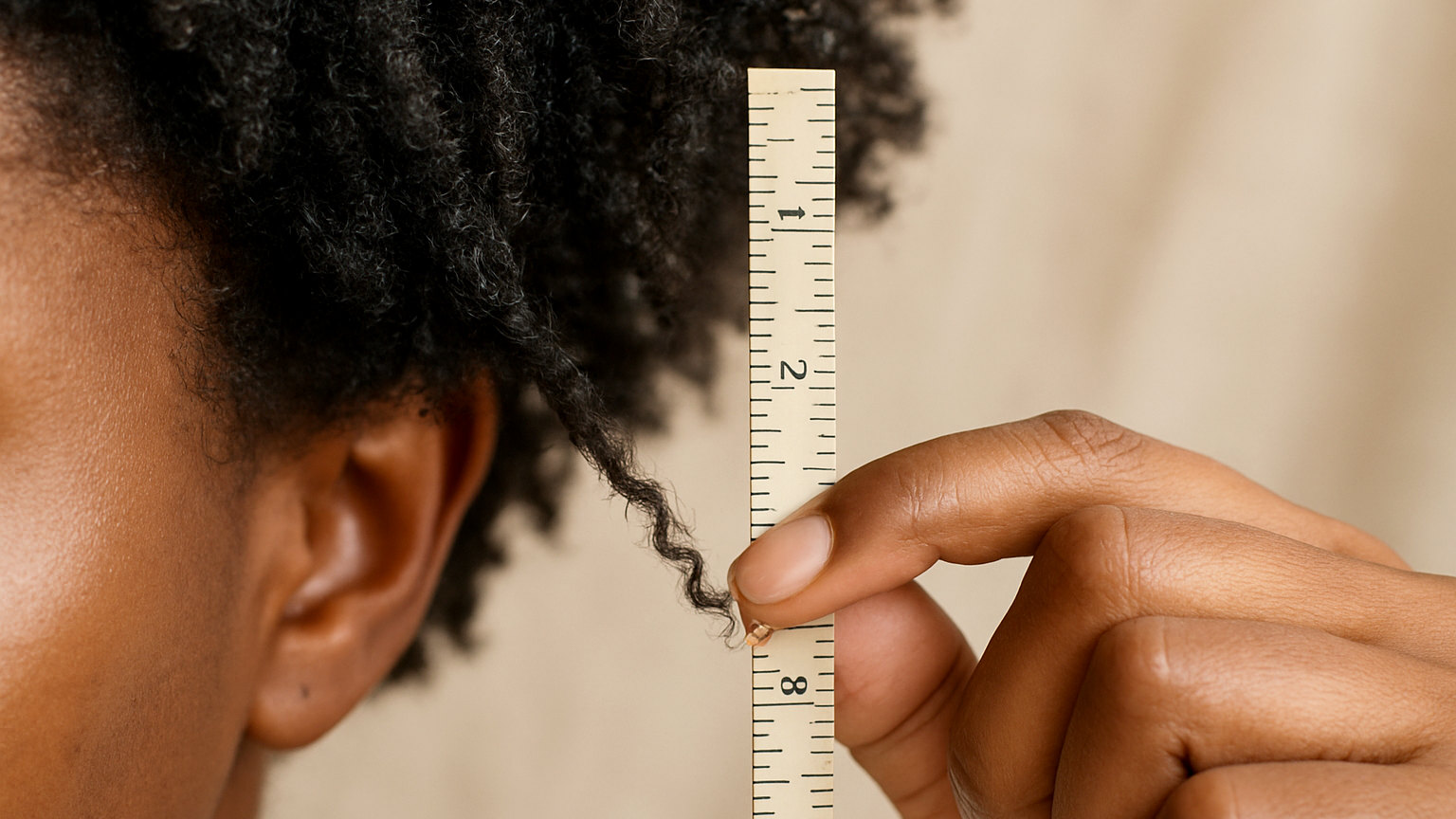
Hair grows at roughly a centimetre a month, or about six inches a year, and that figure varies less between people than most assume. What varies enormously is how much of it is retained, and how long the growth phase lasts before a hair is shed.
What is the actual rate?
Around 0.3 to 0.4 millimetres a day for scalp hair, which works out at roughly 1 to 1.25 centimetres a month.
Body hair grows more slowly and has a much shorter growth phase, which is why eyebrows and eyelashes never reach the length of scalp hair despite growing continuously.
Rate is largely genetic. There is some evidence of small differences between ethnic groups, with Asian hair often growing slightly faster and African hair slightly slower on average, though the overlap between individuals is far larger than the difference between groups.
Why does hair stop growing at a certain length?
Because the growth phase has a limit, and that limit is genetic.
Each follicle cycles through anagen, the growth phase lasting two to seven years, then a short transitional phase, then a resting phase, after which the hair sheds and the cycle restarts.
At a centimetre a month, a two-year growth phase gives a maximum length of around 24 centimetres, roughly shoulder length. A seven-year phase allows well past the waist. That ceiling is called terminal length, and no product extends it.
Someone whose hair will not grow past their shoulders despite excellent care is usually running into this rather than doing anything wrong.
What affects the rate?
Age, which slows it gradually from around the thirties. Genetics, which sets the baseline.
Nutritional status, but only meaningfully in deficiency. Adequate protein, iron and general calorie intake are necessary; exceeding adequate does not accelerate anything.
Hormones, particularly thyroid, which slows growth when underactive. Illness and medication, which can interrupt the cycle entirely.
Season, modestly, with some evidence of slightly faster growth in summer.
What does not affect it?
Trimming, which cannot influence a follicle several inches away and under the skin. Shaving, which does not make hair grow back thicker or faster; the blunt cut end simply feels coarser than a tapered tip.
Most shampoos and conditioners, which are rinsed off within a minute and act on dead keratin rather than the follicle. Brushing a hundred strokes, which causes more breakage than it stimulates growth.
Why does length seem to stall?
Usually because breakage matches growth. If hair grows a centimetre a month and loses a centimetre to split ends, breakage and damage, length stays constant while the hair itself is entirely replaced.
The ends of long hair are years old. A strand at the waist has been washed several hundred times and brushed thousands, and it is the oldest, weakest part of the hair.
This is why reducing damage does more for length than anything marketed for growth, and why people who change nothing except how they handle their hair often see length increase within months.
How do you measure it properly?
From a fixed point, with a tape measure, monthly, taking a photograph at the same time. Measuring from the shoulder or from a parting is unreliable because posture and parting position vary.
Expect around three centimetres over three months. Anything much less suggests breakage rather than slow growth, which is a different problem with a different solution.
Is there anything that genuinely speeds it up?
Very little. Minoxidil prolongs the growth phase and is intended for hair loss rather than for accelerating normal growth, though it does have this effect.
Correcting a genuine deficiency restores a rate that had slowed. Scalp massage has modest evidence and no downside.
Everything else sold for growth is generally working on hair that is already growing at the rate your genetics allow, and the honest lever available to most people is retention rather than speed.
Does hair grow at the same rate all over the body?
No, and the differences are large. Scalp hair has the longest growth phase, which is why it reaches such lengths. Eyebrows and eyelashes have a growth phase of only a few months, so they shed and regrow constantly without ever getting long.
Body hair sits in between. This is also why an eyebrow over-plucked takes weeks rather than years to return, and why a badly cut fringe feels so much slower: it is growing at the same rate as everything else, from a much more visible starting point.


