
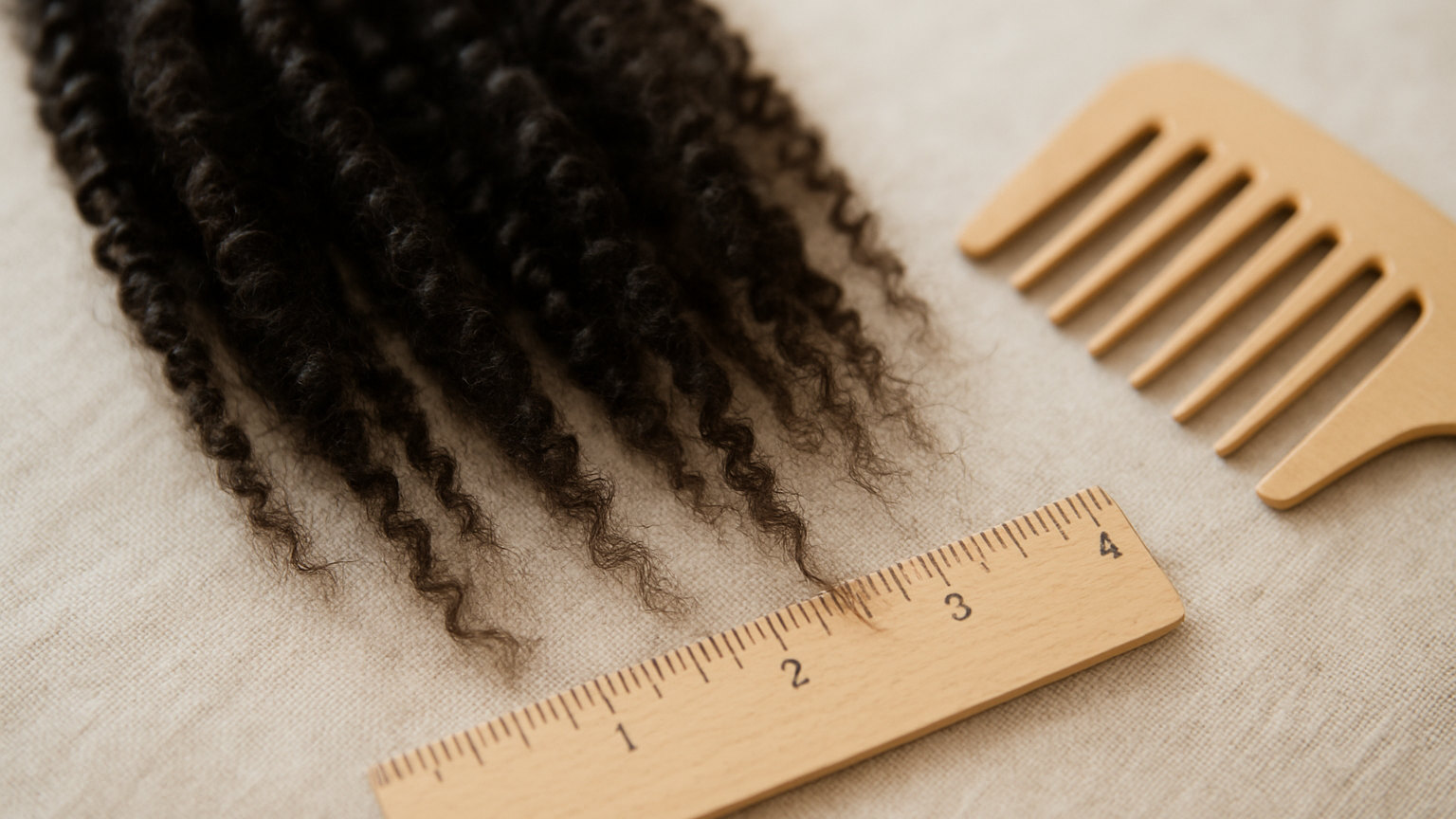
The arithmetic is simple and the answer is longer than most people want. Hair grows around a centimetre a month, so the calculation is straightforward until you account for what is being lost at the other end.
What are the realistic timescales?
Working from a chin-length bob at roughly 20 centimetres, and assuming a centimetre of growth a month with minimal breakage:
To shoulder length, around 30 centimetres, takes roughly ten months to a year. To collarbone, around 35 centimetres, adds another five months.
To mid-back, around 45 centimetres, takes around two years from a bob. To waist, around 60 centimetres, takes closer to three and a half years.
From a pixie cut, add a further year to eighteen months before you reach chin length at all.
Why does it take longer in practice?
Because those figures assume you keep every centimetre, and almost nobody does.
If hair grows a centimetre a month and loses half a centimetre to breakage and split ends, the effective rate halves and the timeline doubles. Someone who has been growing their hair for two years with nothing to show for it is usually losing as fast as they gain.
Trims complicate the picture and are worth having anyway, since a split left alone travels up the shaft and costs more length than removing it would.
Where does the loss happen?
Almost entirely at the ends, and almost entirely from mechanical damage rather than washing or styling products.
Detangling from the roots down. Rubbing with a towel. Brushing while wet. Tight ties in the same position. Heat styling without protection. Hair caught in collars, seatbelts and bag straps.
Each of these costs a small amount, and over a year of daily repetition the total is substantial.
Is there a maximum length?
Yes, and it is genetic. Each follicle has a growth phase lasting two to seven years, and at a centimetre a month that sets a ceiling of roughly 24 to 84 centimetres.
Someone with a two-year growth phase will not reach the waist however carefully they treat their hair, because each strand is shed before it gets there. Someone with a seven-year phase can, with reasonable care.
If your hair has sat at the same length for two years despite good handling and no visible breakage, you are probably at terminal length rather than doing something wrong.
How do you tell breakage from terminal length?
Look at the ends. Terminal length hair has ends that look reasonably healthy and taper naturally. Breakage produces uneven lengths, visible short hairs throughout the length, and ends that look frayed or white-tipped.
Run a hand down a section: breakage feels rough and catches. Measuring monthly from a fixed point also helps, since hair that is growing but not lengthening is breaking.
What actually shortens the timeline?
Nothing speeds growth meaningfully, so everything worth doing is about retention.
Detangle from the ends upward. Squeeze rather than rub with a microfibre towel or t-shirt. Sleep on silk or satin, or plait loosely. Use lower heat and always use protection. Vary where you tie it. Condition the lengths properly.
Trim to remove damage rather than avoiding trims entirely. Removing half an inch every three months costs less than a split travelling six inches up the shaft.
What should you expect along the way?
An awkward phase, which is real and passes. Growing out a short cut goes through several months where the shape works against you, and layers or a change of parting help more than waiting it out.
Measure from a fixed point monthly and photograph it, because progress at a centimetre a month is invisible day to day and people abandon the project believing nothing is happening when three centimetres have arrived in three months.
Does hair grow at the same rate all over the head?
Not quite. The crown and the sides frequently grow at slightly different rates, and the front sections take the most heat and handling, so they often appear to lag when they are in fact breaking.
This is why layers grow out unevenly and why a fringe seems to lengthen faster than the back. It also means a cut that looked balanced can drift out of shape over six months, which is one of the few genuine arguments for a trim while growing hair out.


