
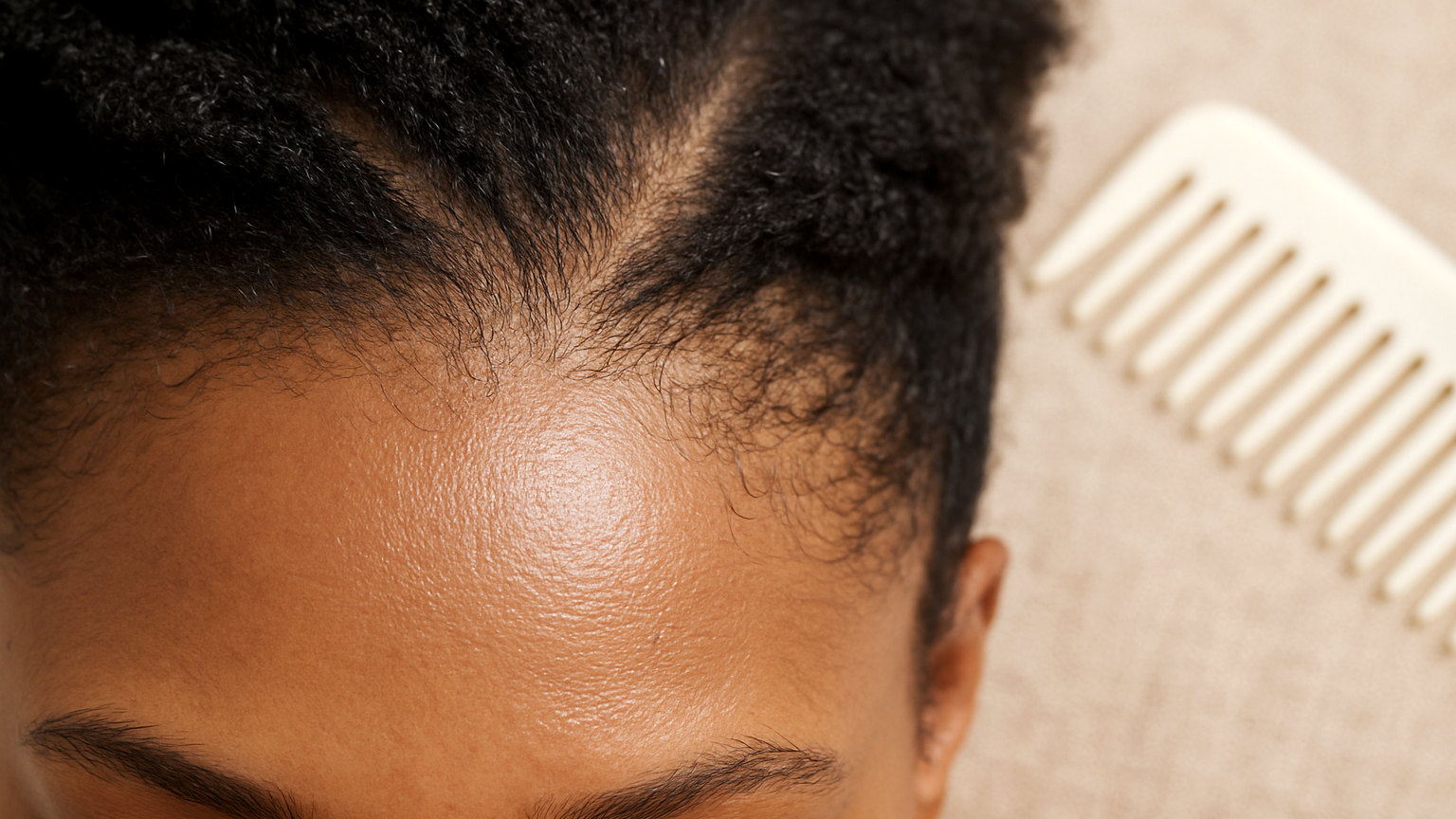
Short hairs standing up around the hairline and along the parting are usually a good sign, and telling genuine regrowth from breakage matters, because one means something is working and the other means something is going wrong.
What are baby hairs?
Two different things, sharing a name.
The permanent kind are the fine, short hairs that naturally frame the hairline and have been there since childhood. They are finer and shorter than the rest by design, they never grow long, and they are simply how the hairline transitions into skin.
The temporary kind are new hairs regrowing after a shed, which will eventually reach full length. These are what people mean when they say their baby hairs are coming through.
How do you tell new growth from breakage?
Look at the tip of the hair.
New growth has a fine, tapered point, because that is how a hair emerges. It is soft at the tip and thinner there than at the base.
Breakage has a blunt, sometimes split or white-tipped end, because the hair snapped. It is the same thickness along its length rather than tapering.
Distribution also helps. New growth after a shed clusters where the shedding was worst, usually the hairline and parting, and appears at broadly similar lengths. Breakage is scattered throughout the length of the hair and appears at random lengths.
Why do they stand up?
Because they are too short to be weighed down by the rest of the hair, and because they have not yet been trained into the direction the surrounding hair falls.
They are also often finer, so they carry static readily and lift in dry air. This is why they seem worse in winter and after a hat.
It is a temporary stage. As they lengthen past a few inches, they lie down with everything else.
When should you expect them?
Around six to nine months after a shedding episode. If you had postpartum shedding, telogen effluvium after illness, or a stress-related shed, the halo of short hairs around the hairline is the visible sign of recovery.
They are also expected two to three months into effective treatment for hair loss, which makes them a useful early indicator that something is working before overall density has visibly changed.
How should you style them?
Lightly, since heavy products weigh down fine hair and make it look greasy rather than smooth.
A small amount of hair wax, gel or a dedicated edge product applied with a fingertip or a small brush. A little hairspray on a spoolie brush or an old toothbrush works well and costs nothing.
Avoid pulling them into a tight style, since the hairline is where traction damage occurs first and these hairs are the most fragile on the head.
What if they never grow longer?
Two possibilities. If they are the permanent hairline kind, they will not grow long, and that is normal.
If they are regrowth that stops at the same short length repeatedly, that suggests either breakage at that point or follicles that are miniaturising, which is the pattern in early pattern hair loss. A halo of short hairs along a widening parting that never lengthens is worth raising with a GP.
Can you encourage them?
Only by not damaging them. They are the newest and most fragile hairs on the head, and the front hairline takes the most heat styling, tension and product.
Ease off tight ponytails, avoid heat on the front sections, and be gentle when brushing near the hairline. That does more than any product marketed for edges.
Is it worth cutting them?
Generally not, since cutting resets progress on hairs you are trying to grow. The exception is where new growth along a parting is standing up in a way that bothers you, and even then, styling it down is a better answer than cutting it shorter and starting the awkward stage again.


