
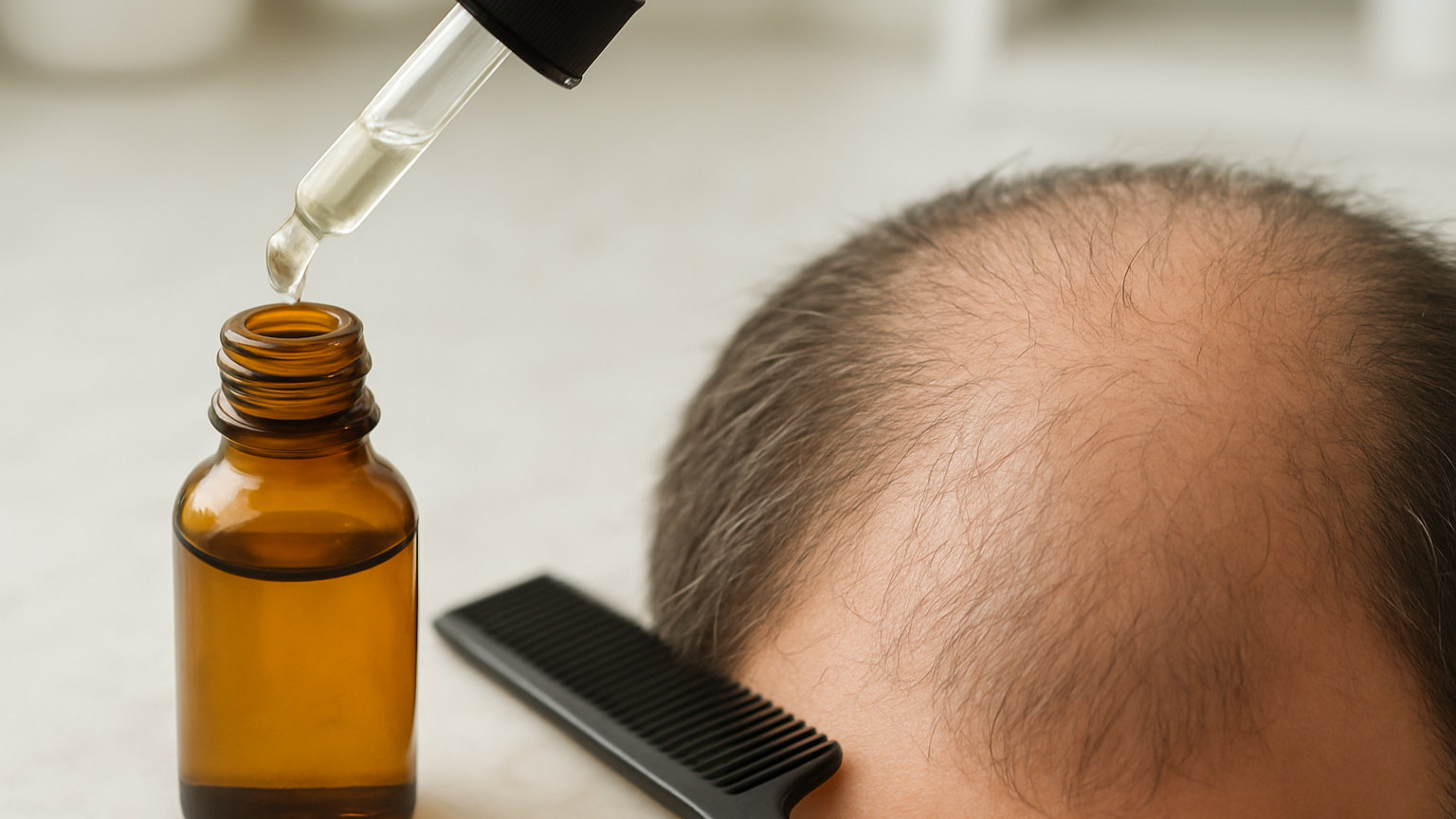
Minoxidil is the only topical treatment for pattern hair loss available over the counter with substantial evidence behind it. It also has a set of characteristics that catch people out, most of which are predictable if you know them in advance.
What does it actually do?
It was developed as a blood pressure medication, and hair growth was an unexpected side effect. The mechanism in the scalp is still not fully settled.
What is reasonably established is that it widens blood vessels, increasing blood flow to the follicle, and that it prolongs the growth phase of the hair cycle while shortening the resting phase. It also appears to increase follicle size, so miniaturised follicles produce thicker hairs.
It does not address the underlying androgen sensitivity driving pattern loss. It works alongside that process rather than against it.
How well does it work?
Reasonably, and not dramatically. Trials generally find that around forty per cent of users see moderate regrowth, a further group see stabilisation without regrowth, and a minority see no benefit.
It works best on the crown and less well on a receding hairline. It works better on smaller areas of recent thinning than on long-established loss, because a follicle that has been dormant for years may no longer respond.
The honest framing is that it slows progression and produces partial regrowth in many people, rather than restoring hair to its previous state.
Why does hair fall out at the start?
This is the feature that stops most people using it, and it is expected rather than a warning sign.
Minoxidil pushes follicles out of the resting phase and into a new growth cycle. Resting hairs that were going to be shed over the following months are shed at once, so shedding increases noticeably between weeks two and eight.
It settles by around month three. Stopping during this phase means abandoning the treatment precisely when it has started working, which is the most common reason for a failed trial.
How long before you can judge it?
Four months at the earliest for any visible change, and six to twelve for a fair assessment.
Hair grows around a centimetre a month, so new hairs take months to become long enough to see. Photographs in consistent lighting every eight weeks are far more reliable than daily observation, which is poorly suited to detecting gradual change.
What happens if you stop?
The gains reverse over three to six months, and hair returns to where it would have been had you never started.
This is the part worth deciding on before beginning. Minoxidil is an ongoing commitment rather than a course of treatment, and stopping after two years means losing what was gained plus the loss that occurred in the meantime.
Which formulation should you use?
Five per cent is more effective than two per cent for most people, including women, though the two per cent formulation is what is licensed for women in some markets.
Foam is generally preferred to liquid because the liquid contains propylene glycol, which causes scalp irritation and itching in a substantial minority. Foam suits people with hair, since it is easier to apply to the scalp without leaving residue.
Apply to a dry scalp rather than to hair, twice daily for the liquid or once to twice for the foam depending on the product, and leave at least four hours before washing.
What are the side effects?
Scalp irritation, itching and flaking are the most common, usually from propylene glycol rather than the minoxidil.
Unwanted facial hair growth occurs in some women, generally from the product migrating rather than from systemic absorption, and washing hands after application reduces it.
Rarely, dizziness, palpitations, fluid retention or swelling, which relate to the cardiovascular effects and warrant stopping and speaking to a pharmacist or GP. It is not suitable during pregnancy or breastfeeding, and it is toxic to cats, so households with cats should take care with application and hand washing.
Should it be combined with anything?
For men, combining it with an oral treatment that addresses the androgen mechanism produces better results than either alone, and that is a conversation with a GP or pharmacist.
For anyone, addressing an underlying cause matters first. Minoxidil applied to hair loss actually caused by iron deficiency or thyroid disease treats the wrong problem, which is why investigation before treatment is worth the delay.


