
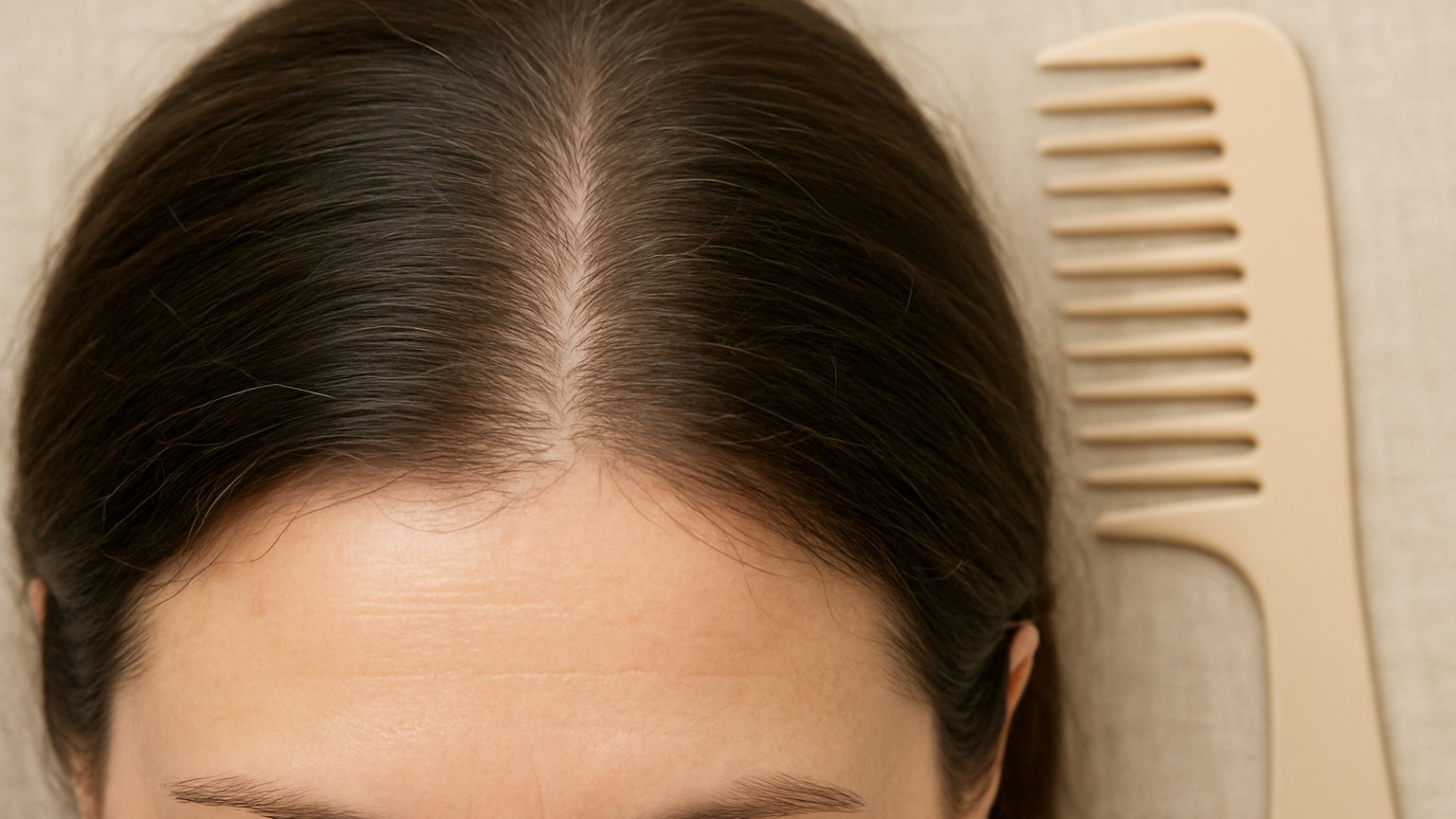
Female pattern hair loss is the most common cause of thinning in women and looks nothing like male balding, which is part of why it is often recognised late and frequently attributed to something else for years.
What does it look like?
Diffuse thinning across the top of the scalp, with the frontal hairline usually preserved. The most common early sign is a parting that gradually widens.
Ponytails become thinner. Scalp becomes more visible in bright light or when hair is wet. The change is gradual enough that people often notice it in a photograph rather than in the mirror.
Unlike male pattern loss, complete baldness is uncommon. The hair miniaturises rather than disappearing entirely.
What causes it?
A genetic predisposition to follicle sensitivity, with hormones as a contributing factor. Follicles gradually miniaturise, each cycle producing a shorter, finer hair.
The role of androgens is less clear-cut than in men. Many women with the condition have entirely normal androgen levels, which is why the older term female androgenetic alopecia has fallen somewhat out of favour.
Menopause is a common point of onset or acceleration, as falling oestrogen shifts the balance. Polycystic ovary syndrome is a recognised association.
How is it different from shedding?
This distinction matters, because the two feel completely different and are often confused.
Telogen effluvium is increased shedding: more hair in the brush and the drain, coming out at the root, usually after a trigger two to three months earlier, and self-limiting.
Pattern loss is not primarily shedding. Hair is being replaced by progressively finer hair, so density reduces without a dramatic increase in what comes out. Someone can have significant pattern loss without ever noticing extra hair in the shower.
Both can occur together, and a shed can reveal underlying pattern loss that was not previously obvious.
What should be ruled out?
Thyroid disease, iron deficiency and vitamin D deficiency, all of which are common and treatable. Polycystic ovary syndrome, particularly alongside irregular periods, acne or unwanted facial hair.
Medications, including some contraceptives and antidepressants. And scarring alopecias, particularly frontal fibrosing alopecia, which causes a receding hairline with loss of eyebrows and is increasingly recognised after menopause. That one is irreversible and needs early diagnosis.
What treatments have evidence?
Topical minoxidil is the mainstay and the only topical treatment with substantial evidence. Both two and five per cent are used, and five per cent applied once daily is now commonly recommended.
Spironolactone, taken orally, blocks androgen receptors and is used off-label with reasonable evidence. It requires a prescription, monitoring, and reliable contraception, since it is unsuitable in pregnancy.
Some combined oral contraceptives help. Low-level laser therapy devices have modest supporting evidence. Finasteride is used in some circumstances after menopause under specialist supervision.
How soon should you act?
As early as possible, because treatment preserves existing follicles far more effectively than it revives miniaturised ones.
A follicle that has been producing barely visible hair for a decade may not respond at all. One that has recently begun to thin usually does. This is the single strongest argument against waiting to see whether it settles.
What helps in the meantime?
A good cut, which makes a substantial difference to how thinning reads. Volumising products at the roots. Coloured scalp powders and fibres, which are genuinely effective at concealing a widening parting.
Avoiding tight styles that add traction. Handling hair gently, since finer hair breaks more easily.
And treating the emotional side as legitimate. Hair loss affects women differently to men in social terms, and distress about it is a reasonable thing to raise with a GP rather than something to apologise for.
Does it always keep progressing?
Not at a steady rate. Female pattern loss often progresses in phases, with periods of noticeable change followed by years of relative stability, which is why it is difficult to predict from a single point in time.
Hormonal transitions tend to mark the accelerations, particularly perimenopause. That is an argument for starting treatment when change is noticed rather than waiting to see where it settles, since what is preserved is easier to keep than what is lost is to recover.


