
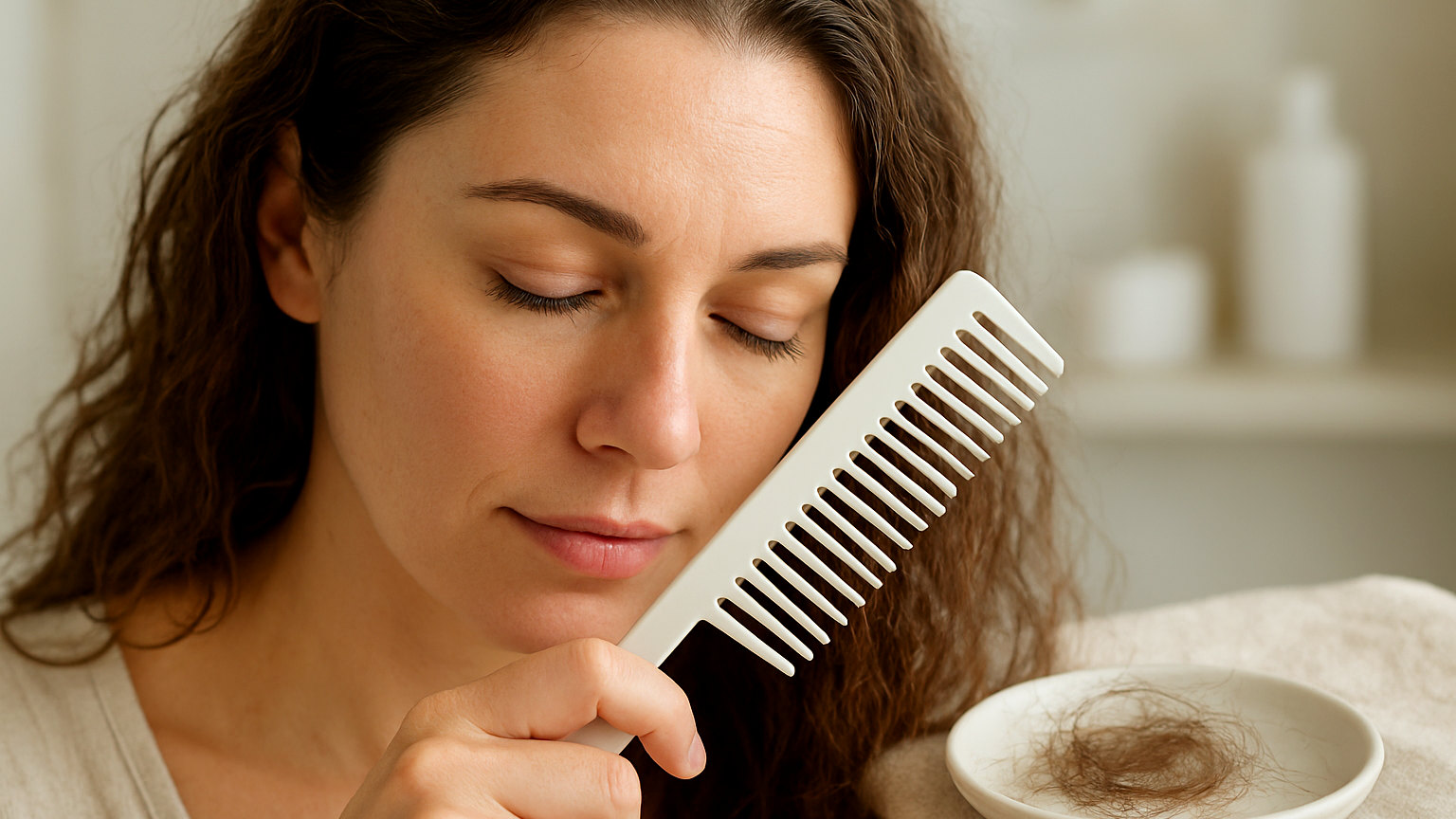
Losing hair in handfuls three or four months after giving birth is one of the more alarming things that happens postpartum, and it is extremely common. It is also, in the large majority of cases, entirely temporary.
Why does it happen?
Because pregnancy interrupted the normal cycle and afterwards it resumes all at once.
Normally around ten per cent of follicles are in the resting phase at any time, shedding gradually. High oestrogen during pregnancy keeps follicles in the growth phase for longer, so far less is shed than usual. That is why hair often looks unusually thick during pregnancy.
After delivery, oestrogen falls sharply and all those retained hairs move into the resting phase together. Three months later, they shed together.
When does it start and peak?
Typically beginning around two to four months after birth, peaking at around four months, and settling by six to twelve months.
The delay is why it catches people out. Nothing has changed in the weeks before the shedding starts, so people look for a recent cause when the trigger was months earlier.
It is often worse after a first baby and can vary considerably between pregnancies in the same person.
How much is normal?
Considerably more than usual. Where fifty to a hundred hairs a day is typical, several hundred during the peak is not unusual, and shedding enough to block a shower drain daily is a common experience.
What should not happen is bald patches, visible scalp in defined areas, or loss that continues past a year. Diffuse thinning across the whole head is expected; discrete patches are not.
Does breastfeeding affect it?
Not directly in the way often assumed. The shedding is driven by the hormonal shift after delivery rather than by feeding, and it occurs whether or not someone breastfeeds.
What breastfeeding can do is increase nutritional demand, and iron deficiency is common postpartum for other reasons too, including blood loss at delivery. That can prolong or worsen shedding, which is why it is worth testing rather than assuming.
What helps while it is happening?
Relatively little that changes the timeline, and several things that make it easier to live with.
Gentle handling, since the hair being shed is coming out regardless and rough brushing damages what remains. Avoid tight ponytails, which are tempting when hair is everywhere and add traction to an already stressed scalp.
Volumising products and a good cut can make thinning less visible. Continue to condition the lengths, since hair quality matters as much as quantity for appearance.
Eat adequately, which is genuinely difficult with a new baby and matters more than any supplement.
Do supplements help?
Only if you are deficient, and postpartum women frequently are, so testing is worthwhile rather than guessing.
Iron is the most common relevant deficiency, and ferritin below a certain level is associated with increased shedding. Vitamin D and B12 are worth checking. Continuing a pregnancy multivitamin is reasonable.
Supplements marketed specifically for postpartum hair loss generally contain the same ingredients at unremarkable doses and do not shorten the process.
When should you see a GP?
If shedding continues beyond twelve months, if hair is not visibly regrowing by nine to twelve months, or if there are defined bald patches rather than diffuse thinning.
Also if it comes with fatigue, weight change, feeling cold or low mood, since postpartum thyroiditis is common, often missed, and easily tested. Iron studies are worth requesting at the same time.
Will it grow back the same?
Usually, and often with a visible fringe of short regrowth around the hairline at around six to nine months, which sticks up and is a good sign rather than a problem.
Texture can change after pregnancy, sometimes permanently, with curl pattern and thickness shifting. That is a genuine hormonal effect rather than damage, and it is not something a product will reverse.
Does it happen after a miscarriage or stopping the pill?
Yes, through the same mechanism, and it is rarely mentioned. Any abrupt fall in oestrogen can trigger the same synchronised shift into the resting phase, so shedding two to three months later is common after miscarriage, termination and stopping hormonal contraception.
The pattern and timescale are the same: diffuse shedding, peaking around month four, resolving within six to twelve months. Knowing the connection exists spares a good deal of unnecessary worry, since the delay makes the cause easy to miss.


