
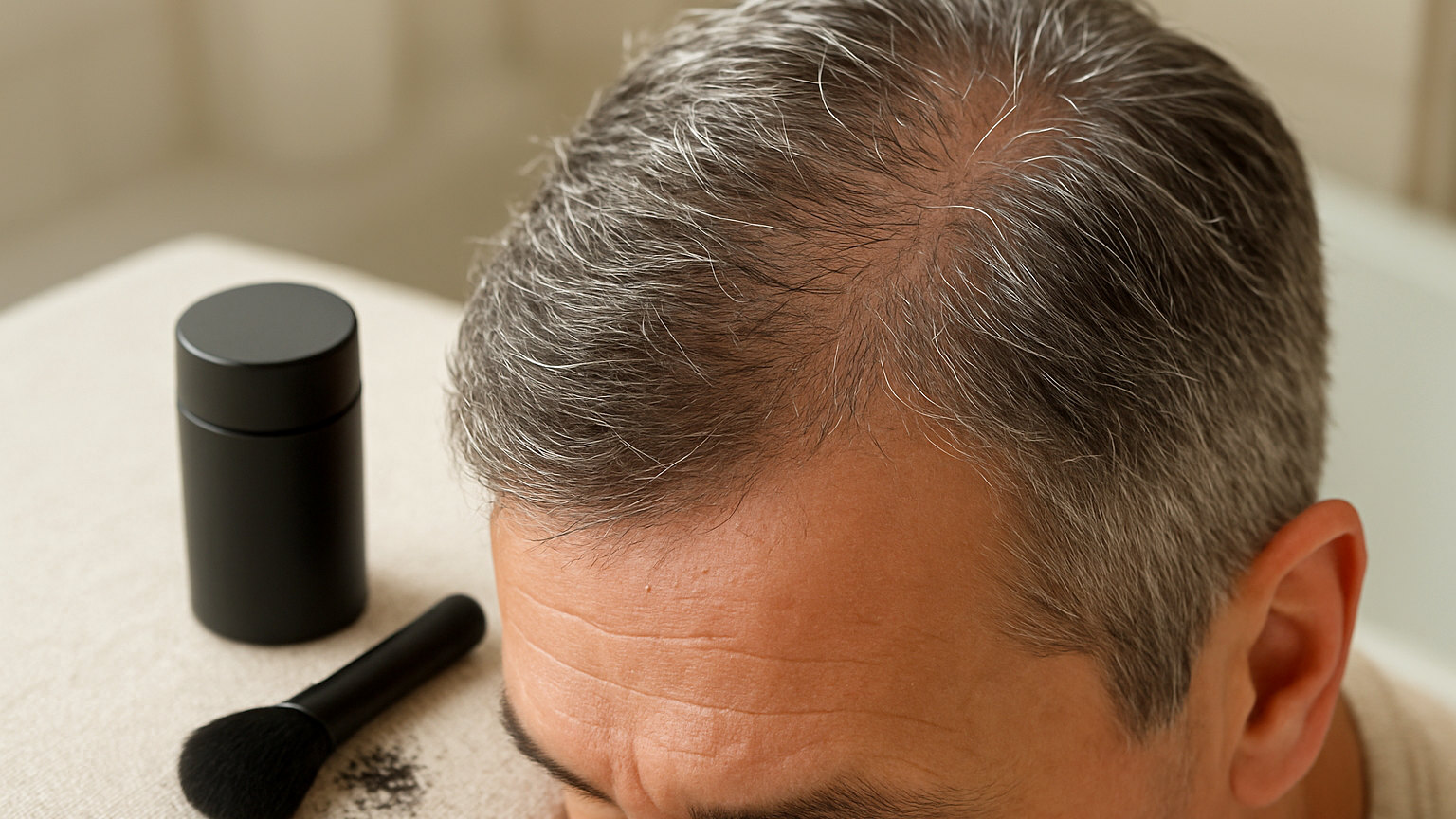
Concealing thinning is not a substitute for finding out why it is happening. It is, however, considerably more effective than most people expect, and treatment takes six to twelve months to show, which is a long time to wait without help.
What conceals a visible scalp?
Coloured products applied directly to the scalp, which work by reducing the contrast between hair and skin. That contrast is what makes thinning visible, more than the absence of hair itself.
Root powders and sprays are the simplest, applied along a parting, and they are effective and inexpensive. Tinted root sprays double as grey coverage between colours.
Hair fibres are the most effective option: keratin fibres that cling to existing hairs by static charge, thickening each one and filling gaps. They are surprisingly convincing, survive wind and light rain, and wash out.
Scalp micropigmentation is the permanent version, tattooing the scalp to mimic follicles, and it suits closely cropped hair particularly well.
How should you use fibres?
On dry, styled hair, after any heat styling, since heat disperses them. Shake them onto the thinning area from above rather than into the hair.
Pat gently to settle, then use a fixing spray, which stops transfer onto collars and pillows. A hairline optimiser, essentially a small comb-shaped shield, keeps the fibres off the forehead at the front.
Colour matching matters more than people expect. Slightly darker than your hair generally looks better than slightly lighter, since the effect works through shadow.
What kind of cut helps?
Shorter, generally, because length pulls hair down and flat, which reveals the scalp. Weight at the ends is the enemy of apparent volume.
Layers create the impression of density by giving hair somewhere to lift. A blunt cut can also work well, since a solid line reads as thicker than tapered ends.
For a widening parting, changing the parting position periodically both conceals it and gives the flattened side a chance to lift. A zigzag parting rather than a straight line breaks up the visible scalp line considerably.
Does colouring help or hurt?
Both, and the trade depends on how fragile your hair is.
Colouring swells the hair shaft slightly, so hair genuinely feels and looks thicker. Reducing the contrast between hair and scalp helps too, which is why going slightly lighter often looks better on thinning hair than going darker.
Against that, colouring damages the shaft, and thinning hair is often already finer and more fragile. Semi-permanent colour and root touch-ups rather than full-head bleaching is the reasonable compromise.
Which products add volume?
Lightweight mousses and root-lift sprays applied at the roots only, then dried with the head upside down or with a nozzle directing air at the root.
Dry shampoo adds texture and grip even on clean hair. Volumising powders at the roots work well and can feel gritty if overused.
What to avoid is anything heavy on the lengths: rich conditioners applied near the roots, oils, and serums designed for thick hair. Conditioner belongs on the ends only.
What should you not do?
Backcombing regularly, which damages the cuticle and causes breakage in hair that is already fragile.
Tight styles to pull hair over a thin area, which adds traction and can cause its own permanent loss. Extensions and clip-in volumisers attached to thinning hair, which bear weight on follicles that are already struggling.
Frequent hot tools, since breakage on top of thinning compounds the problem quickly.
What about wigs and toppers?
A hair topper, which is a partial piece clipped in to cover the crown or parting, is a genuinely good option for moderate thinning and is far less drastic than a full wig.
Modern wigs are considerably better than their reputation, and for extensive loss they are often the option that restores most confidence fastest. Some are available through the NHS depending on cause and circumstances, which is worth asking a GP about rather than assuming.


