
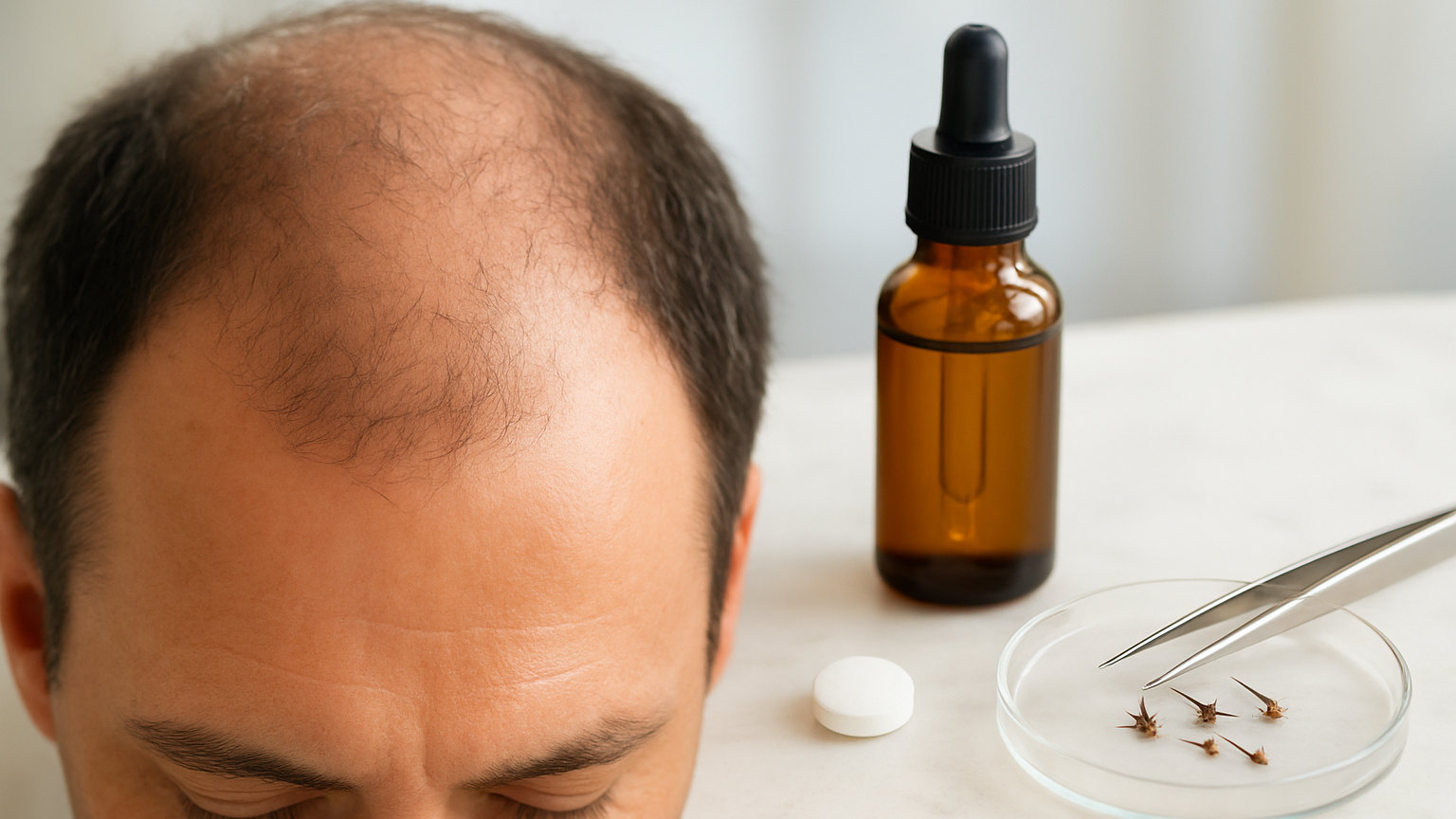
Male pattern baldness affects a substantial majority of men by later life, and the treatment landscape is unusually clear: two medications with solid evidence, one surgical option that works, and a large market of products competing on marketing rather than results.
What is actually happening?
Follicles sensitive to dihydrotestosterone, a derivative of testosterone, gradually miniaturise. Each cycle produces a shorter, finer hair until it is barely visible.
The sensitivity is genetic and inherited from both sides of the family, not solely the mother, which is a persistent myth. Testosterone levels are usually normal; it is the follicle response that differs.
The pattern is characteristic: temple recession first, then thinning at the crown, with the hair around the sides and back generally unaffected because those follicles are not DHT-sensitive.
What does finasteride do?
Inhibits the enzyme that converts testosterone to DHT, reducing scalp DHT substantially. It addresses the cause rather than the symptom, which is why it is the most effective medical treatment available.
Trials consistently show that it halts progression in the large majority of men and produces some regrowth in a substantial proportion, with results building over one to two years.
It is prescription-only in the UK, taken daily, and works only while taken. Stopping means losing the gains over the following year.
What about the side effects?
This deserves a straight answer rather than either reassurance or alarm.
Sexual side effects, including reduced libido and erectile difficulties, are reported in trials at rates of a few per cent, with placebo groups reporting similar symptoms at rates not far below. Most resolve on stopping.
There is ongoing debate about persistent symptoms after discontinuation in a small number of men, and about mood effects. The evidence is contested, and it is a genuine consideration rather than a myth to be dismissed.
It is also unsuitable for anyone whose partner may become pregnant during use in certain circumstances, and it affects PSA readings, which matters for prostate screening. Both are worth raising with the prescriber.
How does minoxidil compare?
Different mechanism, available without prescription, and reasonable as a standalone or in combination.
It prolongs the growth phase and increases follicle size rather than addressing DHT. It works better on the crown than on a receding hairline, and produces moderate regrowth in around forty per cent of users.
Used together, the two produce better results than either alone, which is a common approach.
Do hair transplants work?
Yes, and they are the only permanent option, because they move follicles from the DHT-resistant zone at the back and sides to the thinning areas. Those transplanted follicles retain their resistance.
Two techniques dominate: follicular unit extraction, which harvests individual grafts, and strip harvesting, which removes a strip and leaves a linear scar.
The important caveat is that a transplant does not stop the underlying process. Untransplanted hair continues to thin, which is why medical treatment is usually continued alongside, and why transplanting too early can produce an odd result as surrounding hair recedes further.
What does not work?
Shampoos claiming to regrow hair, which spend under a minute on the scalp. Laser combs and caps have modest evidence and are considerably weaker than the medications.
Most supplements, unless correcting a deficiency. Scalp massage helps circulation modestly and does not reverse miniaturisation. Anything described as a cure.
Platelet-rich plasma has some supporting evidence and remains less established than the standard treatments, at considerable cost.
What if you would rather not treat it?
An entirely reasonable position, and worth stating in an article of this kind. Male pattern baldness is not a disease, it carries no health consequences, and a great many men decide the treatments are not worth the commitment.
Cutting hair shorter as it thins generally looks better than working around it, and shaving it entirely is a legitimate option rather than a defeat. What is worth avoiding is spending years and a good deal of money on products with no evidence behind them, which is the outcome the market is designed to produce.


