
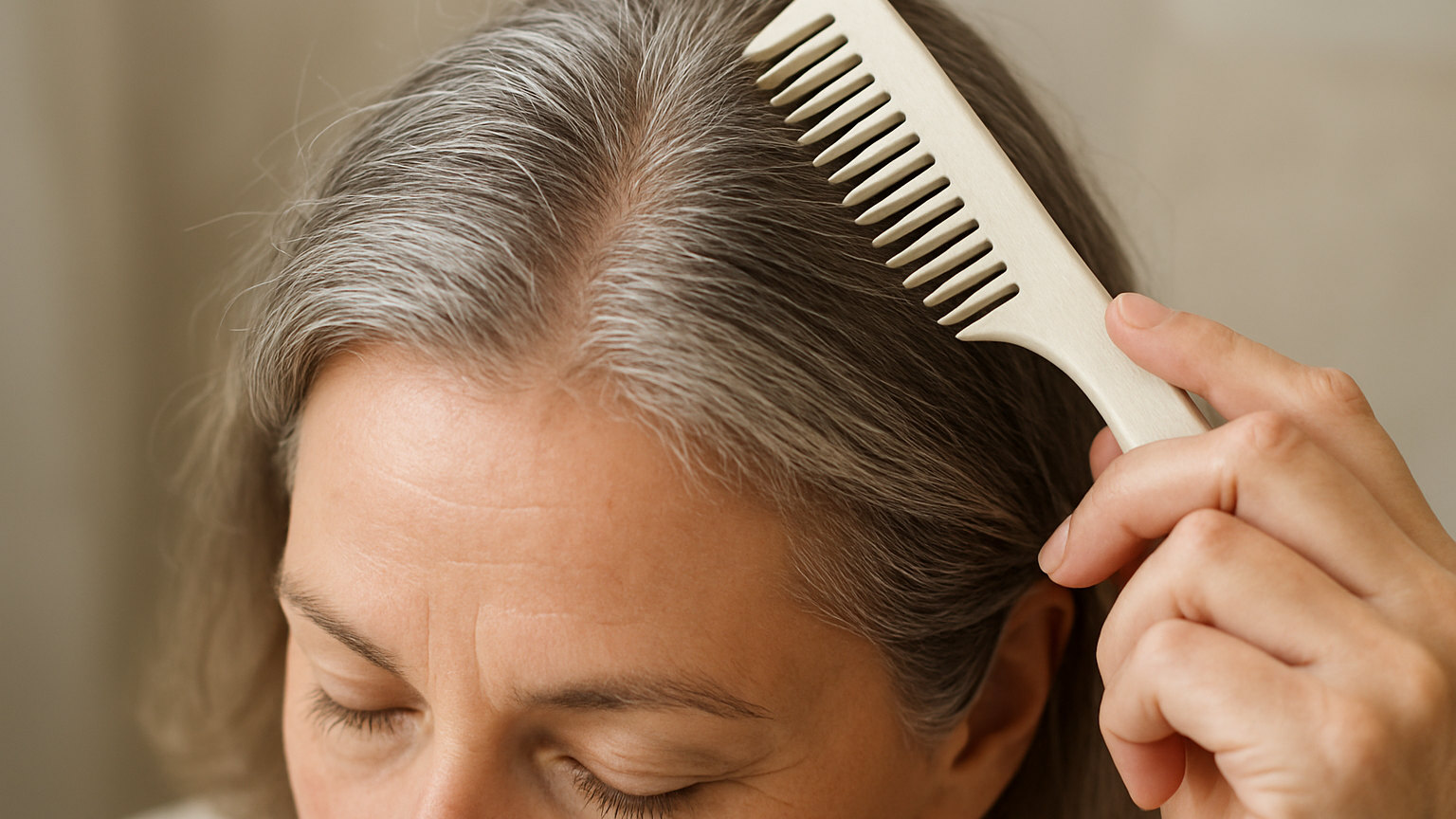
Hair changes around menopause in several ways at once, and thinning is only part of it. Texture shifts, growth slows, and hair appears in places it did not before, all through the same underlying change.
What does oestrogen do for hair?
It prolongs the growth phase of the hair cycle, which means more follicles are actively growing at any time and each hair grows for longer before being shed.
It also supports the scalp as skin, maintaining thickness, hydration and the sebum production that conditions the hair as it emerges.
As oestrogen falls, the growth phase shortens and the resting phase lengthens. More follicles are resting at once, and each hair achieves less length before shedding.
Why does the balance with androgens matter?
Because androgen levels decline much more slowly than oestrogen does, the ratio shifts even though nothing has risen.
In follicles that are genetically sensitive to androgens, that shift accelerates miniaturisation, which is why female pattern hair loss so often becomes noticeable around this time.
The same shift explains why facial hair appears on the chin and upper lip at the same moment scalp hair thins, which is a genuinely unfair combination and a straightforwardly hormonal one.
What changes besides density?
Texture, frequently. Hair often becomes finer in diameter, drier and more prone to breakage, and curl pattern can change in either direction.
Greying accelerates, and grey hair has a different texture, typically coarser and more resistant to styling, because the melanocytes that produce pigment also influence the structure of the shaft.
Scalp skin becomes drier and thinner, which can produce itching or flaking that was not there before.
Does HRT help?
It can, and it is not prescribed for hair.
Systemic hormone replacement can improve hair density and quality for some women, particularly when started close to menopause, by restoring some of the oestrogen effect on the hair cycle.
The choice of progestogen matters, since more androgenic ones may not help and occasionally make matters worse. That is worth raising specifically with a prescriber.
HRT is prescribed on the basis of menopausal symptoms and individual risk, and hair is a reasonable thing to mention within that conversation rather than the reason for it.
What else should be ruled out?
This matters, because attributing everything to menopause is the commonest way a treatable cause gets missed.
Thyroid disease becomes more common with age and causes identical diffuse thinning. Iron deficiency persists in women with heavy or irregular perimenopausal bleeding. Vitamin D deficiency is widespread.
Frontal fibrosing alopecia is a scarring condition that predominantly affects postmenopausal women, causing a receding hairline and loss of eyebrows. It is irreversible, increasingly recognised, and needs early diagnosis, so a receding hairline at this age should be assessed rather than assumed.
What treatments are available?
Topical minoxidil, which has the best evidence for female pattern loss and can be used alongside HRT.
Spironolactone, prescribed off-label, which blocks androgen receptors and is often better tolerated after menopause since contraception is no longer a consideration.
Correcting any deficiency identified by blood tests. And treating the scalp as skin that has become drier and more fragile, with gentler shampoo and less frequent heat.
What helps with appearance?
A cut that works with reduced density rather than against it, usually shorter and with layers that create volume rather than long lengths that emphasise thinness.
Root powders and fibres, which conceal a widening parting effectively. Volumising products at the roots only.
Colouring can help, since it swells the shaft slightly and makes hair appear thicker, though it also damages, so the trade depends on how fragile the hair already is.
Does it affect body and facial hair too?
Yes, in opposite directions, which is the part people find hardest to accept. Scalp hair thins while facial hair on the chin and upper lip becomes coarser and more noticeable.
Both follow from the same shift in the ratio between oestrogen and androgens, since facial follicles respond to androgens by growing thicker while scalp follicles respond by miniaturising. Body hair on the arms and legs often reduces at the same time. None of it indicates anything has gone wrong beyond the ordinary hormonal change.


