
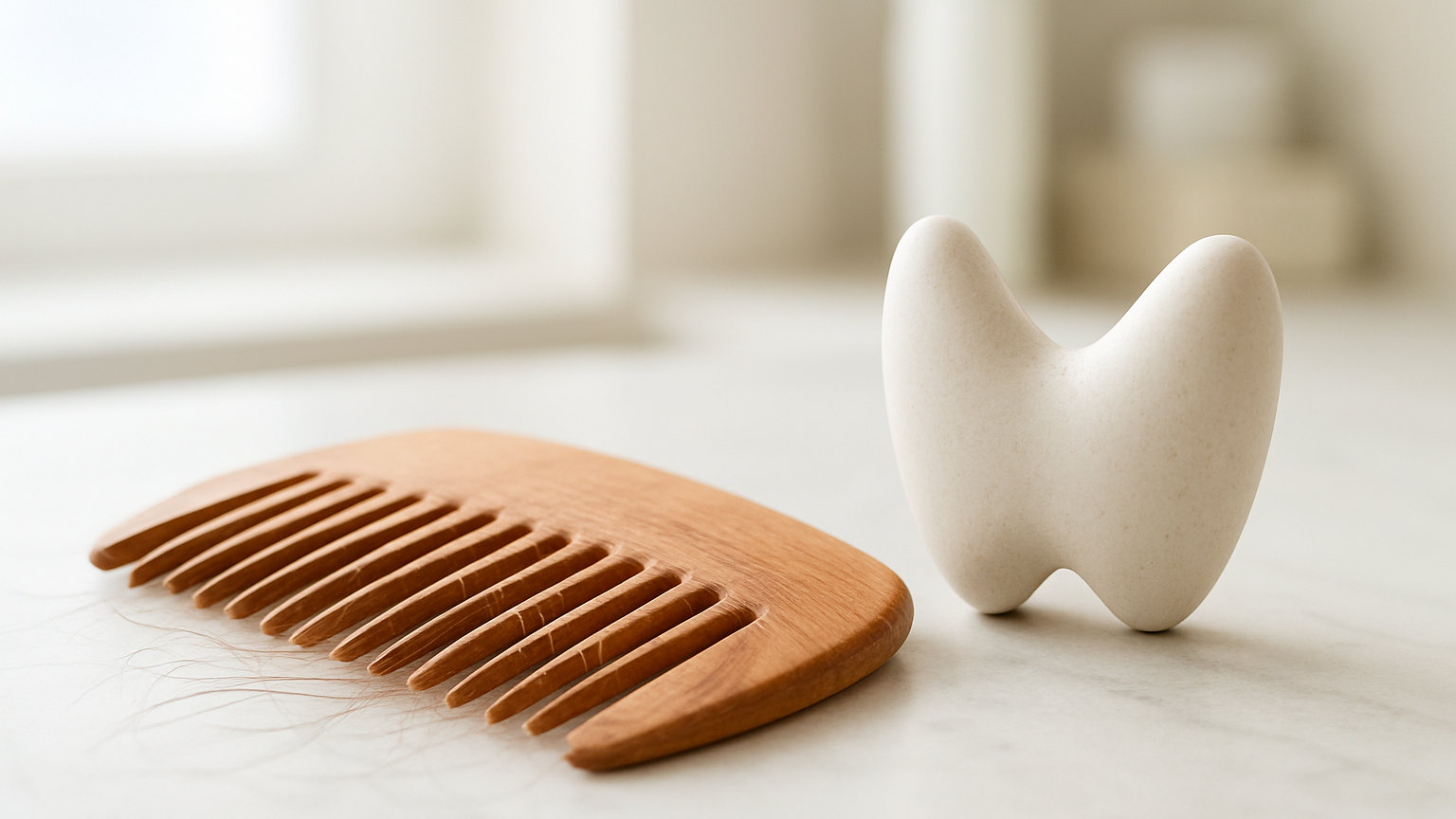
Thyroid disease is one of the most common treatable causes of diffuse hair loss, and hair is frequently the symptom that finally prompts someone to seek testing after months of attributing everything else to being busy or getting older.
Why does the thyroid affect hair?
Thyroid hormones regulate metabolic rate in essentially every tissue, including the follicle. Hair follicles contain some of the fastest-dividing cells in the body and are correspondingly sensitive to metabolic disruption.
When thyroid hormone is too low or too high, follicles are pushed prematurely into the resting phase. The result is diffuse shedding across the whole scalp rather than in patches.
What does an underactive thyroid do?
Hypothyroidism produces diffuse thinning, often alongside hair that becomes dry, coarse and brittle.
The most distinctive sign is loss of the outer third of the eyebrows, which is a classic finding and one worth checking in a mirror. Body hair may also thin.
It usually comes with other symptoms: fatigue, weight gain, feeling cold, constipation, dry skin, low mood and slowed thinking. Any of those alongside hair thinning makes testing straightforwardly worthwhile.
What does an overactive thyroid do?
Hyperthyroidism causes diffuse thinning too, though the hair is more often fine and soft rather than coarse.
Accompanying symptoms differ: weight loss, feeling hot, palpitations, anxiety, tremor, loose stools and difficulty sleeping. The hair effect can be just as pronounced as with an underactive thyroid, which surprises people who associate hair loss only with hypothyroidism.
Which tests should you ask for?
TSH as the starting point, since it is the most sensitive early marker. Free T4 alongside it, since TSH alone can occasionally mislead.
Thyroid antibodies, particularly TPO antibodies, if autoimmune thyroid disease is suspected, which is the commonest cause in the UK.
It is worth requesting ferritin and vitamin D at the same appointment, since iron deficiency frequently coexists and produces the same shedding, and treating one while the other continues is a common reason for disappointing progress.
What if the result is borderline?
This is a genuinely contested area. Subclinical hypothyroidism, where TSH is raised but T4 remains normal, may or may not be treated depending on the level, symptoms and antibody status.
Some people with results at the edge of the reference range do have symptoms, and reference ranges are population statistics rather than individual optima. It is a reasonable conversation to have with a GP rather than a settled matter, and repeat testing after a few months is often more informative than a single reading.
How long before hair improves after treatment?
Longer than the blood results take to normalise, which catches people out.
Thyroid levels can correct within weeks of starting treatment. Hair typically takes three to six months to stop shedding and six to twelve months for visible regrowth, because the follicle cycle has to complete.
Some people notice a temporary increase in shedding shortly after starting thyroid treatment, as the cycle resynchronises. It settles.
Can the treatment itself cause hair loss?
Levothyroxine lists hair loss as a possible side effect, usually in the first few months, and it is generally transient.
Carbimazole, used for an overactive thyroid, can also cause it. In both cases it is worth discussing with the prescriber rather than stopping, since untreated thyroid disease affects hair considerably more than the medication does.
What should you do while waiting?
Handle hair gently, avoid tight styles and heat, and keep the lengths conditioned so that what remains looks its best.
Avoid starting several supplements at once, which makes it impossible to tell what helped. And keep photographs in consistent light, since the improvement is gradual enough that people frequently fail to notice it happening.
Does hair texture change too?
Frequently, and it is one of the more disconcerting parts. An underactive thyroid tends to make hair coarser, drier and duller; an overactive one tends to make it finer and softer.
Both usually reverse once levels are stable, though it takes months rather than weeks. Curl pattern occasionally shifts and does not always return, which is worth knowing so that a permanent change is not mistaken for a sign that treatment is failing.


