
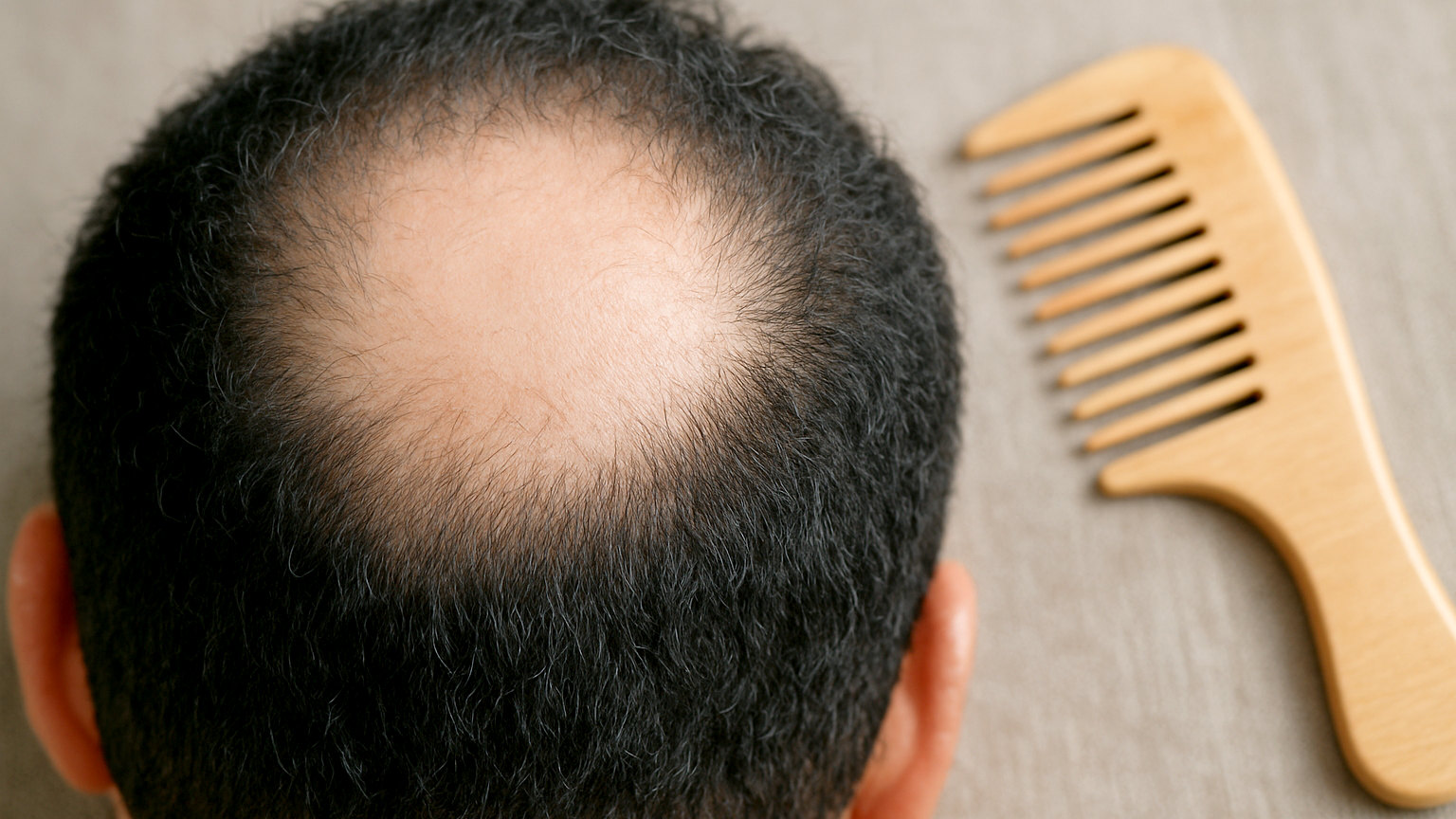
Alopecia areata is a different condition from the thinning most people mean by hair loss. It produces discrete round patches of complete loss, often appearing within days, and the underlying process is autoimmune rather than hormonal.
What causes it?
The immune system attacks the hair follicle, mistaking it for a threat. The follicle stops producing hair and enters a dormant state.
Crucially, the follicle is not destroyed. That is why regrowth is possible even after years, and why it distinguishes this condition from the scarring alopecias where the follicle is lost permanently.
The trigger is not well understood. There is a clear genetic component, and it is associated with other autoimmune conditions including thyroid disease, vitiligo and type 1 diabetes. Stress is often reported as a trigger, though many cases have none.
What does it look like?
Smooth, round or oval patches of complete hair loss, usually a few centimetres across, with normal-looking skin underneath. No redness, scaling or scarring.
At the edges of an active patch, short broken hairs that are narrower at the base than the tip, called exclamation mark hairs, are characteristic and useful diagnostically.
It can affect the scalp, beard, eyebrows, eyelashes and body hair. Nails are involved in some people, showing fine pitting or ridging.
How common is it, and who gets it?
It affects roughly one to two per cent of people at some point, which makes it considerably more common than most people assume.
It can begin at any age and frequently starts in childhood or early adulthood. It affects men and women roughly equally, and all ethnic groups.
Does hair grow back?
Often, and unpredictably. Many people with a single patch see spontaneous regrowth within six to twelve months without any treatment.
Regrowth often comes back white or fine at first and gains colour and thickness over subsequent months, which is normal and not a sign of a problem.
It also recurs in a substantial proportion of people, sometimes years later. More extensive involvement at the outset, onset in childhood, and involvement of the hairline at the nape are all associated with a less predictable course.
What are the more extensive forms?
Alopecia totalis, meaning complete loss of scalp hair, and alopecia universalis, meaning loss of all body hair including eyebrows and eyelashes.
These are less common and harder to treat. Loss of eyelashes and nasal hair has practical consequences beyond appearance, since both serve a protective function, which is worth mentioning to a clinician rather than treating as purely cosmetic.
What treatments exist?
For limited patches, topical or injected corticosteroids are the usual first approach, and intralesional injections have reasonable evidence for localised disease.
Topical immunotherapy, which deliberately provokes a mild allergic reaction to redirect the immune response, is used in specialist centres for more extensive disease.
JAK inhibitors are the significant recent development, with genuine efficacy in severe alopecia areata, and access varies. They are specialist prescriptions with monitoring requirements and are not a casual option.
Minoxidil is sometimes used alongside other treatments to support regrowth, and does not address the immune process.
What should you do first?
See a GP rather than treating it yourself, both to confirm the diagnosis and to check for associated conditions. Thyroid function and iron are commonly tested, and other autoimmune conditions are worth screening for.
Sudden patchy loss should always be assessed rather than watched, since fungal infection of the scalp and scarring alopecias can look similar and are managed quite differently.
What about the psychological side?
It deserves proper weight. Alopecia areata is unpredictable, visible and often begins young, and the impact is frequently out of proportion to how it is treated medically.
Alopecia UK and similar organisations provide support and practical advice on wigs and coverings, some of which is available through the NHS. Asking a GP about that is entirely reasonable, and distress about it is a legitimate reason to seek help rather than something to justify.


