
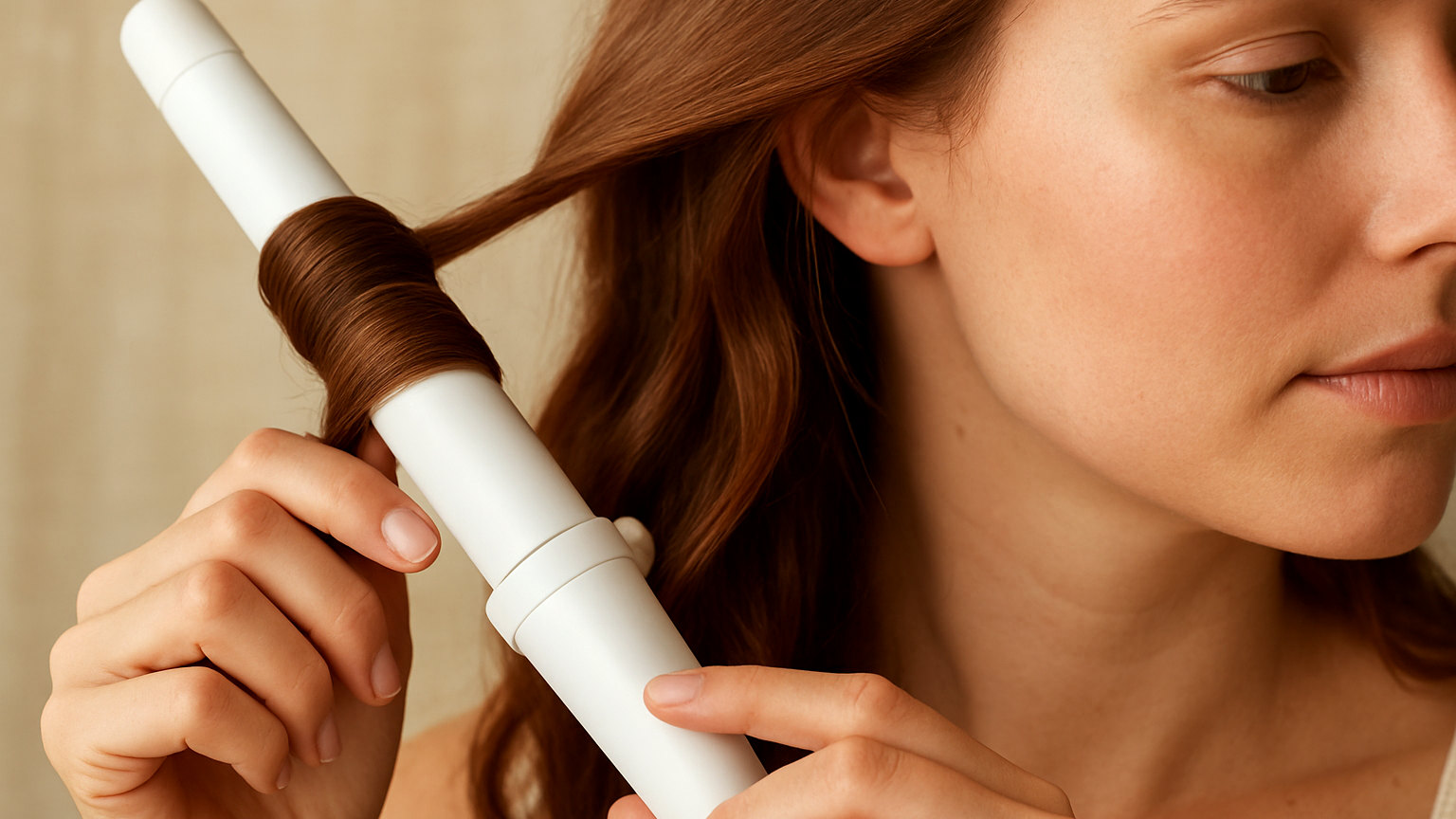
Curling is more forgiving than straightening and considerably more variable in result. The direction you wrap and the size of the section decide the outcome far more than the tool does.
What is the difference between a wand and tongs?
Tongs have a clamp; a wand does not. Tongs hold the end of the section for you, which is easier, and the clamp can leave a crease at the ends.
A wand gives a more natural result with no crease, at the cost of holding the section yourself, which means either a heatproof glove or careful hand placement.
Both work by the same mechanism. A wand is generally better for loose waves, tongs for defined ringlets.
Which barrel size should you use?
The barrel diameter determines curl size directly. A 13mm barrel gives tight ringlets, 19mm gives defined curls, 25mm gives classic curls, 32mm gives loose waves and 38mm or above gives soft bends.
A tapered wand, wider at the base and narrower at the tip, produces varied curl sizes within one section, which reads as more natural.
As a rough guide, choose a barrel roughly the size of the curl you want, remembering that curls loosen as they cool and settle.
Which direction should you wrap?
This is the detail that separates a natural result from an obviously curled one.
Wrapping all sections in the same direction produces uniform, deliberate curls suited to a polished look. Alternating direction between sections, some toward the face and some away, produces a more natural, undone texture.
Wrapping away from the face at the front opens up the face and is the standard approach for soft waves.
What temperature and section size?
The same principles as straightening: 150 to 170 for fine or damaged hair, 170 to 190 for normal, up to 200 for coarse.
Sections roughly two to three centimetres wide. Thicker sections do not heat through and drop out within an hour; thinner sections give tighter, longer-lasting curls.
Hold for eight to ten seconds. Longer does not improve the curl and does increase damage.
What is the technique?
Start with completely dry hair and heat protectant applied earlier at the damp stage. Section the hair, working from underneath upward.
Wrap from partway down the section rather than from the root, leaving the last couple of centimetres of the ends out for a more natural finish, or including them for a defined ringlet.
Slide the section off the barrel while holding its shape, then catch it in your palm and hold for a few seconds while it cools.
That last step matters more than anything else. Curls set as they cool, and catching them rather than letting them drop makes the difference between curls that last four hours and twelve.
How do you finish them?
Let everything cool completely, ten minutes at least, before touching. Pinning each curl to the head while it cools produces the longest-lasting result.
Then either leave them defined, separate them gently with fingers for a softer look, or brush them out with a paddle brush for smooth waves.
A light texture spray or hairspray at the end. Applying product before the curls have cooled makes them drop.
Why do curls drop out?
Hair that was not completely dry. Sections too thick. Not letting curls cool before touching them, which is the most common cause.
Fine, very straight or low-porosity hair, which holds any set poorly and needs texture spray or mousse for grip.
Freshly washed clean hair, which is slippery. Second-day hair holds curls considerably better.
And humidity, which breaks the hydrogen bonds holding the shape and returns hair to its natural pattern.
Should you curl clean or dirty hair?
Second-day hair, generally, and this surprises people. Freshly washed hair is slippery and has no grip, so curls slide out within hours.
If you must curl on wash day, add a texture spray, dry shampoo or mousse first to provide the friction the hair is missing. Applying dry shampoo to clean hair purely for grip is a legitimate technique rather than a contradiction.


