
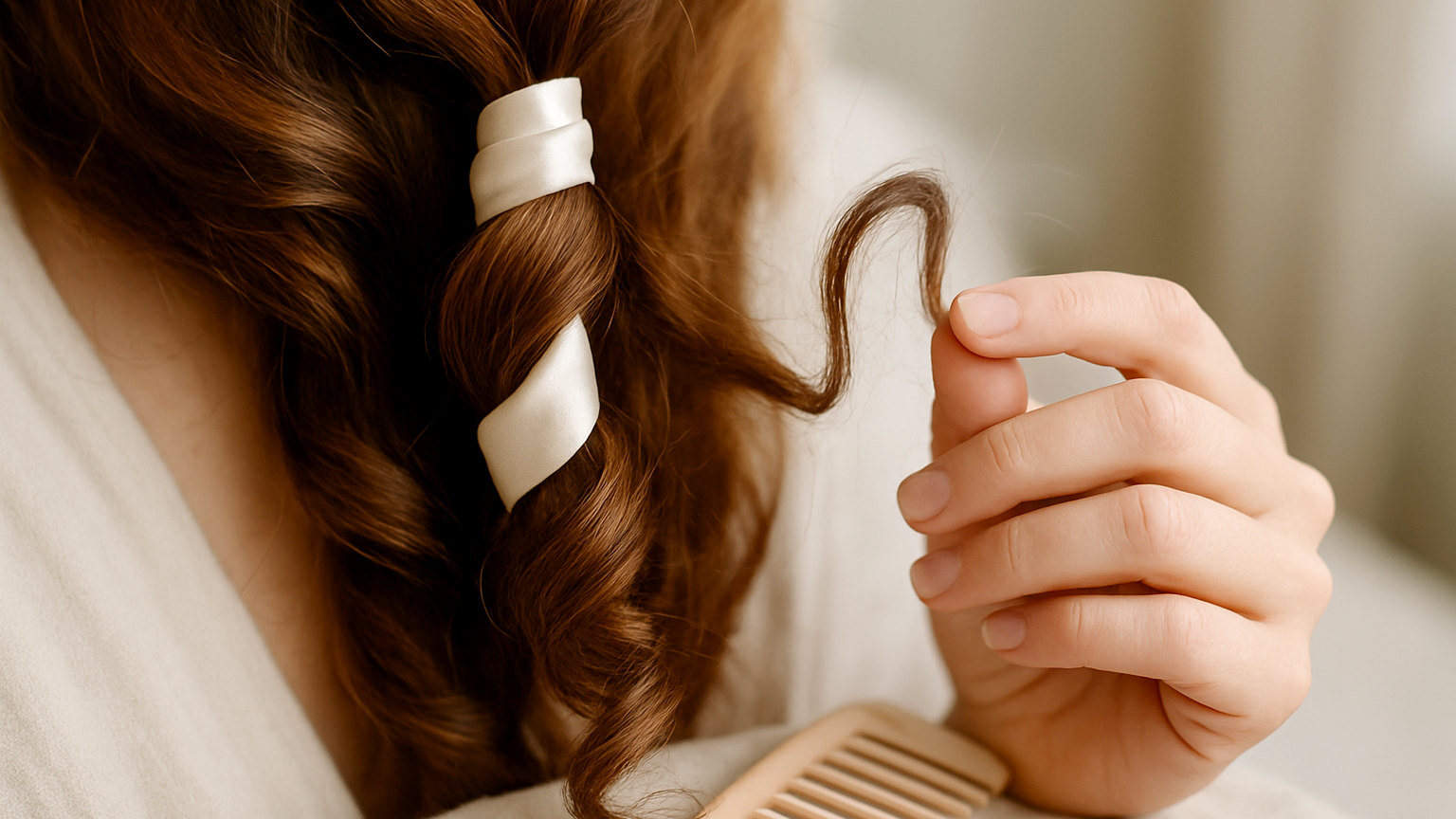
Heatless curling works by the same mechanism as heat styling, more slowly and without the damage. Whether it suits you depends mostly on your hair type and on how much time you are willing to give it.
How does it work?
Hair is held in shape by hydrogen bonds, which break when hair is wet and reform as it dries. Whatever shape the hair is in while it dries is the shape those bonds set into.
Heat styling does the same thing faster by evaporating water rapidly. Heatless methods rely on hair drying slowly in the shape you have wrapped it in.
This is why the essential requirement is that hair must be damp when wrapped and completely dry when unwrapped. Everything else is technique.
Which methods work best?
Robe or ribbon curls, where hair is wrapped around a fabric tube along the head, produce large uniform waves and are comfortable to sleep in.
Sock or headband curls, wrapping sections around a headband, give a similar result with something most people already own.
Foam or fabric rollers give tighter, more traditional curls and more root lift, which the wrapping methods do not provide.
Plaits give waves rather than curls: two plaits give loose waves, many small plaits give a crimped texture. Twisting sections into buns gives soft waves.
How damp should hair be?
Around eighty per cent dry, which is the detail that determines success.
Soaking hair will not dry overnight, and hair that is still damp in the morning drops out within an hour. Bone-dry hair has no hydrogen bonds to reform and holds nothing.
Damp to the touch but not dripping is the target. If hair is fully wet, rough dry it first.
Why do they drop out?
Hair not being completely dry when unwrapped, which is the most common reason by a distance.
Sections that are too large, which cannot dry through. Wrapping too loosely. Fine or very straight hair, which holds any style poorly.
Brushing them out immediately, or handling them before they have cooled and settled. And no product, since hair with nothing on it has nothing to hold the shape.
What products help?
A setting lotion, mousse or a light gel applied to damp hair before wrapping, which adds the polymer film that holds the shape.
A texture spray or hairspray after unwrapping, applied lightly and from a distance.
Avoid anything heavy, including oils and rich creams, which weigh the curl down and prevent it setting.
How do you make them last?
Unwrap gently, section by section, rather than pulling everything out at once. Let the curls hang and cool for ten minutes before touching them.
Separate with fingers rather than a brush. A brush will produce a smoother wave or destroy the curl entirely depending on the method.
Set with a light hairspray at the end rather than the beginning. And on day two, refresh with a little water mist and re-scrunch rather than restyling from scratch.
Which hair types do they suit?
Wavy and slightly curly hair holds them best, since the hair already wants to bend.
Thick straight hair can hold them well with enough product and drying time. Fine straight hair struggles, since it lacks the structure to hold any set, and coloured or slightly damaged hair often holds better than virgin hair because of the added grip.
Very curly hair does not need them, and heatless methods are used there for stretching rather than curling.
Are they genuinely better than heat?
For hair health, unambiguously. No heat means no water vaporising inside the shaft and no keratin degradation.
The trade is time and predictability. A heatless set takes six to eight hours and the result varies with how damp the hair was and how well it dried, where a curling tong takes twenty minutes and does the same thing every time.
For anyone with damaged, bleached or fragile hair, that trade is clearly worth making.


