
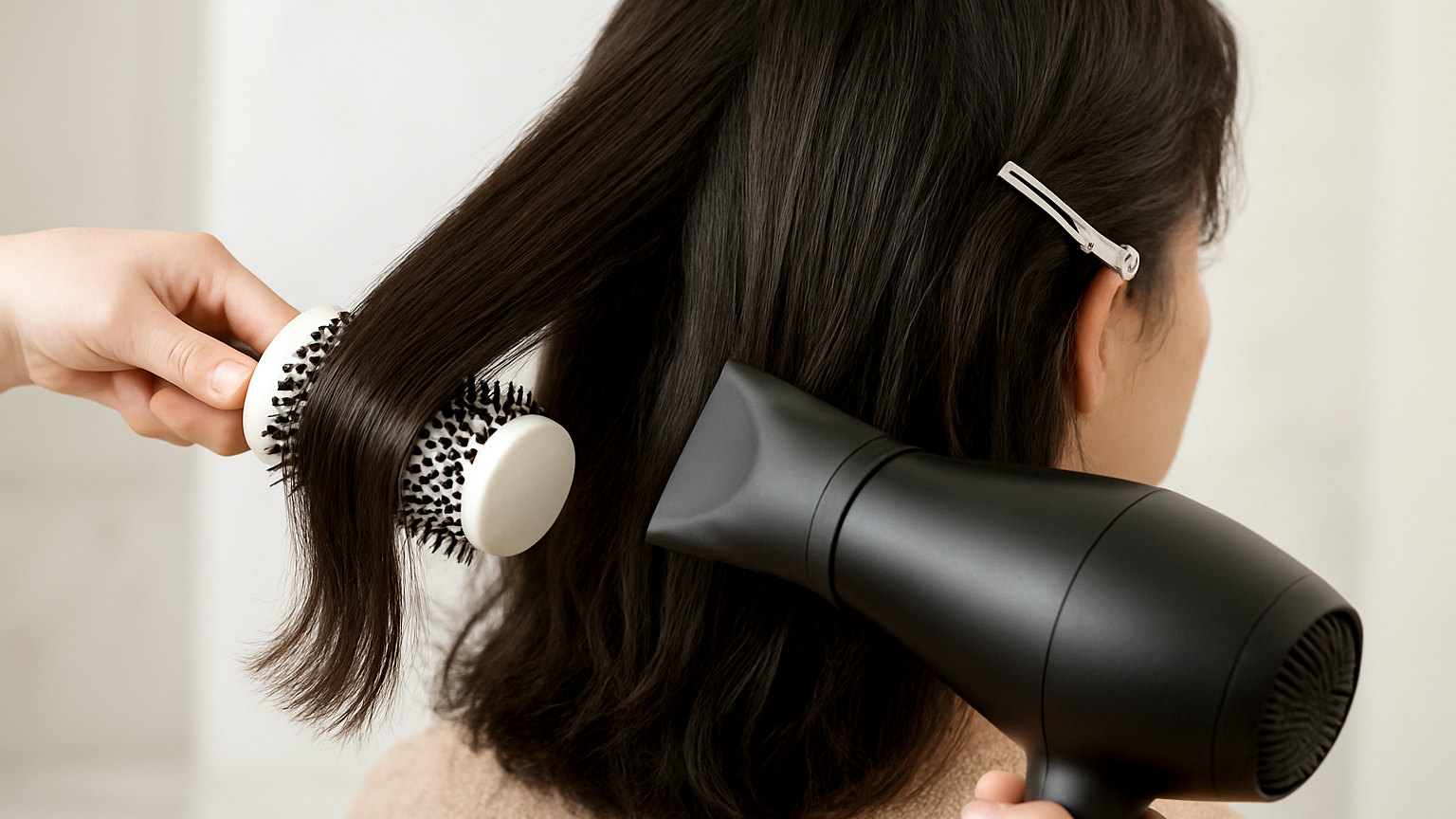
The gap between a salon blow dry and a home one is mostly sequence and airflow direction. Both are learnable, and neither requires an expensive dryer.
What should you do before starting?
Let hair dry naturally to around eighty per cent first. This reduces both the time and the temperature needed, and it is the single largest reduction in damage available.
Apply heat protectant to damp hair and comb it through so it is evenly distributed. Add a volumising mousse at the roots or a smoothing cream on the lengths depending on what you want.
Detangle fully before any heat, since working through knots with a brush and a dryer causes considerably more breakage than doing it beforehand.
Why does airflow direction matter?
Because the cuticle lies in one direction, from root to tip, like roof tiles.
Directing air down the shaft encourages the cuticle to lie flat, which produces shine and smoothness. Directing it upward roughs the cuticle open, which produces frizz.
This is what the nozzle is for, and leaving it off is why home blow dries frizz. It concentrates airflow so you can aim it, and it should point downward along the hair.
What temperature should you use?
The lowest that gets the job done, and lower than most people use. Medium heat with high airflow dries as quickly as high heat with low airflow, and does less damage.
Hold the dryer around fifteen centimetres from the hair and keep it moving. Holding it still on one section is what causes localised damage.
Finish each section with the cool shot, which sets the cuticle flat and helps the style hold. It is one of the few dryer features that does exactly what it claims.
What is the right sequence?
Rough dry first, without a brush, until hair is around eighty per cent dry. Using a brush on soaking hair is wasted effort and causes stretching.
Then section: bottom layers first, clipping the rest up. Work from the nape upward, finishing with the top layers and the front, which is what people see.
Each section should be fully dry before moving on. Hair that is still damp when you finish will revert as it dries.
How do you use a round brush?
Take a section no wider than the brush. Place the brush underneath at the root, direct the nozzle at the root from above, and pull the brush slowly down the length with the dryer following.
For volume, lift the section straight up from the scalp and dry the root that way, which is where volume comes from. For smoothness, pull the section taut and directly downward.
Rotate the brush at the ends to create a bend inward or outward.
A larger barrel gives a smoother, straighter result; a smaller barrel gives more curl and lift.
How do you make it last?
Make sure hair is completely dry and completely cool before touching it or tying it up. Warm hair is still in a malleable state and will drop.
Let it cool fully, ideally for ten minutes, before brushing through. Rollers set at the crown while you finish getting ready hold volume remarkably well.
A light hairspray or texture spray at the roots. And sleeping in a loose bun on top of the head, sometimes called plopping or pineappling, preserves a blow dry for a second day.
Does the dryer itself matter?
Airflow matters more than heat or price. A dryer with strong airflow dries faster at a lower temperature, which is the goal.
Ionic dryers reduce static and can speed drying, which suits thick or frizzy hair and can leave fine hair flat. A diffuser is essential for curly hair and pointless for straight.
A dryer without a temperature control, running at whatever it reaches, is the worst option regardless of what it costs.
How long should it take?
Fifteen to twenty-five minutes for most hair, once it has air dried to eighty per cent. Considerably longer than that usually means the sections are too large or the airflow is too weak.
Working in smaller sections feels slower and finishes faster, because each section dries properly the first time rather than needing a second pass. If you find yourself going back over areas that have reverted, the sections were too big.


