
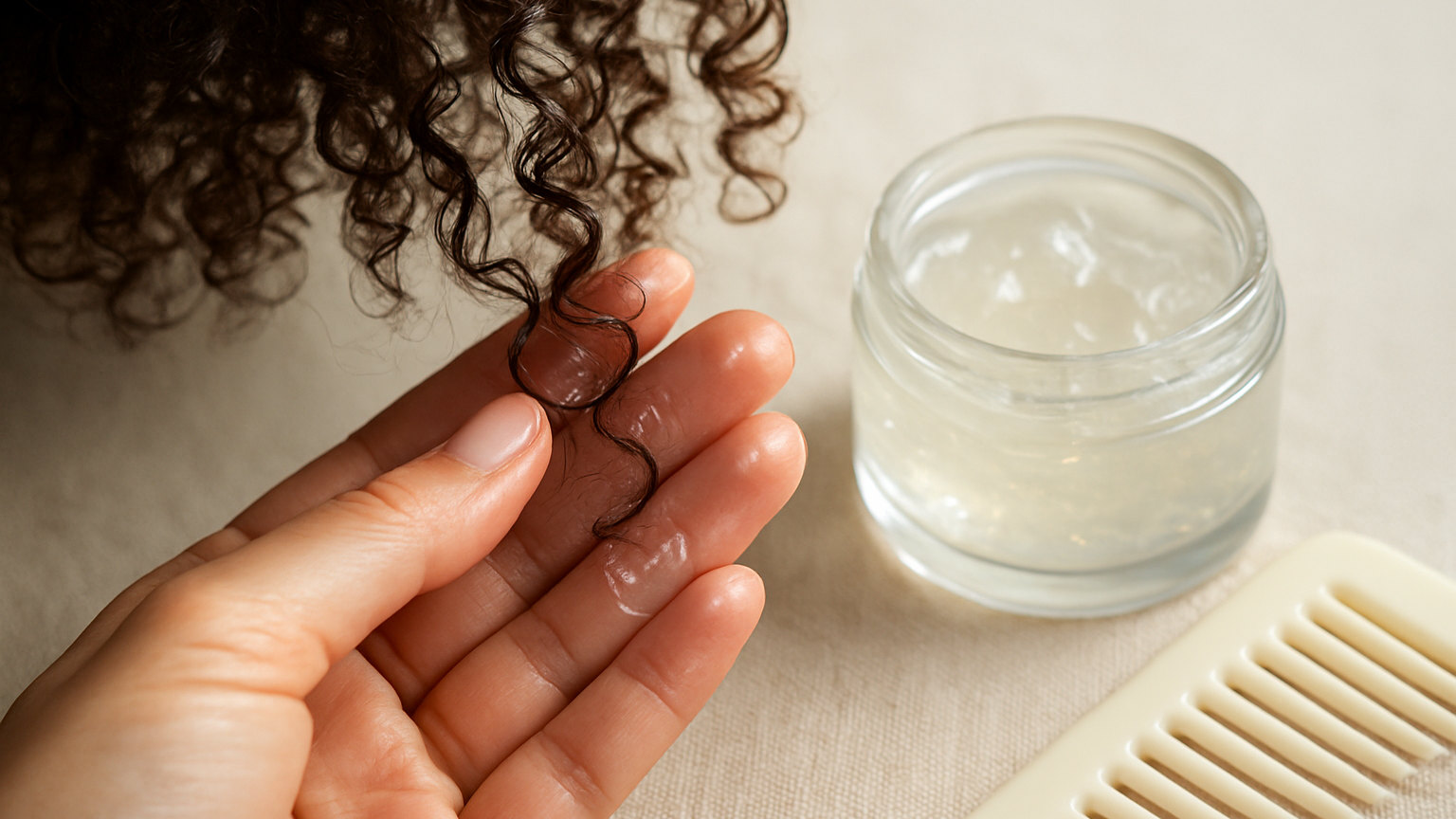
Curly hair needs close to the opposite of standard styling advice, and two rules account for most of the difference: apply products to soaking wet hair, and stop touching it while it dries.
Why does curly hair behave differently?
Because sebum cannot travel easily down a curved shaft, so curly hair is drier by default rather than through neglect.
The bends in the shaft also create weak points where the cuticle lifts naturally, which means curly hair is more porous and more prone to breakage even undamaged.
And curl formation depends on hydrogen bonds, which are set as hair dries. Whatever shape the hair is in while drying is the shape it keeps.
Why apply products to soaking wet hair?
Because water is what forms the curl. Product applied to damp hair sets a partly collapsed curl pattern; product applied to soaking hair sets the full one.
The most effective approach is applying leave-in and styler while still in the shower, or immediately after, with water still running out of the hair.
This feels wrong and produces noticeably better definition, which is why it is the first thing most curly hair guides insist on.
What is the product order?
Leave-in conditioner first, distributed by raking or smoothing through sections.
Then a curl cream for moisture and softness, or a gel for hold and definition, or both with the cream first. Apply by praying hands, smoothing between flat palms down the section, then scrunching upward.
Scrunching encourages the curl to spring; raking separates and elongates. Which you use depends on whether you want definition or length.
How should you dry it?
Squeeze gently with a microfibre towel or cotton t-shirt, never rub. Plopping, where hair is wrapped on top of the head in a t-shirt for ten to twenty minutes, removes water while preserving curl shape.
Then either air dry undisturbed, or diffuse on low heat and low speed. Cup sections into the diffuser and hold rather than moving it around, which disturbs the pattern.
The single most important rule while drying is not to touch it. Every touch breaks the forming curl clumps and creates frizz.
What is a cast, and should you break it?
Gel dries into a hard shell around the curl, which locks the shape in place while it finishes drying. That is a cast, and it means the gel is working.
Once hair is completely dry, scrunch gently with a little oil on your palms to break the cast. The curls underneath are soft and defined rather than crunchy.
Breaking it while hair is still damp undoes the set and produces frizz, which is the most common reason people conclude gel does not suit them.
How do you preserve curls overnight?
Pineappling: gathering hair loosely on top of the head with a soft scrunchie, which keeps the curls off the pillow.
A silk or satin pillowcase or bonnet, which reduces the friction that causes overnight frizz. Loose plaits for looser curl patterns.
In the morning, refresh with a light mist of water and a little leave-in rather than rewashing, scrunching to reform the pattern.
What causes frizz in curly hair?
Touching it while drying, most of all. Brushing dry curls, which separates every clump. Terry towelling. Sleeping on cotton.
Insufficient moisture, since dry hair draws water from humid air and swells. Damage, since a raised cuticle catches on neighbouring strands.
And in humid conditions, humectants such as glycerin can draw in more moisture than the hair can handle, which is why a product that works in winter can fail in August.
Does the curly girl method matter?
It codified useful principles: avoid harsh sulfates, avoid heat, apply products to soaking hair, and stop brushing dry curls.
The stricter rules, particularly avoiding all silicones and all sulfates, are more contested than the method suggests. Water-soluble silicones rinse out with a gentle shampoo, and some scalps need a proper cleanser.
Take the technique and treat the ingredient bans as optional rather than obligatory.


