
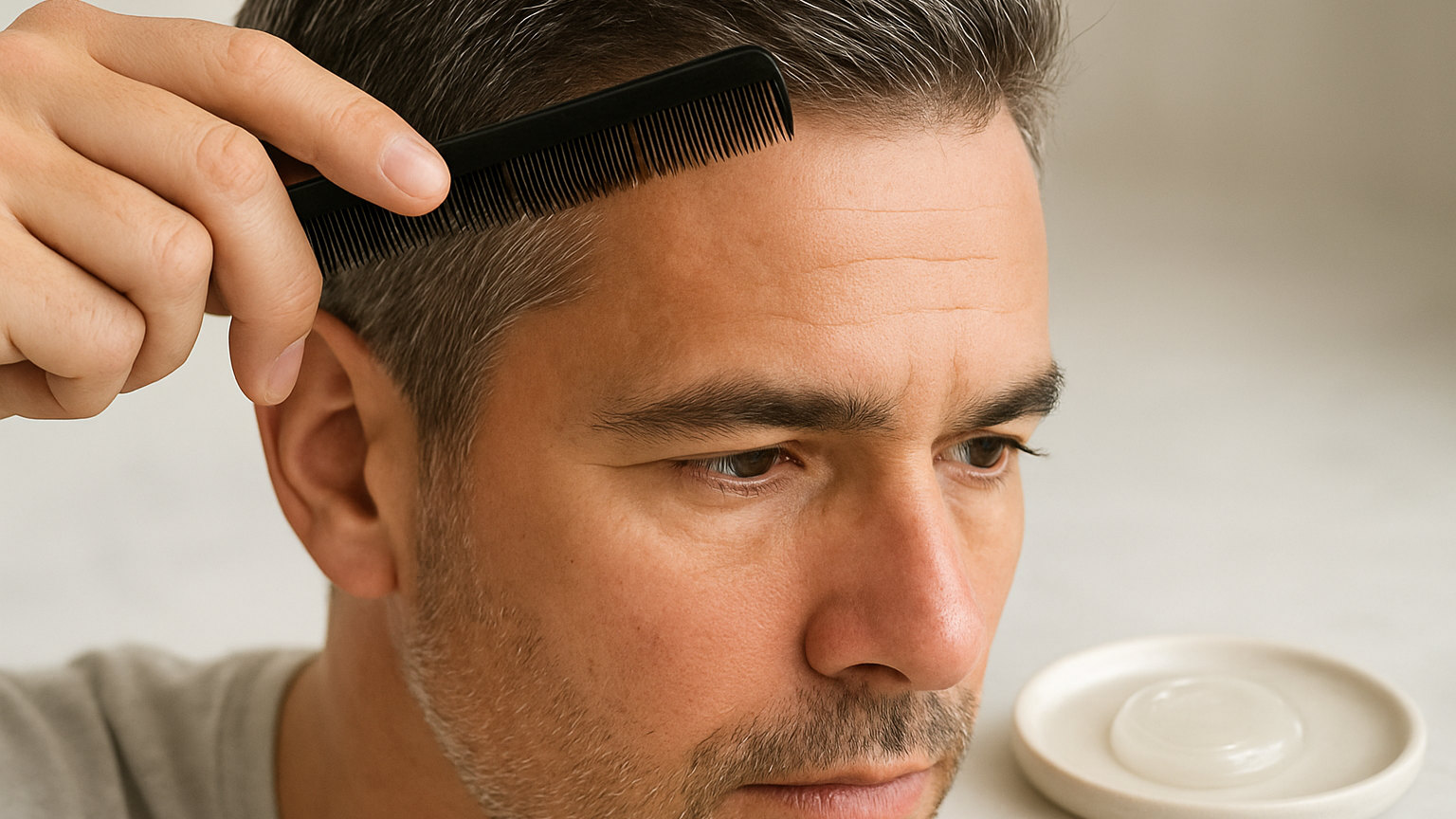
Short hair takes less time to style and offers less forgiveness. Every section is visible, there is no length to disguise a mistake, and the difference between a good day and a bad one is often a matter of a few millimetres of product.
What products suit short hair?
Texture and hold rather than smoothing. Wax, clay and paste for definition and separation. Texture spray and sea salt spray for a looser finish.
Mousse at the roots on damp hair for volume before drying. A light hairspray to finish.
What generally does not work is anything heavy: rich creams, oils and serums weigh short hair down quickly and there is not enough length to carry them.
How much should you use?
A pea-sized amount at most, and less for fine hair. This is the most common error with short hair, since the same amount that disappears into long hair sits visibly in a crop.
Warm it thoroughly between the palms until it is almost invisible, then apply with fingertips from the ends inward rather than starting at the roots.
Build up if needed. Removing excess product means washing it out.
How do you create volume?
At the root, while drying. Blow dry with fingers, pushing hair against its natural direction and lifting at the crown.
Mousse or a root-lift spray applied to damp roots before drying. Volumising powder at the roots on dry hair for immediate lift.
Changing the parting, or drying with no parting and creating one afterwards, adds noticeable lift at the front.
How do you add texture?
Texture is what makes short hair look deliberate rather than flat. Work a small amount of wax or clay through with fingertips, pinching sections between fingers to separate them.
A texture spray after drying, scrunched through. For a piecey finish, twist small sections between the fingers.
Avoid brushing after styling, which removes separation and returns hair to a uniform shape.
How do you style a bob?
Blow dry with a round brush, directing the ends under for a classic finish or slightly outward for a more modern one.
Straighteners used with a slight turn at the ends rather than pressed straight give a softer line. A wand on the mid-lengths and ends only, alternating direction, gives a lived-in texture.
Tucking one side behind an ear changes the shape entirely and costs nothing.
What about a pixie or crop?
Mostly product and finger drying. Damp hair, a small amount of mousse or a light lotion, then dried roughly with fingers pushing in the direction you want it to sit.
Wax or clay applied to the tips only for definition. Nothing at the roots except volumising product.
Short hair shows regrowth quickly, so a crop generally needs cutting every four to six weeks to keep its shape, which is worth factoring in before committing.
How do you manage growing it out?
Reshaping rather than waiting. Regular trims that adjust the shape as it grows prevent the stage where the cut loses its structure entirely.
The awkward phases are around the ears and at the nape, both of which can be addressed by a stylist tidying those areas while letting the top grow.
Accessories genuinely help: headbands, clips and scarves cover the transitional lengths that will not sit properly.
Does short hair need less care?
Less conditioning, since the ends are younger and less damaged. More frequent cutting, more frequent washing for many people, and more attention to the scalp, which is more exposed.
Sun protection matters more, since the scalp and neck are less covered. A hat or a scalp sunscreen along the parting is worth having.
What suits different face shapes?
Less rigidly than the usual advice suggests, and a couple of principles hold. Height at the crown lengthens a rounder face; width at the sides broadens a longer one.
A side parting softens strong angles; a centre parting emphasises symmetry. Length around the jaw draws attention there, which suits some faces and not others.
The more useful conversation with a stylist is about your hair's natural growth pattern, particularly cowlicks and how the hairline sits, since a cut that fights those will need styling every day to work at all.


