
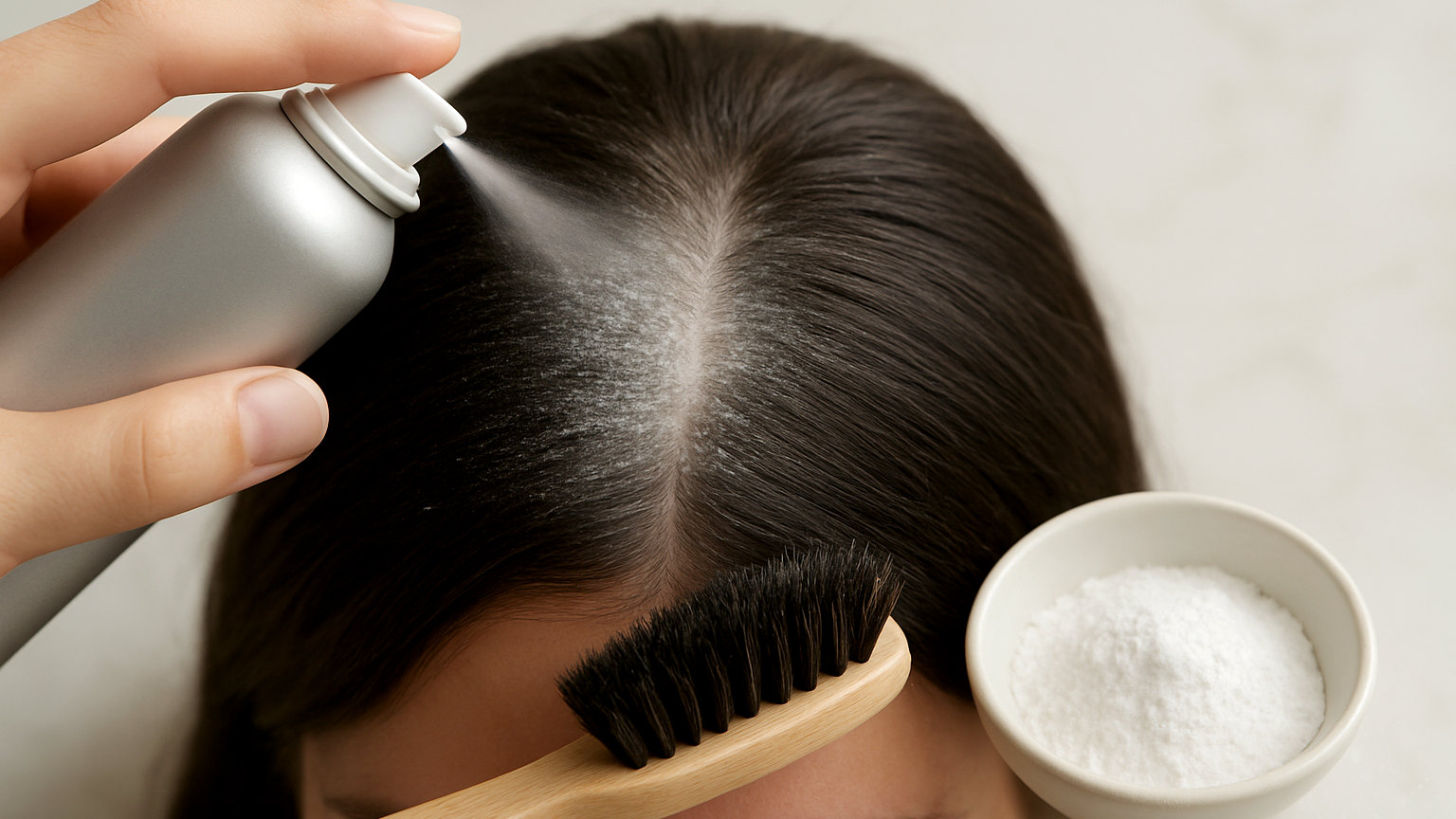
Dry shampoo does two genuinely useful things and one damaging one. The difference between them is almost entirely a matter of how many consecutive days it is used.
What does it actually do?
It absorbs oil, using starches such as rice or tapioca starch, or silica, or in older formulations talc. The powder binds surface sebum so hair looks less greasy.
It also adds texture and grip, which creates volume at the roots. This second effect is arguably more useful than the first, and it works on clean hair as well as dirty.
What it does not do is clean. Sweat, dead skin cells and product residue all remain, and the absorbed oil stays on the scalp rather than being removed.
How should you apply it?
Fifteen to twenty centimetres from the scalp, which is further than most people hold it. Closer than that deposits a concentrated patch that will not distribute.
Section the hair and spray directly at the roots in short bursts, working around the head rather than spraying the whole thing from one position.
Then wait. This is the step almost everyone skips: give it two to five minutes to absorb before touching it. Massaging it in immediately spreads oil rather than lifting it.
Finally, massage with fingertips and brush through to distribute and remove excess.
When is the best time to use it?
The night before, which is counterintuitive and works considerably better.
Applied before bed, it has hours to absorb, and body heat helps distribute it. You wake up with hair that looks freshly washed rather than freshly powdered, and there is no white residue to manage in the morning.
How do you avoid a white cast?
Use less than feels necessary, hold it further away, and wait before touching it.
Tinted formulations exist for dark hair and are worth the extra cost. Brushing thoroughly after waiting removes most residue. Applying at night gives it time to disappear.
If a white cast persists, the product is being applied too close and too heavily rather than being the wrong shade.
How many days in a row is too many?
Two, as a working limit. Beyond that, the powder accumulates on the scalp along with the oil it has absorbed.
That mixture blocks follicle openings and creates a layer that ordinary shampoo struggles to remove. The consequences are itching, flaking that looks like dandruff, and in some cases folliculitis.
People who use dry shampoo for four or five consecutive days routinely develop scalp problems and attribute them to something else entirely.
Does it cause hair loss?
Not directly, and prolonged heavy use can contribute indirectly. Blocked follicles and chronic scalp inflammation are not a good environment for hair growth.
The evidence that dry shampoo itself causes hair loss is weak. The sensible position is that used within limits it is harmless, and used to avoid washing for a week it creates conditions that are not.
How do you remove the build-up?
A proper wash, with shampoo applied to the scalp and massaged for a full minute. Two washes if you have used dry shampoo for several days.
A clarifying shampoo every two to four weeks if you use it regularly, since ordinary shampoo does not fully remove the accumulation.
A silicone scalp brush during washing helps lift residue without abrasion.
Is it a substitute for washing?
For a day, reasonably. As a strategy, no.
The belief that washing less is better for hair leads people to stretch washes with dry shampoo indefinitely, and the scalp pays for it. Washing when your scalp needs it, with a gentle shampoo, is better for hair than a week of dry shampoo followed by an aggressive clarifying wash.
Are aerosol or powder versions better?
Powders give more control and no propellant, and they are easier to over-apply since the quantity is harder to judge. Aerosols distribute more evenly and are quicker.
The practical difference for most people is small. What matters more is holding it far enough away and waiting before touching. If you find aerosols leave a coating regardless, a powder applied with a brush along the parting gives considerably more precision.


