
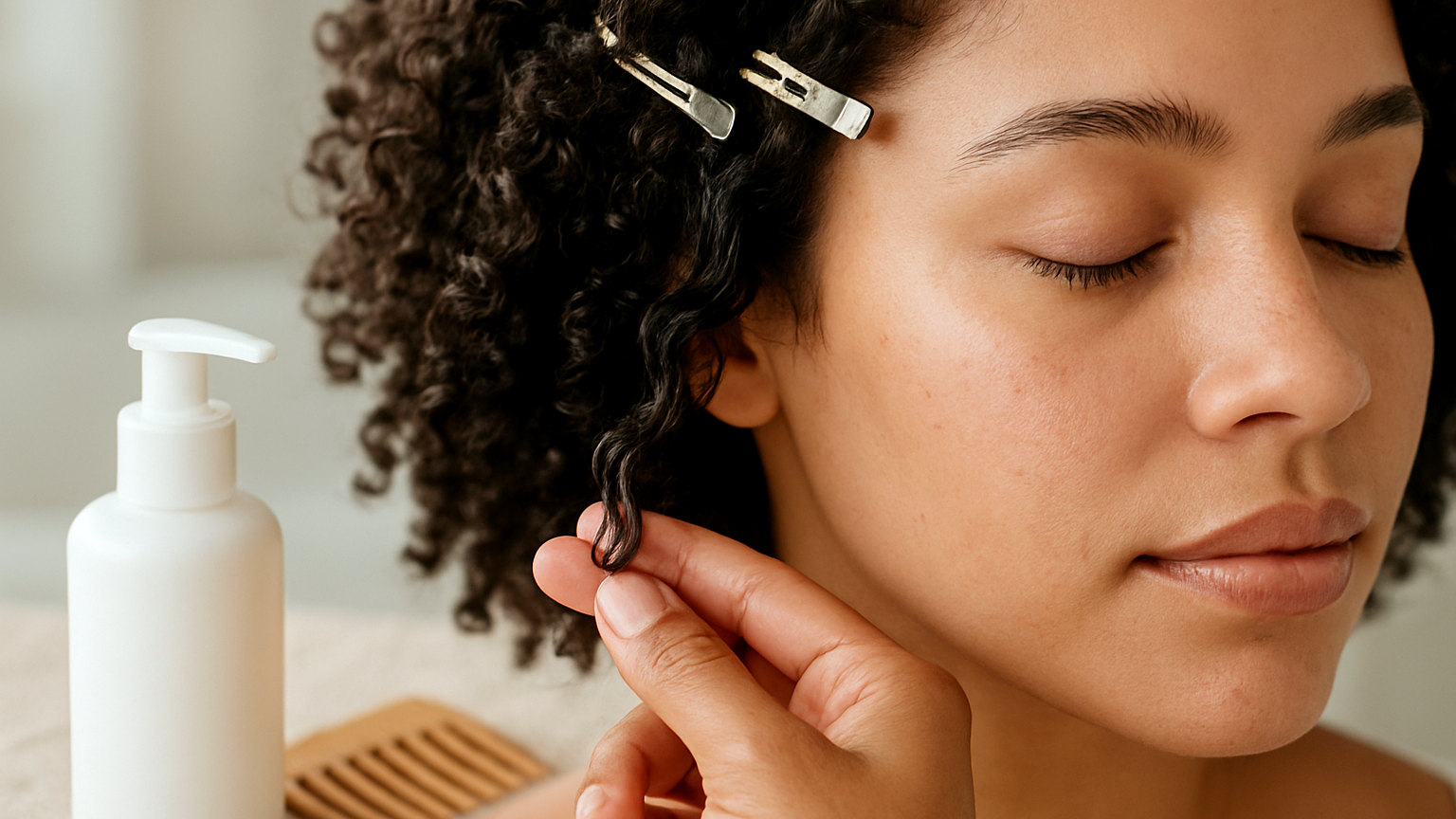
Styles drop for three reasons: the hair was not properly set, the hair itself will not hold, or the environment defeated it. Two of the three are decided before you pick up a product.
Why does hair hold a style at all?
Hydrogen bonds within the shaft break when hair is wet and reform as it dries, setting into whatever shape the hair is in.
That is why hair must be wet or damp at some stage in styling, and why a style set on dry hair with heat alone drops faster. It is also why humidity destroys styles: water in the air breaks those bonds again.
Products add a second layer of holding by forming a polymer film, which supports the shape mechanically.
What is the most common mistake?
Not letting hair cool. Hair is malleable while warm and sets as it cools, so touching, brushing or tying it while still warm undoes the set.
Let it cool completely, ideally ten minutes, before doing anything to it. Clipping curls to the head while they cool, or setting rollers at the crown while you finish getting ready, dramatically improves how long a style holds.
This costs nothing and is skipped almost universally.
Why will some hair not hold anything?
Fine, very straight and low-porosity hair all hold styles poorly, and none of that is a failure of technique.
Fine hair lacks structural rigidity. Very straight hair has no natural bend to reinforce. Low-porosity hair has a tightly closed cuticle with little grip, so hair slides against itself.
Clean freshly washed hair is also slippery, which is why styles frequently hold better on second-day hair.
What adds grip?
Texture products, which is what they are for. Texture spray, dry shampoo on clean hair, sea salt spray or volumising powder all roughen the surface so hair holds against itself.
This is the most useful adjustment for anyone whose hair simply will not hold. Applying dry shampoo to clean hair sounds counterintuitive and works.
Mousse on damp hair before drying adds a film that provides grip through the whole style.
How should you use hairspray?
From around thirty centimetres away, in light passes, rather than saturating one area. Too much makes hair stiff and, once it cracks, the style collapses entirely.
Spray the underneath layers rather than only the surface, since that is where the support is needed. Let each layer dry before adding another.
For updos, spray a brush and use it to smooth flyaways rather than spraying directly at the head.
What defeats a style regardless?
Humidity, which breaks hydrogen bonds and returns hair to its natural pattern. An anti-humidity spray or a silicone serum forms a barrier and slows this considerably.
Heat and sweat. Touching your hair, which transfers oil and disturbs the shape. Wind, which is largely unbeatable.
Wearing hair down against a coat collar, which flattens and disturbs the ends within an hour.
How do you get a second day?
Protect it overnight. A loose bun on top of the head, or pineappling for curls, keeps the shape off the pillow. Silk or satin reduces friction and frizz.
In the morning, dry shampoo at the roots for oil and texture, then reshape rather than restart. A light water mist and re-scrunch revives curls; a quick pass with a tong on a few front sections revives a blow dry.
Refreshing takes five minutes and produces a better result than washing and starting again, which is also better for the hair.
Does the cut affect it?
Substantially, and it is the factor people least associate with hold. A cut with too much weight pulls out curl and volume regardless of technique.
Layers give curls somewhere to sit and help them hold. A blunt heavy cut on fine hair drops flat within an hour. If a style consistently fails within two hours despite good technique, the cut is worth discussing before buying more products.


