
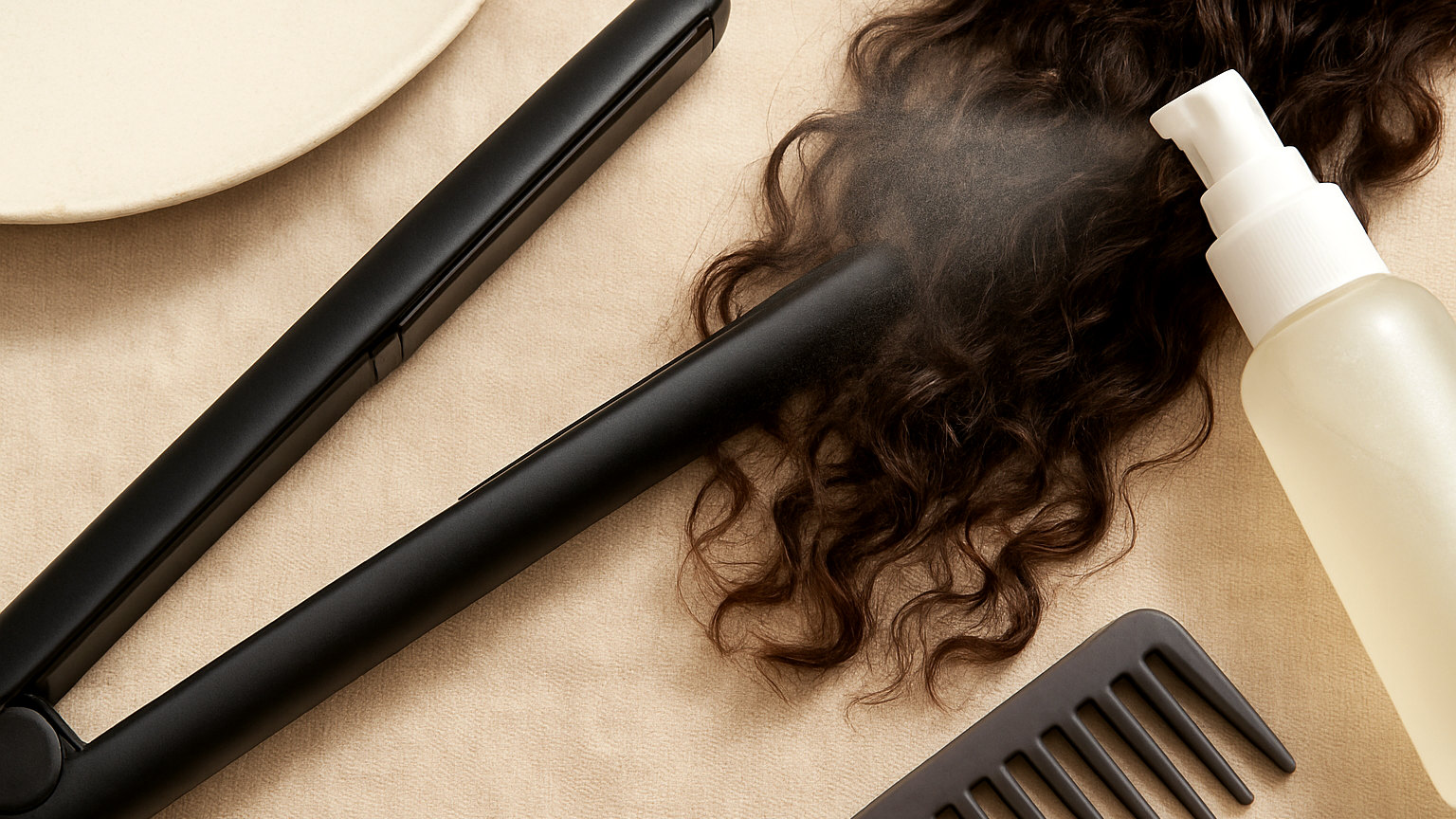
Straighteners do more damage than any other styling tool, because they apply direct contact heat to the hair rather than hot air. Almost all of that damage comes from three habits, and all three are straightforward to change.
What are the three?
Using them on damp hair. Using them at maximum temperature. And going over the same section repeatedly.
Fixing those three matters more than any product, and none of them requires buying anything.
Why is damp hair so damaging?
Because water inside the shaft turns to steam on contact with a plate at 180 degrees or more, and forces its way out through the cuticle.
That leaves small cavities and lifts the cuticle permanently. The audible sizzle is the sound of it happening, and it is not something a protectant prevents.
Hair must be completely dry before straighteners touch it. Not nearly dry, and not blow dried until it feels warm and slightly damp underneath.
What temperature should you use?
Lower than the default. Fine, damaged or coloured hair: 150 to 170 degrees. Normal hair: 170 to 185. Coarse or very thick hair: 185 to 200.
Above 215 degrees, keratin degrades regardless of protection. Tools reaching 230 exist because a higher number sells, not because hair needs it.
If a lower setting requires two passes, that is generally still less damaging than one pass at a much higher temperature, provided you are not repeating it four or five times.
How many passes should each section take?
One, ideally, moving slowly and steadily rather than quickly and repeatedly.
The most common error is rushing a section, finding it not straight, and going over it three more times. Each pass is a fresh heat exposure, so four fast passes do considerably more damage than one slow one.
If sections consistently need multiple passes, they are too thick. Work with sections no wider than the plates and no thicker than a couple of centimetres.
How should you apply heat protectant?
To damp hair, combed through, then dry completely before straightening. Applying it to dry hair immediately before use gives no time to form a film.
Use enough to coat evenly rather than concentrating it in one place. Uneven application means unprotected sections.
Protectant reduces damage rather than preventing it, and it is not permission to raise the temperature.
What technique reduces damage?
Section properly, working from the nape upward and clipping the rest away. Take thin sections and comb each one before it goes between the plates.
Keep the plates moving continuously. Pausing partway down a section creates a hot spot and often a visible dent.
Start a centimetre or two from the roots rather than pressing against the scalp, which risks burns and does not improve the result.
Let the hair cool completely before brushing or tying it, since warm hair is still malleable.
Do plate materials matter?
Less than the marketing implies. Ceramic distributes heat relatively evenly and is the practical default. Titanium heats faster and hotter, which suits professional use and is unforgiving at home. Tourmaline coatings are largely a marketing distinction.
What genuinely matters is even heat distribution and an accurate temperature control. Cheap tools frequently have hot spots where part of the plate runs far above the displayed setting.
Floating plates, which move slightly under pressure, reduce snagging and are a genuine improvement.
How often is too often?
Daily straightening at any temperature causes cumulative damage that shows within months, particularly on the front sections and ends.
Two or three times a week with a proper blow dry in between, or straightening only the top layers rather than all of the hair, both reduce total exposure substantially. Air drying to eighty per cent first also cuts the time each section spends under heat.
How do you know if damage is happening?
Curl or wave that stops returning after washing is the clearest early sign, since heat has broken the bonds holding the pattern.
Ends that feel rough while the roots feel normal. Short broken hairs standing up through the length. White dots along the shaft, which mark where the cuticle has worn through and the hair is about to snap. Any of these means reducing temperature and frequency now rather than after it becomes obvious.


