
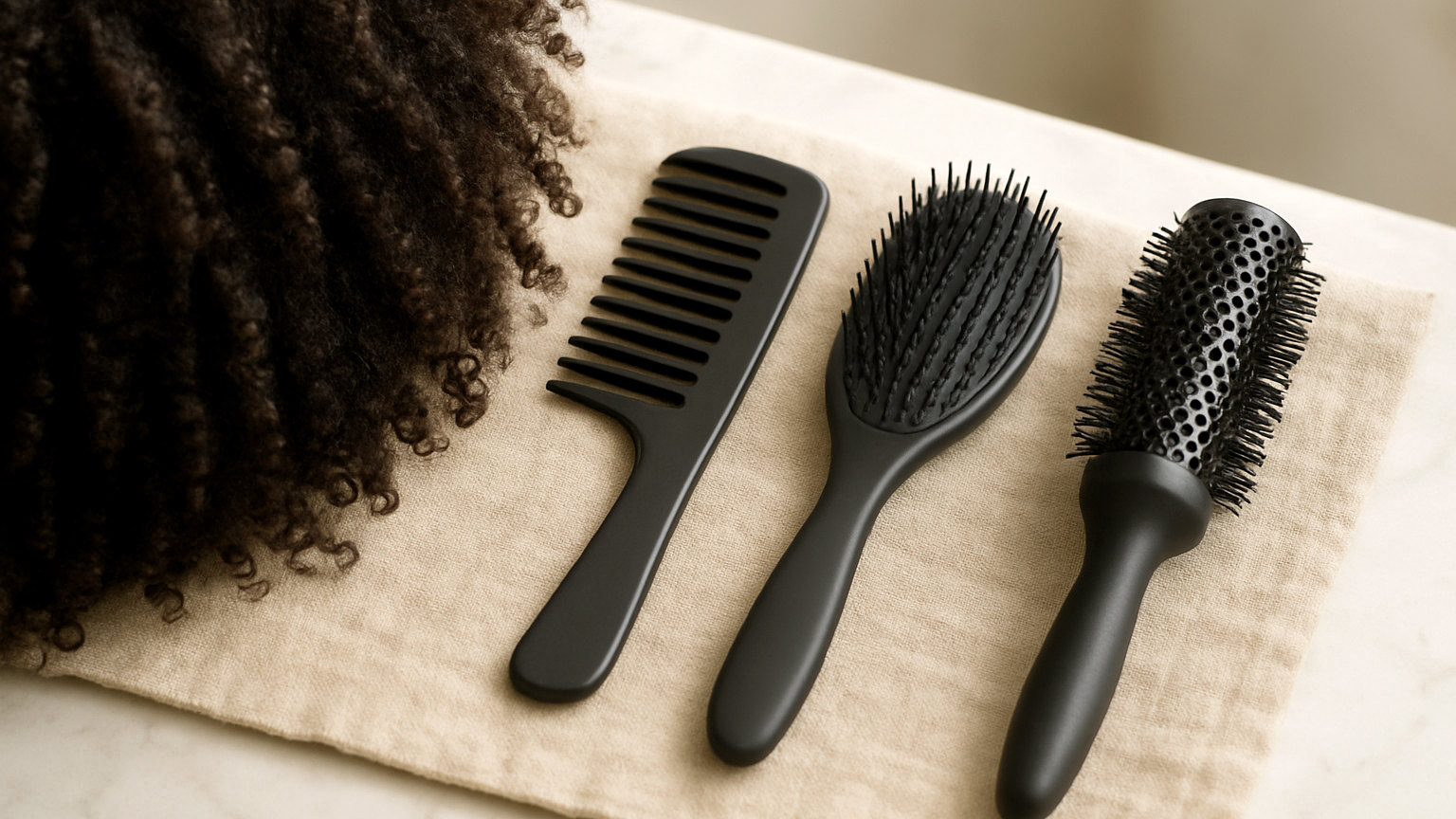
Brushes are usually chosen by appearance or by whatever came free with something else, and using the wrong one accounts for a great deal of avoidable breakage. Each type does a specific job.
What is a wide-tooth comb for?
Detangling wet hair, and detangling curly hair at any stage. The spacing between teeth means it separates strands rather than dragging through them.
It is the only tool that should touch soaking wet hair, and even then with conditioner in for slip. For curly hair it is often the only tool needed at all.
Look for one with smooth, seamless teeth, since moulded combs frequently have a ridge along each tooth that catches and tears the cuticle. Running a fingernail along the teeth will find it.
What is a detangling brush for?
Damp or dry hair that tangles readily. The flexible bristles of varying lengths bend under resistance rather than forcing through, which reduces the tension applied to any single strand.
These are genuinely better than conventional brushes for fine, damaged or tangle-prone hair, and they are not a marketing invention.
They are less good at smoothing or distributing oil, so most people need something else as well.
What is a paddle brush for?
Smoothing long, straight or wavy hair, and general daily brushing on dry hair.
The wide flat base covers a lot of hair quickly, and the cushioned pad gives some flex. Look for bristles with rounded ball tips rather than sharp points, which snag.
Not suitable for curly hair, which it separates into frizz, and not suitable for wet hair.
What is a round brush for?
Blow drying, and nothing else. The barrel creates tension and shape while hot air sets it.
Larger barrels give smoothness and a soft bend; smaller barrels give more curl and root lift. Ceramic or metal barrels heat up and speed drying, which also means more heat exposure.
Boar bristle round brushes grip well and can tangle if the hair is wrapped too far. Vented brushes let air through and dry faster.
What is a boar bristle brush for?
Distributing sebum from the scalp down the length, which conditions dry ends naturally. This is a genuine and under-used benefit, particularly for straight hair with oily roots and dry ends.
It also smooths the cuticle and adds shine. It works best on dry hair, and it is not a detangling tool.
Pure boar bristle is too soft for thick hair, where a mixed boar and nylon brush works better.
Which brushes cause damage?
Any brush with hard plastic bristles ending in a point, which snag and tear the cuticle.
Fine-tooth combs used on tangled or wet hair. Brushes with seams or ridges on the bristles. Metal-pinned brushes on fine hair.
And any brush used from the roots downward on tangled hair, which is a technique problem rather than a tool problem and does more damage than the wrong brush would.
Which should you own?
Most people need two. A wide-tooth comb or detangling brush for wet hair and knots, and either a paddle brush or a boar bristle brush for dry hair.
Add a round brush if you blow dry. Curly hair often needs only fingers and a wide-tooth comb, used with conditioner in the shower.
Should you clean them?
Yes, and almost nobody does. Brushes accumulate shed hair, sebum, dead skin and product residue, which then transfers back onto clean hair.
Remove hair after each use and wash the brush every couple of weeks in warm water with a little shampoo, drying bristles down so water does not sit in the cushion. Wooden brushes should not be soaked.
Does an expensive brush work better?
Sometimes, and not in proportion to the price. What genuinely matters is smooth seamless bristles, rounded tips, and a cushioned base with some flex, and those appear well below the top of the market.
Where money can be justified is in a good boar bristle brush, where quality of bristle affects how well it distributes oil, and in a detangling brush with properly engineered flex. A forty-pound paddle brush is largely paying for the handle.


