
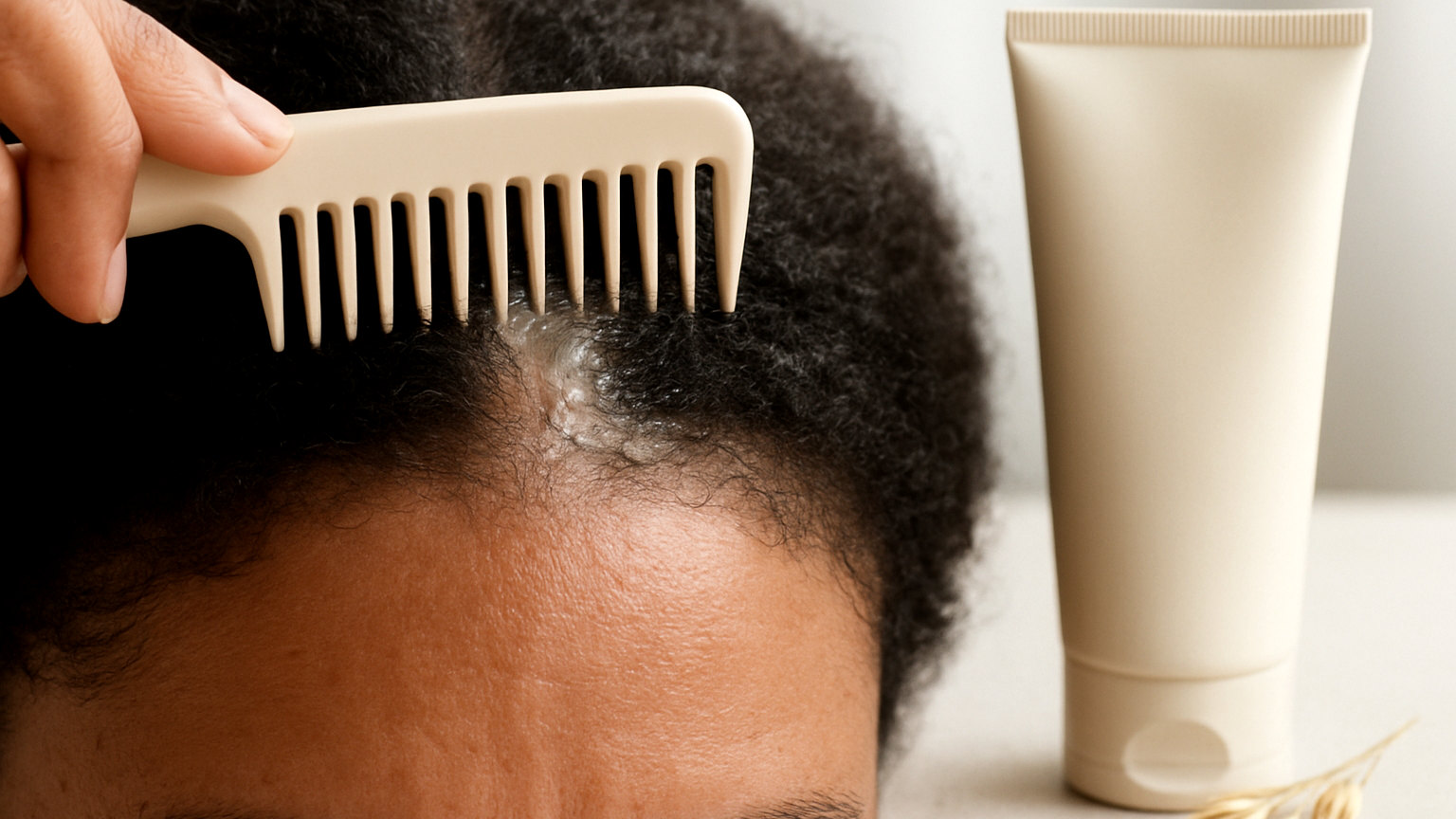
Scalp build-up is an accumulation of things that should have been washed away and were not. It is frequently mistaken for dandruff, treated with the wrong product for months, and the two are straightforward to tell apart once you know what to look for.
What accumulates?
Four things, usually together. Sebum that has oxidised on the scalp rather than being washed off. Dead skin cells that have not shed cleanly.
Product residue: styling products, silicones, conditioner applied too close to the roots, and dry shampoo in particular. And environmental deposits including hard water minerals, pollution and sweat salts.
Together these form a layer that can be felt as a waxy or gritty film on the scalp.
How do you tell it from dandruff?
By what comes away and what is underneath.
Build-up produces flakes that are larger, often greyish or the colour of your products, and they lift off in sheets when scratched. The skin beneath looks normal rather than pink. It is usually worst where product is applied and where hair is thickest.
Dandruff produces smaller, greasier yellowish flakes with pink, inflamed skin underneath, and it appears across the scalp and often on the face too.
The clearest test is what happens after a thorough clarifying wash. Build-up largely disappears and returns slowly over weeks. Dandruff returns within days.
What causes it?
Not washing often enough for your sebum production, which is the most common cause and the one people resist most.
Dry shampoo used for several consecutive days without a proper wash in between. Conditioner or masks applied to the roots rather than the lengths. Heavy oils and butters used on the scalp.
Insufficient rinsing, which is more common than people think, particularly at the back of the head. And hard water, which leaves mineral deposits that ordinary shampoo does not remove.
How do you remove it?
A clarifying shampoo, applied to the scalp specifically, massaged with fingertips for a full minute, and repeated if the first wash produces little lather.
For hard water areas, a chelating shampoo instead, since mineral deposits need binding agents rather than stronger detergent.
A salicylic acid scalp treatment used before shampooing helps dissolve the accumulation, particularly if it has been building for months.
Follow with conditioner on the lengths only, since clarifying leaves hair more porous.
Should you exfoliate the scalp?
Chemically rather than physically, and no more than every week or two.
Salicylic acid is oil-soluble and reaches into the follicle opening, which is where the sebum plugs sit. Physical scrubs with grains abrade a scalp that may already be inflamed and can worsen flaking.
A silicone scalp brush used during shampooing is a reasonable middle ground, since it lifts residue without abrasion, and it is gentler than nails.
How do you prevent it coming back?
Wash often enough for your scalp rather than for your hair, which usually means more often than people who are stretching washes would like.
Limit dry shampoo to two consecutive days. Keep conditioner and masks off the roots. Rinse for considerably longer than feels necessary. Apply styling products to the lengths rather than the scalp.
And clarify on a schedule, every two to six weeks, rather than waiting until the scalp feels bad.
Does it cause hair loss?
Not directly, and severe long-standing build-up is not good for follicle health. The evidence that it causes loss on its own is weak, and the inflammation it can provoke is unhelpful.
What it does do is trap shed hairs and make shedding look worse when it is finally washed out, which alarms people unnecessarily. Those hairs were already shed; they simply had nowhere to go.
When is it not build-up?
If flaking returns within days of a clarifying wash, it is a scalp condition rather than accumulation.
If there is itching, redness, soreness or pustules, or if flakes are thick and silvery on raised plaques, that needs treating as seborrhoeic dermatitis or psoriasis, and clarifying repeatedly will strip the scalp without addressing anything.


