
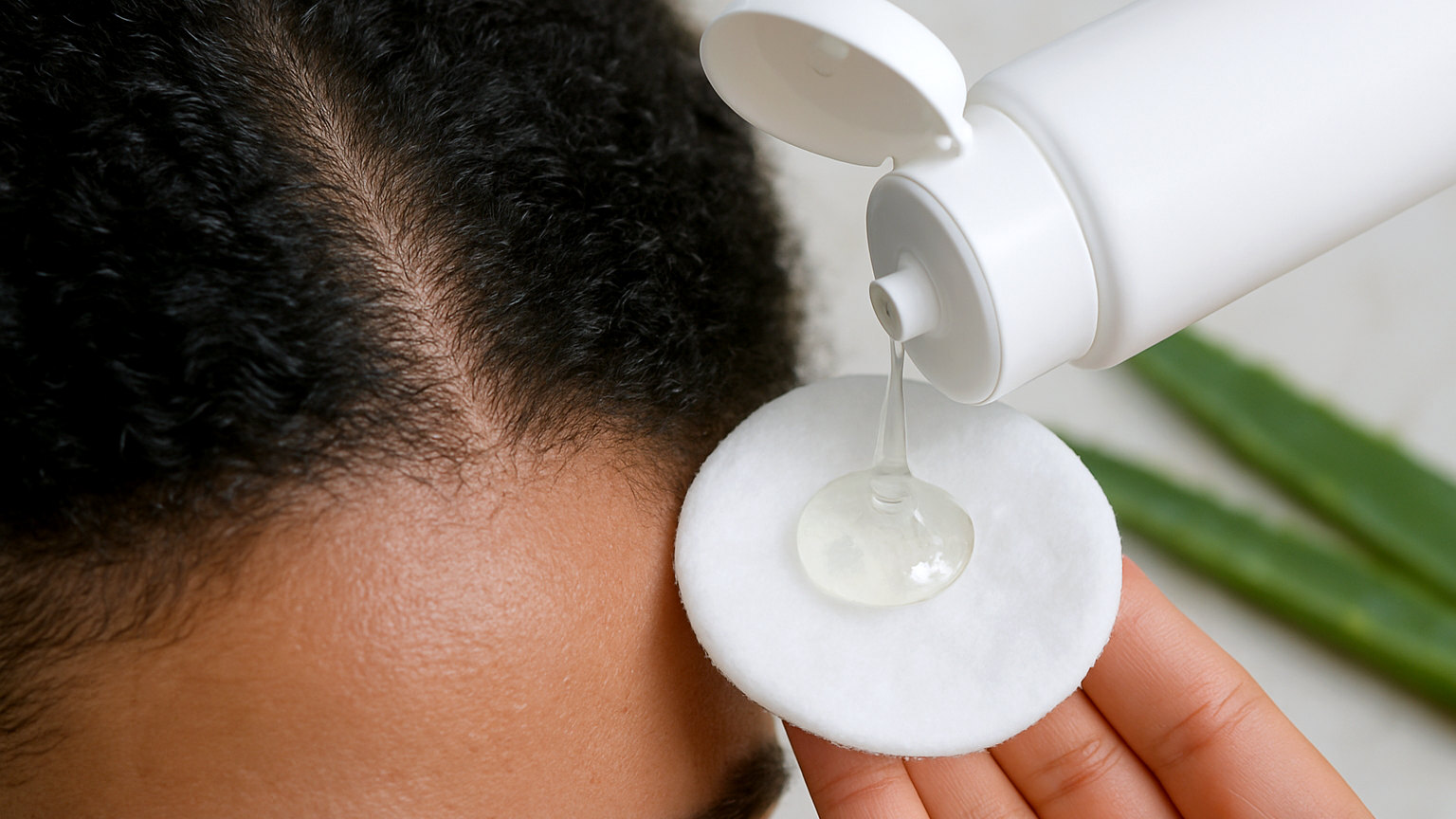
Bleach on the scalp is a chemical exposure rather than a hair treatment. Some tingling is common; genuine burning is not, and the aftercare is closer to managing a mild burn than to conditioning.
What does bleach do to the scalp?
Bleach works by raising the hair to a highly alkaline pH so the cuticle lifts, then oxidising melanin. The scalp sits at around pH 5, so contact with an alkaline product disrupts its barrier directly.
The result is barrier damage, loss of protective lipids and, with stronger formulations or longer processing, chemical irritation of the skin itself. Heat generated by the reaction adds to it.
This is why a full head bleach applied to the roots is considerably harder on the scalp than foils that keep the product off the skin.
What is normal and what is not?
Mild warmth or tingling during processing is common. Slight tenderness for a day afterwards is common.
What is not normal: significant burning during application, pain that makes you want it removed, blistering, weeping, open sores or scabs afterwards, or swelling.
Burning during processing should always be acted on immediately rather than endured. Asking for it to be rinsed off is entirely reasonable, and a stylist would considerably rather do that than treat a burn.
What should you do straight afterwards?
Rinse thoroughly and for longer than feels necessary, with cool rather than warm water. Residual product left at the roots continues to act.
Use an acidic post-treatment or a pH-balancing shampoo, which helps bring the scalp back toward its normal range.
Leave the scalp alone for several days. No exfoliating, no clarifying shampoo, no scalp scrubs, no active treatments and no dry shampoo.
How do you treat a sore scalp?
Gently, and largely as you would treat any irritated skin. A bland, fragrance-free shampoo, lukewarm water, and fingertips rather than nails.
A light application of aloe vera gel or a plain emollient soothes and supports recovery. Avoid heavy oils on a broken or weeping scalp.
Do not pick scabs, which risks infection and, on the scalp, can cause permanent bald patches if the follicle is damaged.
Keep it out of the sun, since damaged scalp skin burns readily and a parting is exposed.
How long does recovery take?
Mild irritation settles in a few days. Barrier recovery takes two to four weeks, matching the skin cycle.
Scabbing or blistering indicates a chemical burn and takes longer, and should be assessed rather than managed alone. Do not bleach again until the scalp has fully healed, which usually means at least six to eight weeks and often longer.
Can it cause hair loss?
Yes, in two ways, and they differ in seriousness.
Breakage from over-processed hair is common and is damage to the shaft rather than the follicle, so the hair regrows normally from the root.
Loss from a chemical burn is different. If the burn is deep enough to scar, the follicle is destroyed and hair will not regrow in that area. This is uncommon and it is the reason burns should be taken seriously rather than treated as an unpleasant side effect.
Some people also experience telogen effluvium two to three months after a severe scalp injury, which is temporary.
When should you see a GP?
Blistering, open sores, weeping or crusting. Any swelling of the scalp or face. Signs of infection: increasing pain, warmth, pus or fever.
Hair loss from a burned area, particularly if the skin looks smooth and shiny without visible follicle openings. And any reaction after dye rather than bleach, since allergic reactions to paraphenylenediamine can be severe.
How do you reduce the risk next time?
Foils or a technique that keeps product off the scalp where possible. A lower volume developer with longer processing rather than a high volume one.
Do not wash your hair for a day or two beforehand, since natural sebum offers some protection. Scalp protection products applied before bleaching are worth asking about.
Space full-head root bleaches at least eight weeks apart, and tell your stylist about any previous reaction, since they can adjust the formulation.


