
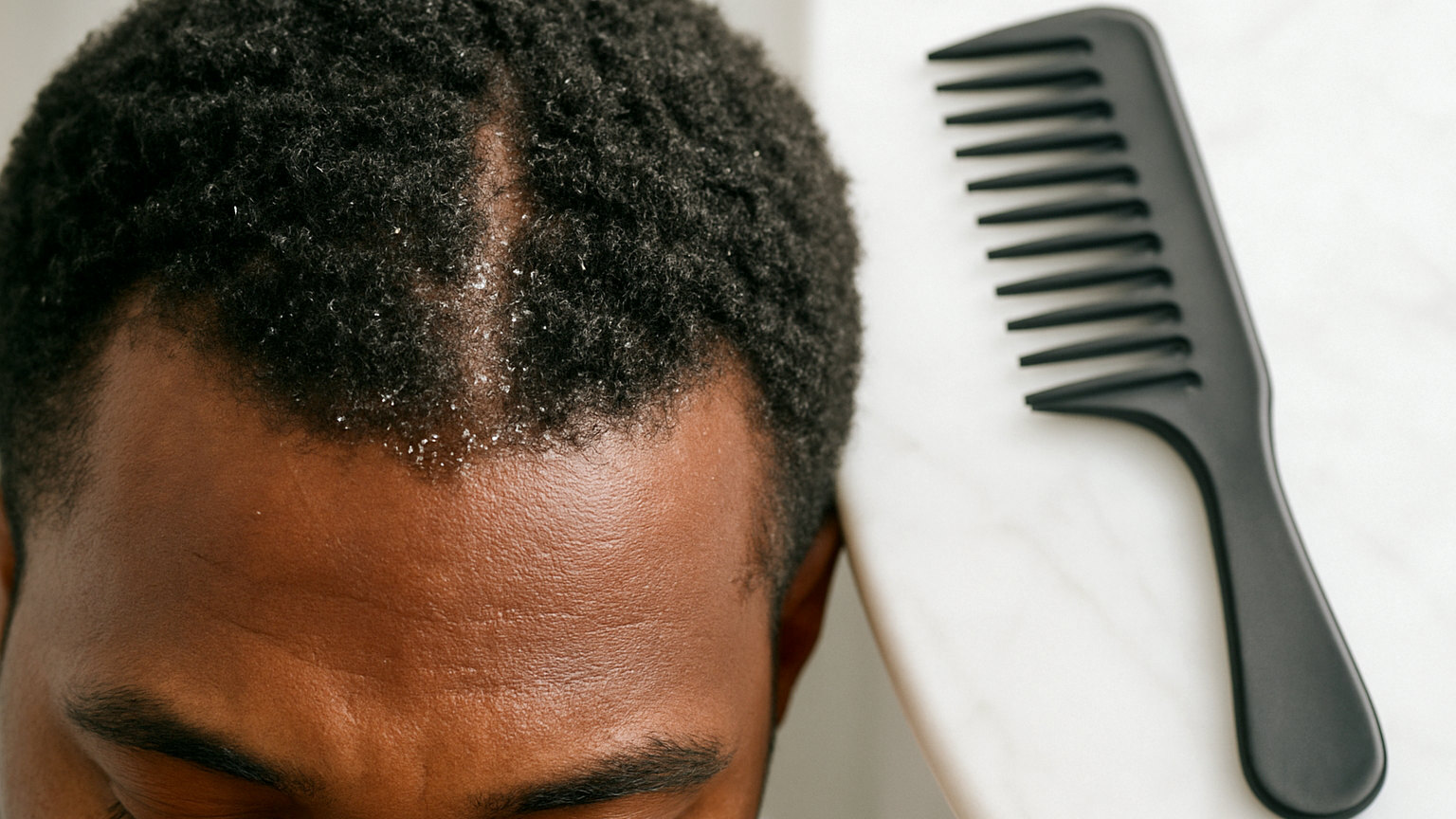
Dandruff is neither dryness nor poor hygiene, and both assumptions lead people toward treatments that make it worse. It is a mild inflammatory condition involving a yeast that lives on everyone, and it responds well to the right shampoo used properly.
What is actually happening?
Malassezia, a yeast present on almost all adult scalps, feeds on the lipids in sebum. In doing so it produces oleic acid as a byproduct.
Some people are sensitive to that byproduct, and their immune system responds with inflammation. Inflammation accelerates skin cell turnover, so cells reach the surface before they are ready to shed individually, and they come away in visible clumps.
That is dandruff: a reaction to a normal organism, not an infection and not a failure of washing.
Why is it not dryness?
Because it requires sebum. The yeast feeds on scalp oils, so dandruff occurs on oily rather than dry scalps, which is why it commonly appears alongside an oily T-zone and greasy roots.
The flakes look dry because they are dead skin, but the underlying condition is not. This matters practically: treating it with rich oils and heavy conditioners provides more of what the yeast feeds on.
Genuine dry scalp produces small fine flakes with tight skin, improves with gentler washing, and does not respond to antifungal shampoo. Dandruff produces larger greasy yellowish flakes with pink skin beneath, and does.
What makes it worse?
Stress, reliably, through effects on both the immune response and sebum production. Cold, dry weather, which is why it is worse in winter.
Hormonal changes, which is why it commonly appears at puberty. Illness and fatigue. Some medical conditions, notably Parkinson's disease and immunosuppression, are associated with more severe seborrhoeic dermatitis.
Washing too infrequently, which allows sebum to accumulate. And oils applied to the scalp, which are a common self-treatment and frequently counterproductive.
Which ingredients work?
Ketoconazole, an antifungal, which is the most effective single ingredient and available over the counter at one per cent and on prescription at two per cent.
Zinc pyrithione, which is antifungal and antibacterial and appears in many mainstream anti-dandruff shampoos. Selenium sulfide, effective and with a stronger smell.
Coal tar, which slows cell turnover and helps with scaling. Salicylic acid, which removes the scale rather than treating the cause and works best alongside an antifungal.
How should you use them?
This is where most treatment fails. Anti-dandruff shampoo needs contact time: apply to the scalp, massage in, and leave for five minutes before rinsing.
Rinsing it off immediately, as with an ordinary shampoo, gives the active ingredient no opportunity to work, and people conclude the product is ineffective.
Use it two or three times a week initially, then reduce to once or twice weekly for maintenance. Follow with conditioner on the lengths only, keeping it off the scalp.
Should you rotate shampoos?
There is a reasonable argument for alternating between two different active ingredients, since some evidence suggests reduced effectiveness over time with a single agent.
Alternating ketoconazole with zinc pyrithione, for example, is a common approach. It is also worth having a clarifying shampoo occasionally, since medicated shampoos can leave residue.
Does it ever go away?
It is controlled rather than cured. The yeast is a normal part of the scalp and cannot be eliminated, and the sensitivity to it is individual.
Most people find that consistent treatment keeps it away, and that it returns within weeks if they stop entirely. Continuing a maintenance wash once a week after it clears is far more effective than treating each flare from scratch.
When is it something else?
If flakes are thick and silvery on raised, well-defined plaques, that suggests psoriasis. If the scalp is weeping, crusting or has pustules, that needs a GP.
If there is hair loss from the affected areas, or if four to six weeks of proper antifungal use has changed nothing, it is worth an appointment rather than another shampoo.


