
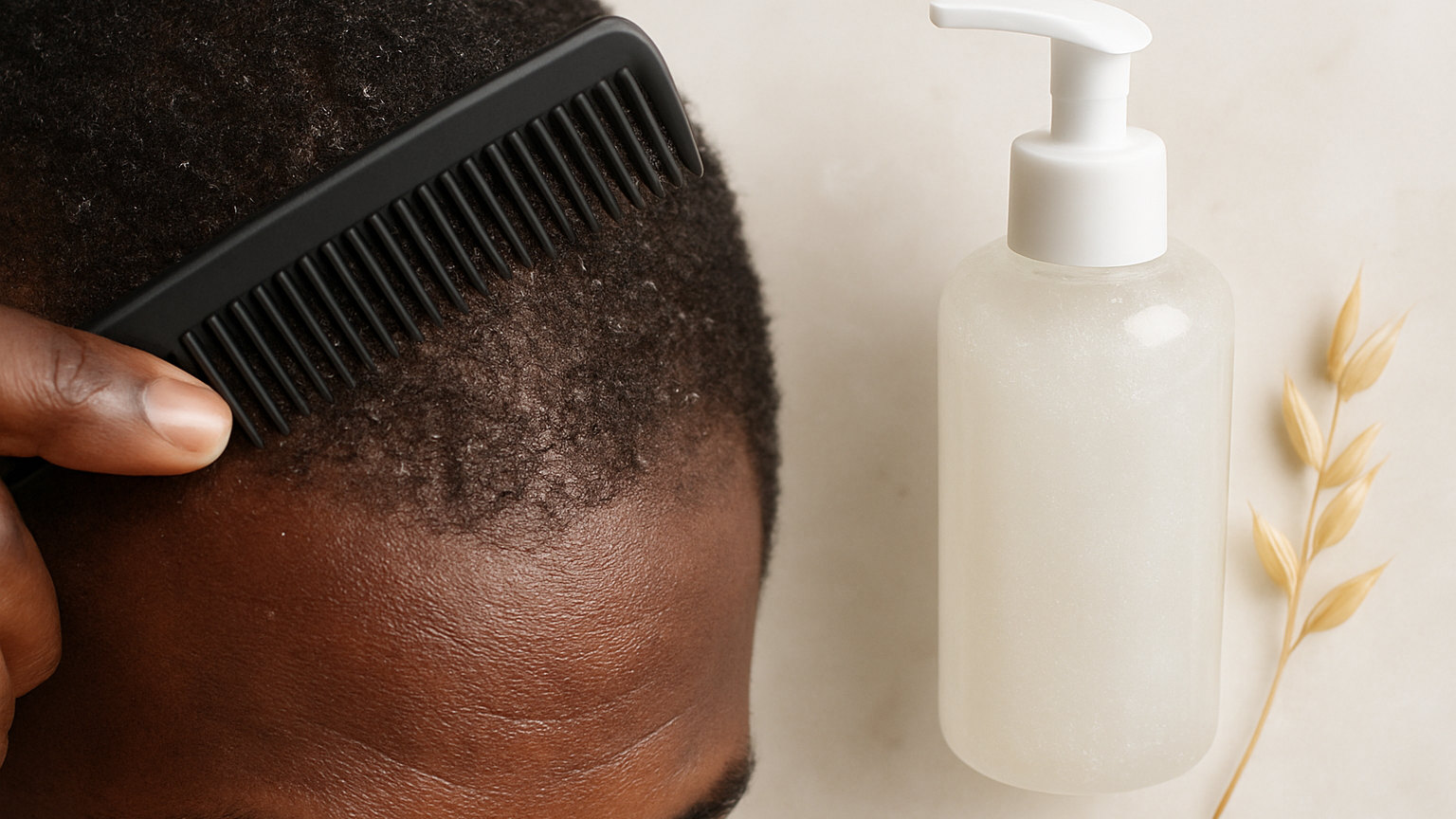
An itchy scalp has several causes that present similarly, and the most common one responds to antifungal treatment rather than to the moisturising most people reach for first. Working out which you have determines whether anything improves.
What are the usual causes?
Seborrhoeic dermatitis, which is by a distance the most common, and is what most people call dandruff.
Genuine dry scalp, which is less common than assumed. Contact dermatitis from a product. Scalp psoriasis. Product build-up. Head lice, which are not confined to children. And occasionally a fungal infection of the scalp requiring oral treatment.
How do you tell dryness from seborrhoeic dermatitis?
By the flakes and the skin beneath.
Dry scalp produces small, fine, white flakes and skin that feels tight. It is usually accompanied by dry skin elsewhere, worsens in winter and after harsh shampoo, and improves with gentler washing.
Seborrhoeic dermatitis produces larger, greasier, yellowish flakes, and the skin underneath is pink or red. It affects the sides of the nose, eyebrows and behind the ears as well as the scalp, and it flares with stress, cold weather and illness.
The distinguishing test is what happens with moisturising shampoo. Dryness improves; seborrhoeic dermatitis usually does not, and can worsen.
Why does the common one need antifungal treatment?
Because it involves malassezia, a yeast that lives on everyone and feeds on scalp lipids. In susceptible people the immune system reacts to its byproducts, producing inflammation, flaking and itching.
Treating it as dryness by adding oils and rich conditioners provides more of what the yeast feeds on, which is why the intuitive approach often makes it worse.
Shampoos containing ketoconazole, zinc pyrithione, selenium sulfide or coal tar reduce the yeast population and settle the inflammation. Used two or three times a week, left on for several minutes rather than rinsed immediately.
Could it be a product reaction?
Frequently, and it is under-recognised. Methylisothiazolinone, a preservative, causes a substantial share of scalp reactions and was widely used before restrictions.
Fragrance is the other common culprit. Hair dye, particularly paraphenylenediamine, causes reactions ranging from mild itching to severe swelling.
The clue is timing: itching that began within days or weeks of a new product, and that is worst where the product sits. Stopping the suspect for a fortnight is the simplest test.
What if there are no flakes at all?
Itching without visible flaking points elsewhere. Product build-up can cause it, particularly from dry shampoo used for consecutive days.
Traction from tight styles causes tenderness and itching at the hairline. Head lice cause itching that is often worse at night, with the itch concentrated behind the ears and at the nape.
Stress and anxiety genuinely produce scalp itching without visible cause, and some people have a heightened itch response with no dermatological finding.
What about psoriasis?
Scalp psoriasis produces thicker, silvery scale on well-defined raised plaques, often extending slightly past the hairline, which is a useful distinguishing feature.
It is frequently accompanied by patches elsewhere, particularly elbows, knees and nails. It needs medical treatment rather than an over-the-counter shampoo alone, though tar and salicylic acid preparations help.
What should you do first?
Try an antifungal shampoo for four weeks, since the most common cause responds to it. Leave it on for five minutes, use it two or three times a week, and follow with conditioner on the lengths only.
Stop any product introduced in the weeks before the itching started. Wash more rather than less if you have been stretching between washes. Avoid scratching, which damages skin and worsens inflammation.
When should you see a GP?
If four weeks of antifungal shampoo has not helped, if there are raised plaques, pustules or bleeding, if hair is falling out from affected areas, or if the skin is broken and possibly infected.
Itching with hair loss is the combination that matters most, since scarring alopecias present that way and are irreversible once established.


