
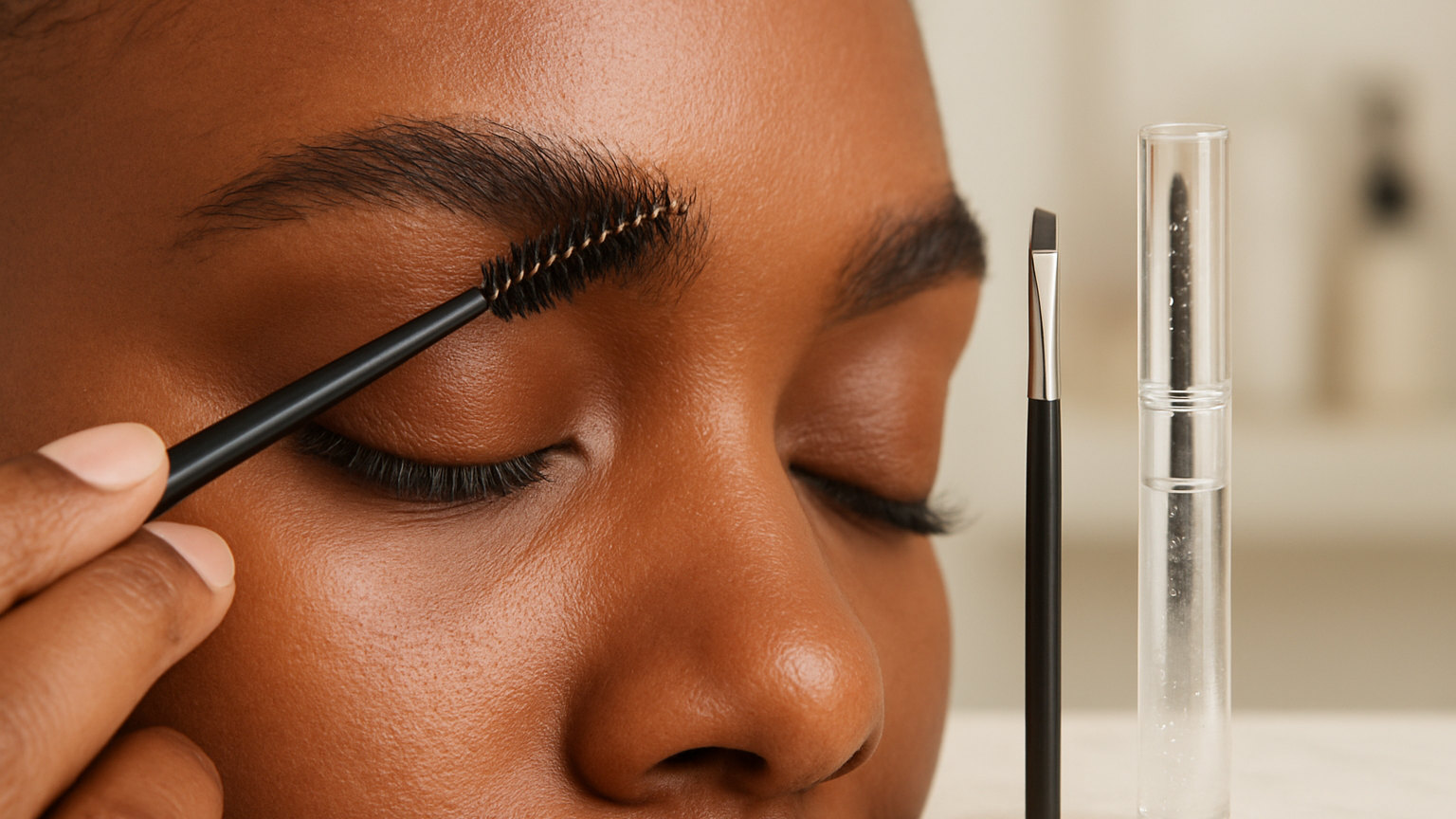
Brow tools are a short list, and the most useful item is also the cheapest. Sets containing six brushes are largely padding around the two that matter.
What does a spoolie do?
Almost everything. It is the single most useful brow tool and costs very little.
Brushing through before application reveals the natural shape and shows exactly where the skin is visible.
Brushing during application prevents build-up.
Brushing afterwards blends product into the hairs, distributes it evenly and softens hard edges, which is the step that turns filled brows into natural-looking ones.
Anyone whose brows look too solid should brush through and reassess before adding anything.
What does an angled brush do?
Applies powder and pomade with control, following the angle of the brow naturally.
A firm, thin, well-shaped angled brush gives precision; a soft floppy one deposits product unevenly.
The thinner the brush, the more it can mimic individual hair strokes.
Many brow products come with one attached, and a separate good brush is usually better than the one on the end of the pencil.
Do you need brow scissors?
If you have long hairs sticking out above the natural line, yes, and it is the most under-used tool here.
Small curved or straight scissors with fine blades. Nail scissors are too blunt.
Brush upward and trim only what protrudes above the top line, cutting a little at a time. Then brush downward and repeat below.
Trimming preserves density where plucking the same hairs would thin the brow permanently, which is why it is the safer correction.
What about tweezers?
Slanted tweezers with tips that meet cleanly are the standard, and pointed ones suit fine or ingrown hairs.
The quality genuinely matters here, since tweezers that do not grip cause repeated pulling and breakage.
Wipe the tips with alcohol before and after use.
The main risk with tweezers is not the tool but the temptation, since over-plucking is the one brow error that cannot be corrected the next morning.
Are brow stencils useful?
Rarely, and they suit fewer people than they are sold to.
A stencil imposes a generic shape rather than following your own bone structure, which is why stencilled brows frequently look applied.
They can be useful for anyone with very sparse brows who wants a consistent shape day to day, used lightly as a guide rather than filled in solidly.
For most people, mapping with a pencil against the nose gives a better result for nothing.
What about brow razors?
Small blades used to remove fine hair and tidy edges.
They cut hair at the surface rather than removing it from the root, so regrowth appears within days and can feel coarse.
They are easy to slip with, and removing too much in one stroke is a common and slow-to-fix error.
Tweezers give more control for brow work, though a razor is quicker for fine hair on the surrounding skin.
How should you clean them?
Angled brushes used with pomade need washing weekly, since cream product hardens in the bristles and ruins the shape.
Brushes used with powder need washing every two weeks.
Wash with a gentle cleanser, rinse pointing downward so water does not enter the ferrule, reshape and dry flat with the bristles over an edge.
Spoolies are worth having several of, since they are cheap and get dirty quickly. Disposable ones are useful for travel.
What is the whole list?
A spoolie, an angled brush, small scissors and decent tweezers.
Four items, of which two are used daily and two occasionally.
Everything else in the brow tool aisle is optional, and spending the money on getting the shade right instead does considerably more for the result.
Are electric brow trimmers worth it?
For most people, no. They remove hair at the surface like a razor, so regrowth is quick, and the small heads make it easy to take off more than intended in one pass.
They suit anyone who finds scissors and tweezers difficult to handle, including people with limited dexterity or tremor, where the trade-off is genuinely worth it.
Used on the brow itself rather than the surrounding skin, they thin the brow quickly and are difficult to correct.
What about lighting and mirrors?
Underrated as tools, and arguably more important than a third brush.
Natural light from a window is the most reliable, since it shows warmth and heaviness that bathroom lighting conceals entirely.
A magnifying mirror is useful for tweezing and actively harmful for filling, since it makes brows look sparser than they are and leads directly to over-filling. Use it for the tidy and a normal mirror for the makeup.


