
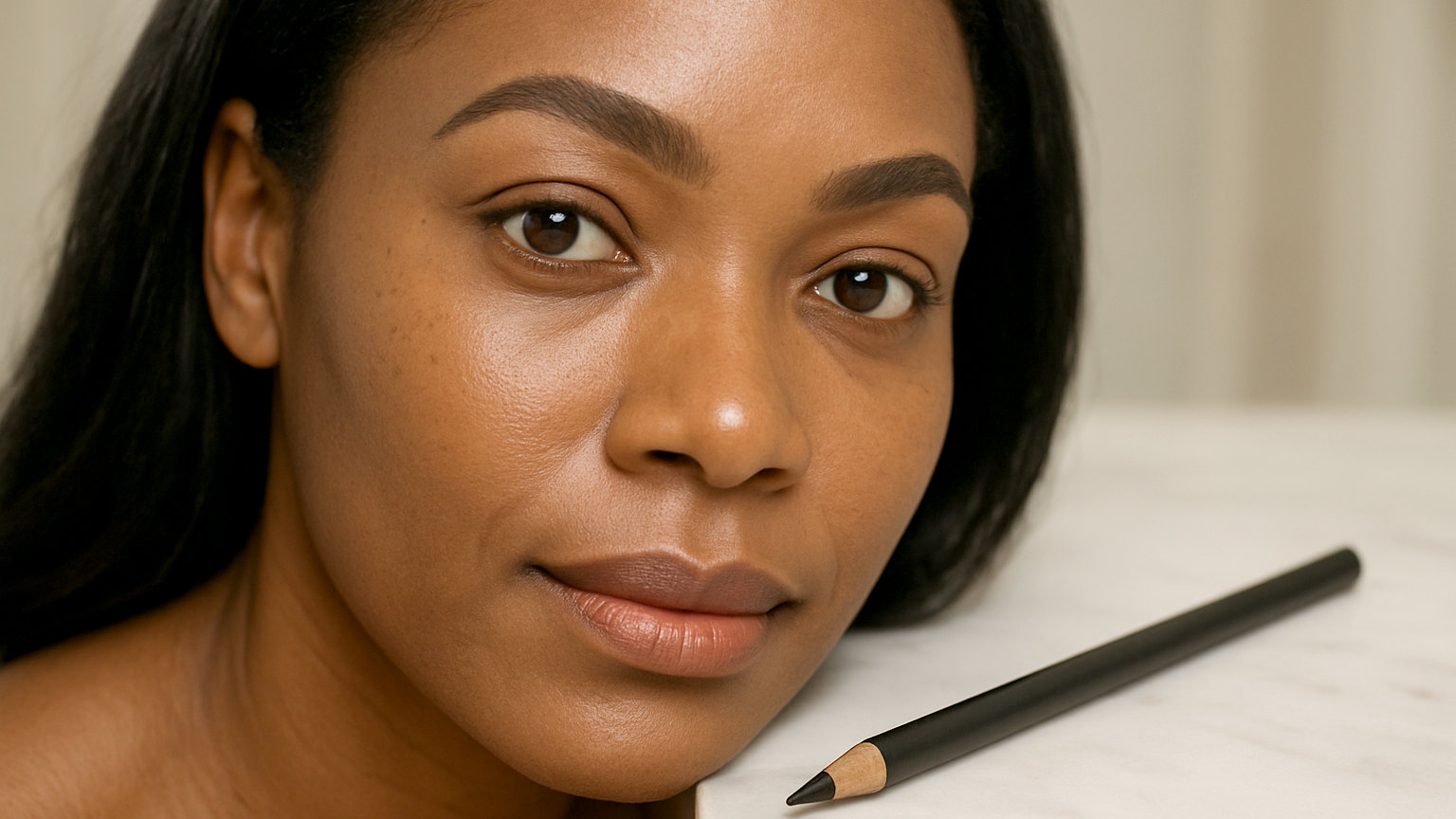
Brows frame the eyes and sit at the widest structural point of the upper face, which is why small changes to them alter apparent facial proportions more than almost anything else in makeup.
What actually changes the effect?
Height, meaning how far the arch sits above the eye, which affects how open and lifted the eye area appears.
Angle, meaning how steeply the brow rises and falls, which affects whether the expression reads as soft or defined.
Thickness, which affects how prominent the brow is and how much attention it draws.
Of the three, angle does the most, and thickness does considerably less than people assume.
What does a higher arch do?
It opens the eye area and lifts the face, creating more space between brow and lash line.
Placed too high or too far inward, it reads as surprised or severe.
The reliable position is where a line from the side of the nose through the outer edge of the iris crosses the brow.
A gradual curve to that point reads as lifted; a sharp peak reads as drawn.
What does a flatter brow do?
Straighter, more horizontal brows widen the face and soften the expression.
They suit longer or narrower faces, since horizontal lines add apparent width.
They can make rounder faces look wider, which is worth knowing before adopting the shape.
A very flat brow with no arch at all can read as heavy, so a slight rise generally works better than a completely straight line.
Which shapes suit which faces?
Rounder faces generally suit a defined arch with some angle, which adds structure and length.
Longer faces suit flatter, more horizontal brows, which add width.
Square faces suit a softly curved brow, which counterbalances a strong jaw.
Heart-shaped faces suit a soft rounded arch rather than a sharp one.
These are starting points rather than rules, and your own bone structure is a better guide than any chart.
How do brows affect the eyes?
More space between brow and eye reads as a more open eye, which is why cleaning up strays underneath the arch lifts the whole area.
A tail sitting higher than the brow's starting point lifts; a tail dropping below it pulls the eye down and reads as tired.
Brows too close together make the eyes appear closer set; too far apart makes them appear wider.
A defined brow makes lashes and eye makeup read as intentional rather than as an afterthought.
What lifts the face most?
Raising the tail, which is the single most effective adjustment available.
Brushing the hairs upward at the front and outward along the tail, held with gel.
Cleaning up strays under the arch without over-plucking.
A small highlight just under the arch, blended, which sharpens the line.
Together these take under two minutes and do more than most eye makeup.
Does thickness matter?
Less than the shape. Fashion has swung between pencil-thin and very full within living memory, and both looked correct at the time because of what surrounded them.
What matters more is that the brow suits the scale of your features. Delicate features are overwhelmed by very heavy brows; strong features can carry them.
Brows fuller at the front and tapering toward the tail read as natural at any thickness.
Should you follow trends?
Cautiously, since the cost is asymmetric. Filling brows differently costs nothing and is reversible by the evening.
Removing hair to follow a trend is not, since brow hair regrows slowly and repeated plucking over years can be permanent. A generation who thinned their brows in the nineties discovered this.
The safe approach is to follow trends with product and to leave the hair alone, which keeps every option available.
What happens to the effect with age?
Brows drop as the skin above loses elasticity, so a tail that once sat above the start point gradually falls below it. That single change is responsible for a good deal of what reads as a tired expression.
Brows also thin, particularly at the tail, and lose pigment, so the framing effect weakens at exactly the point where it matters more.
The response is lifting the tail and filling it slightly more than the front, rather than darkening the whole brow, which adds weight without adding lift.
How much difference does it actually make?
More than any other two-minute step in makeup. Brows sit at the structural top of the face and determine where the eye is drawn first.
The practical test is filling one brow and leaving the other, then looking at both halves of the face together. The difference is usually larger than expected and explains why brows are worth the attention.


