
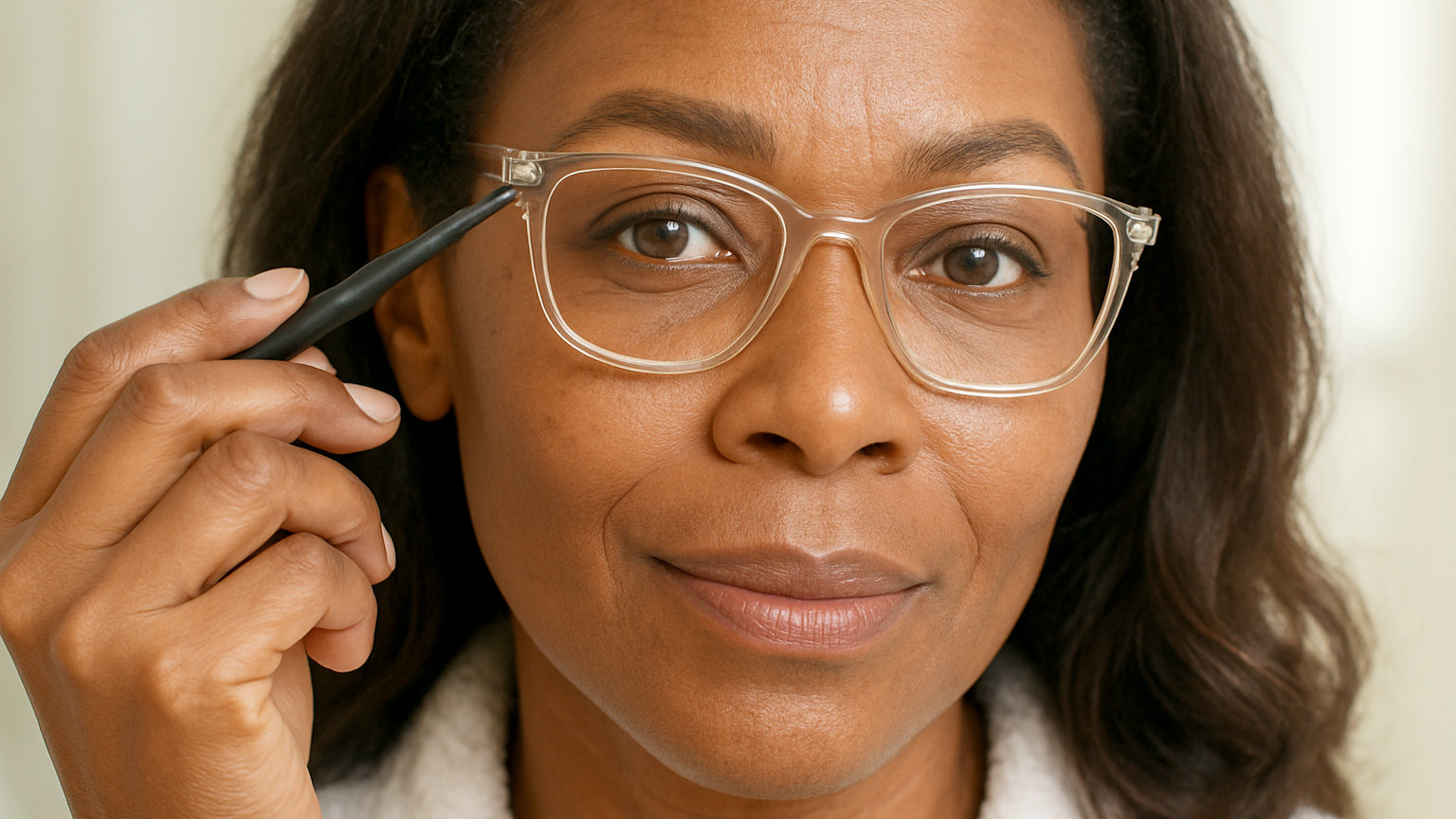
Glasses sit directly across the brow area, which makes them the one accessory that genuinely changes what works. Frames compete for the same visual space, and the lens alters how the brow behind it is seen.
How do lenses change the look?
Short-sighted prescriptions, which correct for distance, make the eyes and brows behind them look smaller.
Long-sighted prescriptions magnify, so brows appear larger and any imprecision is more visible.
Stronger prescriptions exaggerate both effects.
The practical consequence is that short-sighted wearers can generally afford slightly more definition, and long-sighted wearers need a lighter hand and more careful blending.
Where should the frame sit relative to the brow?
Ideally just below the brow line, so the brow remains visible above the frame.
Frames covering the brows entirely remove one of the face's main framing features and can make the expression harder to read.
Frames sitting well below the brow leave a large gap that can look disconnected.
This is a frame-choosing consideration as much as a makeup one, and it is worth checking when trying glasses on.
Should the frame shape match the brow?
Echoing the brow shape generally works better than contradicting it.
Angular frames suit brows with some angle; rounder frames suit softer curved brows.
Frames whose top line runs directly parallel to the brow, very close to it, can create a heavy doubled line.
A small amount of contrast reads better than an exact match.
Does frame colour matter?
Yes. Heavy dark frames are visually strong and compete with a dark brow, so the brow can be kept softer.
Light, rimless or wire frames leave the brow doing the framing work, so it can carry more definition.
A frame considerably darker than your brows tends to make the brows look faint, which is a common reason people suddenly feel their brows have disappeared after new glasses.
What should you adjust?
With heavy frames: lighter, softer brows, since two strong horizontal lines is a great deal.
With light or rimless frames: slightly more definition, since the brow is the main frame.
With magnifying lenses: less product, better blending, and softer edges.
With any frames: keep the tail visible above the arm of the glasses where possible, since a tail hidden by the frame shortens the brow visually.
What about the rest of the face?
Eyes behind lenses need adapting too, though that belongs elsewhere. In brief, short-sighted wearers benefit from lighter lid shades and defined lashes, and long-sighted wearers from restraint.
Concealer under the eyes matters more with glasses, since frames cast shadows.
Nose pads mark foundation, so setting the sides of the nose with powder reduces it.
Do glasses affect brow makeup wear?
Considerably. Frames resting on or near the brow rub product off through the day, and pushing glasses up the nose repeatedly is a constant source of disturbance.
Long-wear products, pomades and pens, hold up better than powder.
Setting with a brow gel is more important for glasses wearers than for anyone else.
Frames that fit properly and do not slide reduce the problem at source.
What is the general principle?
Balance. Glasses are already a strong feature across the upper face, so brows usually need less rather than more.
Check the result wearing the glasses rather than without them, which sounds obvious and is frequently not done, since brows are usually applied with the glasses off.
And check in a mirror at conversational distance, since the interaction between frame and brow is a thing seen from a metre away rather than close up.
How do you apply brows when you cannot see without glasses?
A genuine practical problem and rarely addressed. The usual solutions are a magnifying mirror, which distorts scale and encourages over-filling, or doing one brow at a time with the glasses pushed up.
Better options are a mirror close to a window with strong natural light, or wearing the glasses and lifting them briefly to check each stroke.
Some people find applying brows with contact lenses in, then switching to glasses, resolves it entirely.
Whatever the method, check the finished result wearing the glasses at arm's length rather than close up.
Do sunglasses change anything?
They sit higher on the face than most prescription frames and frequently cover the brows entirely, so anything done to them is invisible while worn.
The relevant point is that brows are seen when the sunglasses come off, usually indoors and in different light, so applying them for the glasses rather than for the face is a mistake.


