
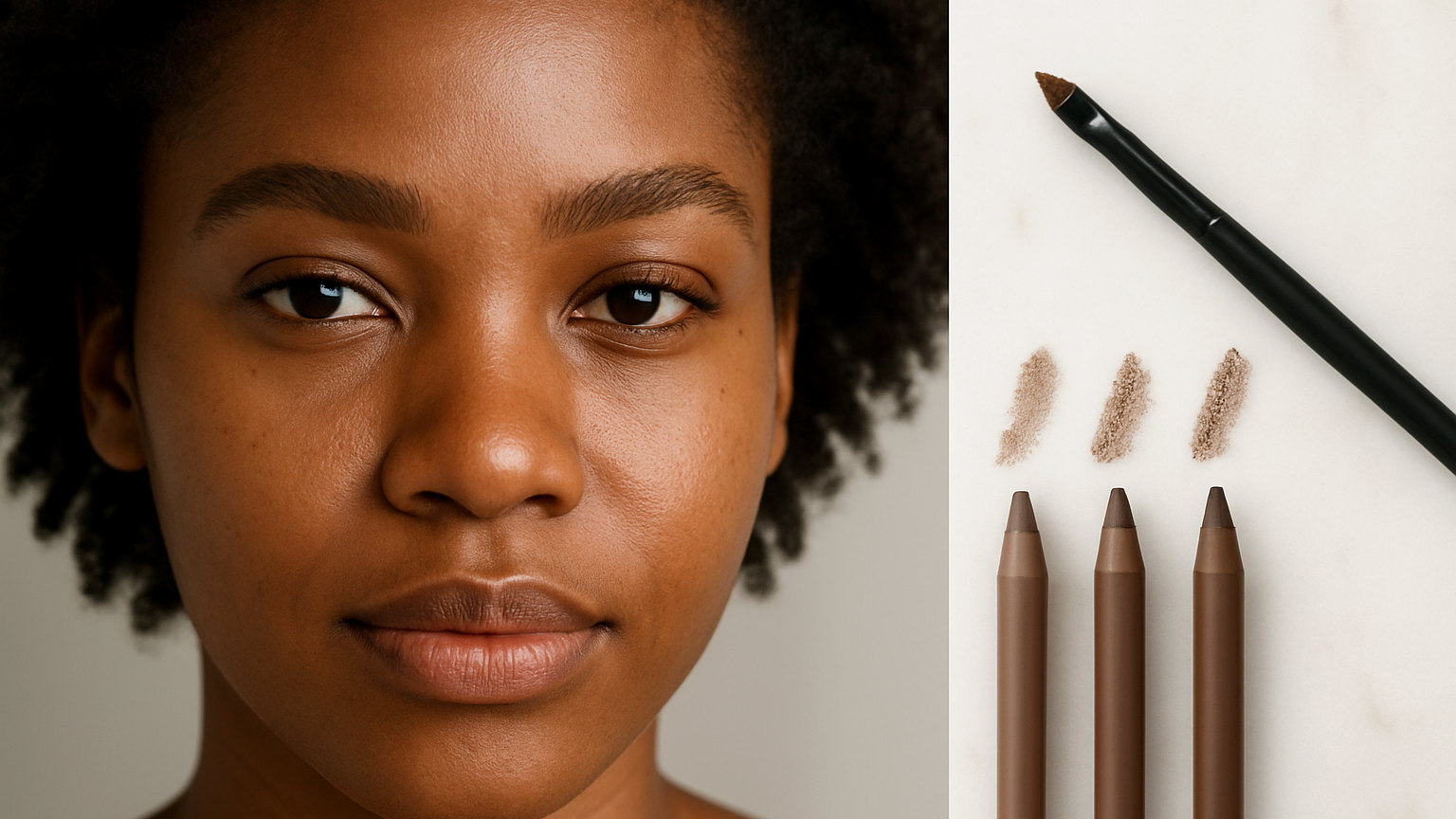
Brow shade goes wrong in two consistent ways: too warm, which reads orange or ginger, and too dark, which reads severe. Both are avoidable, and neither has much to do with matching your hair colour exactly.
What is the general rule?
If you have dark hair, go one to two shades lighter than your hair.
If you have fair hair, go one to two shades darker.
Both adjustments move toward the middle, which is why the advice appears contradictory. Brows that match hair colour exactly tend to look either heavy or invisible depending on which end you started from.
The target is a shade close to your natural brow hair at the root, slightly deepened.
Why does undertone matter more than depth?
Because most brow product errors are about warmth rather than darkness.
Cool and neutral shades, taupe and ash brown, look like hair. Warm shades with red or orange bases look like product.
Natural brow hair is almost always cooler than people expect, which is why taupe suits a surprising range of colouring.
If your brows look ginger or orange in daylight, the shade is too warm rather than too dark.
What suits different hair colours?
Black hair: a deep cool brown or soft black rather than true black, which is harsh on almost everyone.
Dark brown: a medium cool brown, one to two shades lighter than the hair.
Mid brown: taupe or a neutral medium brown.
Light brown and dark blonde: taupe, which is the most universally useful brow shade.
Blonde: a light taupe or greige, going slightly darker than the hair.
Red and auburn: a soft warm brown, which is the one situation where warmth is appropriate. Avoid anything ashy, which looks grey against red hair.
Grey and white: soft grey-brown or light taupe rather than trying to match a former colour.
What about skin tone?
Deeper skin tones generally suit richer, deeper browns, and pale ashy shades can look grey or chalky.
Very fair skin needs less pigment for the same effect, so a lighter shade applied with a light hand.
Olive skin suits neutral to slightly cool browns and can look sallow in warm gingery tones.
The undertone principle holds across all of them: cooler reads more natural than warmer.
How do you test it?
On your actual brow, not on the back of your hand, which tells you nothing useful.
Apply a few strokes at the front of the brow, where any mismatch is most visible.
Check in daylight rather than shop lighting, which is where warmth becomes apparent.
Look from a normal conversational distance rather than in a magnifying mirror, since brows are seen from a metre away rather than ten centimetres.
What if you are between shades?
Go lighter. A brow that is slightly too light reads as soft; one that is too dark reads as drawn on and is far more noticeable.
You can build a lighter shade up; you cannot easily lighten a dark one once applied.
Mixing two shades is entirely reasonable, and many people use a lighter shade at the front and a slightly deeper one through the tail, which is how brows grow naturally.
Should the front and tail be the same?
No, and this is one of the more useful details.
Natural brows are lightest at the inner end and deepest through the arch and tail.
Using a lighter hand at the front, or a lighter shade, produces a considerably more natural result than uniform colour across the whole brow.
The front is where a heavy brow becomes obvious, so leaving it softer costs nothing and improves most brows.
Does it change if you colour your hair?
Yes, and it is a common reason brows suddenly look wrong.
Going considerably lighter or darker shifts the relationship between hair and brows, and the product that suited before may now be too dark or too light.
Undertone matters too: going from warm to ash blonde makes a warm brow shade look distinctly orange.
Retesting the shade after a significant colour change is worth doing rather than assuming the brows are the problem.


