
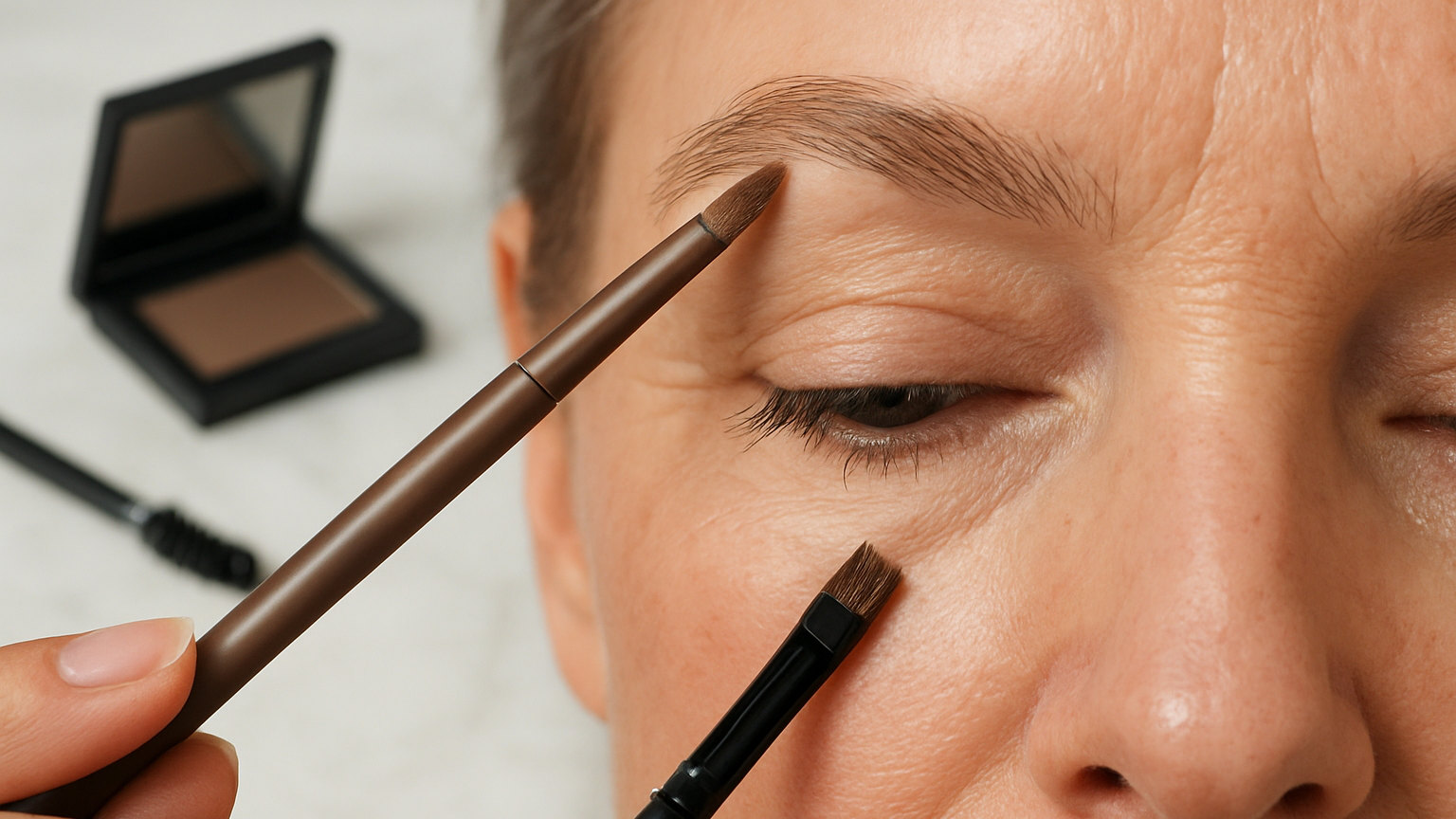
Filling a brow that has plenty of hair is a matter of tidying. Building one where there is very little is a different job, and applying the same technique to both is why sparse brows frequently end up looking like solid shapes.
Why does one layer not work?
Powder alone on bare skin reads as a flat block of colour, because there is no hair texture to break it up.
Strokes alone on bare skin read as a series of separate marks, since real brows have soft density between the hairs as well as the hairs themselves.
Natural brows have both: a soft shadow from the skin and hair density, and individual hairs on top.
Reproducing both is what makes a built brow convincing.
What is the two-layer method?
First, establish the shape with a light powder or a soft pencil blended out, using a shade lighter than your target. This creates the soft base.
Keep it deliberately soft and slightly diffuse, particularly at the edges, so there is no hard boundary.
Second, add individual hair strokes on top with a fine pencil, pen or pomade in a slightly deeper shade.
Place strokes into the areas where the base is visible, varying length and spacing.
Finally, brush through with a spoolie and set with a clear or tinted gel.
How do you build a shape from very little?
Map the three points first: the start, the arch and the tail, using the pencil-against-the-nose method. With little hair to guide you, the mapping matters more.
Mark the points lightly, then join them with a soft base rather than a drawn line.
Follow the natural bone structure of the brow bone underneath, which describes an arch even where hair is absent.
Keep the shape softer and less defined than you might for a fuller brow, since a sharp shape on a built brow reads as artificial immediately.
What about bald patches?
Strokes into the patch, not powder, since powder in a gap surrounded by hair produces a visible flat area.
Match the direction of the surrounding hairs so the strokes read as continuous.
Vary the length and do not fill the patch completely, since a slightly less dense area is more natural than a perfectly uniform one.
A tinted gel brushed through afterwards helps the real and drawn hairs read as one.
What shade should you use?
Lighter than for a full brow. Sparse brows show pigment more clearly because there is more visible skin.
Cool and neutral shades, taupe and ash brown, since warmth reads as product particularly on bare skin.
Two shades work well: a lighter one for the base and a slightly deeper one for the strokes, which creates depth.
If you own one, go lighter and build.
How do you make it last?
Set with a clear or tinted brow gel, which holds both the product and any real hairs in place.
Apply brow product before foundation on oily skin, or set with a light dusting of translucent powder afterwards.
Long-wear pomades and pens outlast pencils and powders considerably, which matters more when the product is doing most of the work.
Avoid touching or rubbing the area, which is the main cause of a built brow disappearing by lunchtime.
What should you avoid?
A hard outline, which is the commonest error and the most visible.
Filling to a uniform density, which looks like a shape rather than hair.
Making both brows identical.
Too dark or too warm a shade, both of which are more obvious on sparse brows than on full ones.
Concealer traced around the whole brow, which produces a cut-out effect.
What are the alternatives to makeup?
Brow lamination redistributes existing hairs and needs hairs to work with, so it does less for very sparse brows.
Microblading and powder brows deposit pigment in the skin and are the semi-permanent option that suits this situation best. They are tattoos, so the practitioner matters enormously.
Brow transplants move follicles from the scalp and are permanent and expensive.
Bimatoprost on prescription improves growth in follicles that still exist, and it cannot revive ones destroyed by years of plucking.
And leaving them alone for three months, which is worth trying before anything else, since many brows recover more than expected.


