
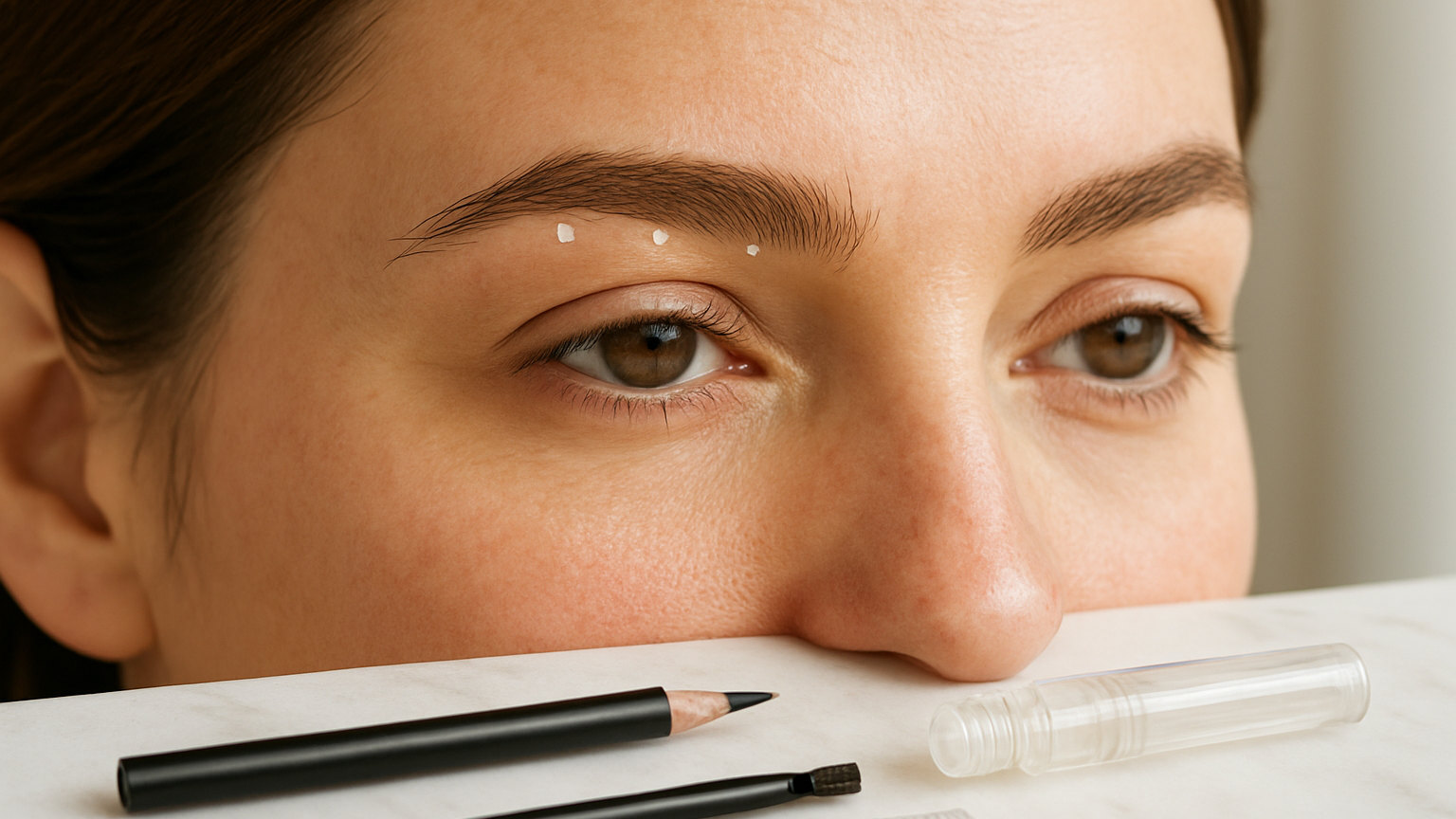
Brow mapping means finding the three points that define the shape before you apply anything. It takes half a minute, it costs nothing, and it prevents most of what goes wrong when filling brows.
Where should the brow start?
Hold a pencil or a brush handle vertically against the side of your nose, running straight up.
Where it meets the brow is the start point.
Filling inward of that point brings the brows closer together and can make the face look heavier through the centre. Leaving a gap wider than that point makes the eyes look further apart.
Mark it lightly with a dot if you find it easier.
Where should the arch sit?
Angle the pencil from the side of the nose through the outer edge of the iris, looking straight ahead.
Where it crosses the brow is the natural highest point.
Some people prefer it slightly further out, toward the outer edge of the eye, which gives a softer, more horizontal brow. Further in than the iris reads as surprised.
The arch should be the highest point of a gradual curve rather than a peak.
Where should the brow end?
Angle the pencil from the side of the nose to the outer corner of the eye.
Where it crosses is where the brow should end.
A tail finishing short of that point makes the eye look smaller. Extending beyond it, particularly downward, drags the eye down.
Critically, the tail should never finish lower than the start point. Draw an imaginary horizontal line from the start; the tail should sit on or above it.
Why does the tail height matter so much?
Because a tail sitting below the start point pulls the whole eye area downward and reads as tired regardless of everything else.
It is one of the changes that happens naturally with age as the brow drops, and correcting it lifts the face more than almost anything else in makeup.
Keeping the tail level with or slightly above the front is the single most useful mapping rule here.
How do you handle asymmetry?
Accept most of it. Brows are siblings rather than twins, and the phrase exists because forcing them to match is the commonest route to over-plucking and over-filling.
Map both independently rather than trying to copy one onto the other.
Where they genuinely differ, adjust the fill rather than the hair: fill slightly more where one is sparser, and slightly less where one is fuller.
Focus on getting the start points level and the tails at the same height, which is what the eye actually notices. Small differences in thickness are invisible in conversation.
Should you follow your natural shape?
Mostly, yes. The brow bone underneath already describes an arch, and shaping to it produces a result that looks like your face rather than a template.
Mapping is for checking that the natural shape has not drifted, particularly after years of plucking, rather than for imposing a new one.
If your natural brow differs from the mapped points, the honest question is whether it looks good rather than whether it matches the measurement.
How do you use the map?
Brush the brows upward with a spoolie so you can see the skin and the natural line.
Mark the three points lightly with your brow product.
Fill between them, starting at the arch and working outward to the tail, then inward toward the front with a lighter hand.
Brush through with the spoolie again at the end, which blends the product into the hairs and softens any edges.
What should you not do with it?
Draw hard outlines between the three points and fill them in, which produces the most artificial result available.
Treat the measurements as rules rather than guides, since faces vary and a mapped brow that looks wrong on you is wrong.
Use it to justify removing hair, since the mapping is for filling rather than for plucking, and removing hair outside the mapped line is frequently regretted.
Does the mapping change over time?
The measurement points do not, since they are based on the position of your nose and eyes. What changes is where your brow actually sits relative to them.
Brows drop with age as the skin above loses elasticity, so a tail that once sat above the start point may now sit level with or below it. Re-mapping every few years catches that.
It is also worth re-checking after any significant weight change or after a period of growing brows out, both of which alter the shape more than people expect.


