
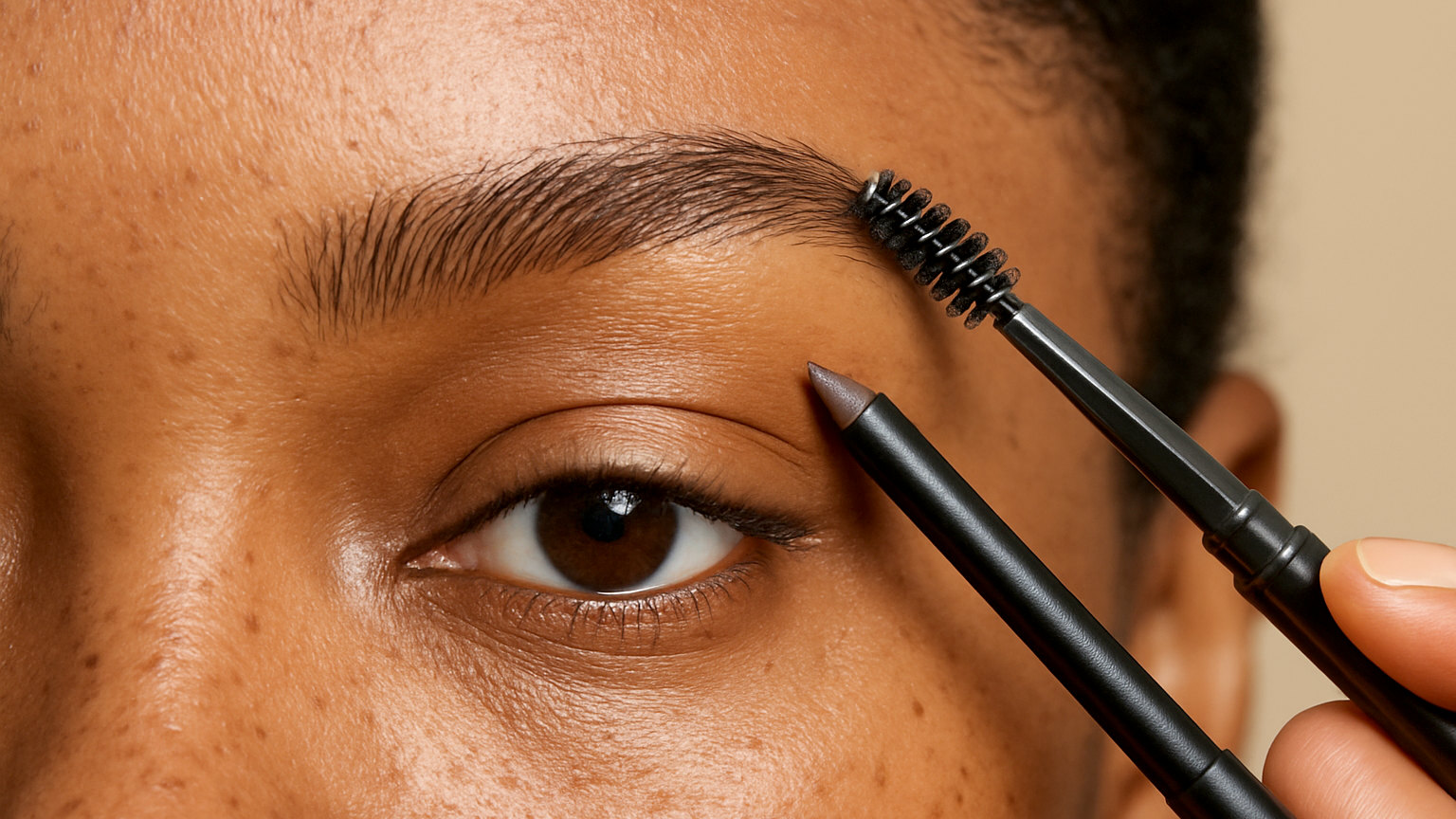
A natural brow has three characteristics that drawn-on brows lack: it is lightest at the front, it is made of visible individual hairs rather than solid colour, and it is not perfectly symmetrical. Reproducing those three is most of the technique.
Why should the front be lightest?
Because that is how brows grow. Hairs at the inner end are sparser, finer and grow upward rather than along the brow.
A brow of uniform density from front to tail is the single clearest indicator of product, and it is what makes brows read as blocks.
Start filling at the arch and work outward to the tail, then come back toward the front with whatever remains on the brush.
Many people use a lighter shade at the front entirely, which is a reliable improvement.
How do you do hair strokes?
Short, light, flicking strokes in the direction the hair actually grows, which changes across the brow.
At the inner end, hairs grow upward, so strokes go upward.
Through the middle and arch, they angle upward and outward.
Along the tail, they lie almost horizontally, angled slightly downward.
Vary the length and spacing rather than making them uniform, since real hairs are not evenly distributed.
Use a sharp fine pencil or a fine brush with pomade, and apply less pressure than feels natural.
Where should strokes go?
Only into gaps, rather than across the whole brow.
Brush the brows upward with a spoolie first, which shows exactly where the skin is visible.
Drawing strokes over areas that already have hair produces density where none was needed and is a common cause of heaviness.
The tail usually needs the most, since it is where brows thin first.
What does the spoolie do?
More than any other tool. Brushing through after applying blends product into the hairs, distributes it evenly and softens hard edges.
Brushing before shows you the natural shape and the gaps.
Brushing between layers prevents build-up.
Anyone whose brows look too solid should brush through and reassess before adding anything, since the product is frequently sitting on the surface rather than blended.
What makes brows look drawn on?
A hard outline, particularly a defined front edge with a sharp start.
Uniform colour and density across the whole brow.
Too warm a shade, which reads orange rather than like hair.
Too dark a shade.
Both brows identical, since real brows are not.
Concealer traced around the entire brow, which creates a cut-out effect obvious in daylight.
Should you use concealer around them?
Sparingly if at all. A small amount blended under the arch to tidy an uneven line is reasonable.
Outlining the whole brow with concealer produces a hard edge that reads as artificial, particularly in daylight and in photographs.
Blend anything you use thoroughly outward, and use a shade matched to your foundation rather than a lighter one.
How much product should you use?
Considerably less than most people. Tap the brush thoroughly, or use the pencil with almost no pressure.
Build in layers, checking from a normal distance rather than in a magnifying mirror.
Brows are viewed from a metre away, and what looks sparse close up frequently looks correct at conversational distance.
If in doubt, do less and check in daylight before adding.
How do you check?
Step back from the mirror and look at both brows together with the whole face, rather than one at a time up close.
Photograph yourself, which shows asymmetry that a mirror hides because the image is reversed.
Check in daylight, which reveals warmth and heaviness that bathroom lighting conceals.
And brush through one final time, which fixes more than any correction.
Does trimming help?
Considerably, and it is frequently the missing step. Long hairs sticking out above the natural line make brows look untidy no matter how carefully they are filled.
Brush upward with a spoolie and trim only what protrudes above the top line, using small scissors and cutting a little at a time. Then brush downward and repeat for anything hanging below.
Trimming preserves density where plucking those same hairs would thin the brow permanently, which is why it is the safer correction.
How does this change with age?
Brows thin, lose pigment and develop occasional coarse wiry hairs, all of which shift what looks natural.
Go lighter rather than darker, use a taupe or soft grey-brown for grey hair rather than matching a former colour, and let the tail sit slightly higher than the natural drop.
Trim the long wiry hairs rather than plucking them, since density is the scarce commodity at that point.


